





THE ‘CP-LIE’ ONION
What’s behind the numbers?
The ninth CPI print of the year didn’t shuffle in — it kicked the door down. Headline rose +0.65% MoM, its hottest reading since March, and annual inflation crept up to 3.7% YoY. So much for the summer’s “peace-driven disinflation,” which lasted about as long as most peace-driven things. Energy, last seen posing as the well-behaved houseguest, has raided the fridge. It contributed 0.39 points of the 0.65 monthly rise, so a layer weighing barely 7% of the basket delivered roughly 60% of the damage. Energy is now up 20.4% YoY, while food (~2%) and core (~2.5%) look on like bystanders who haven’t yet realised they’re next. They are next.
Welcome to Act Two of Inflation Wave Two. The commentators who pronounced the concert over in July are quietly checking their programmes. The fertiliser shortage and the diesel shock have only just started to work through the supply chain, and food will follow fuel as surely as the invoice follows dinner. “Temporary,” the most durable adjective in the English language, may at last be heading for retirement. Not because inflation has gone, but because nobody can say it with a straight face anymore.
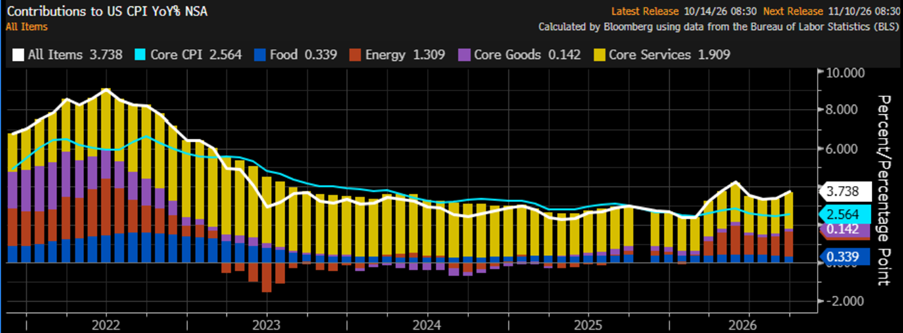
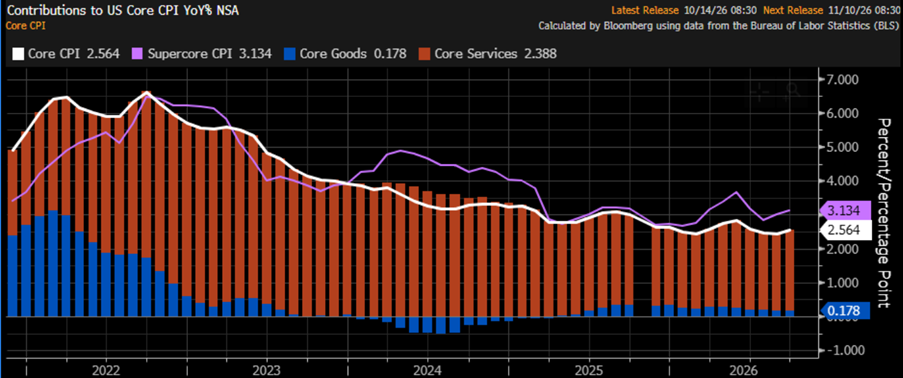
Peel back the energy layer and the core is no longer cooling. Core CPI rose +0.34% MoM, its hottest since April and the third acceleration in a row (0.22 → 0.29 → 0.34). That works out to roughly 4% annualised, about double the Fed’s target. Services did the heavy lifting with 0.28 points, but the tell is core goods. Their 0.06 contribution is the biggest in over a year, which is exactly what you’d expect when freight, fertiliser and fuel costs start showing up in shop prices.
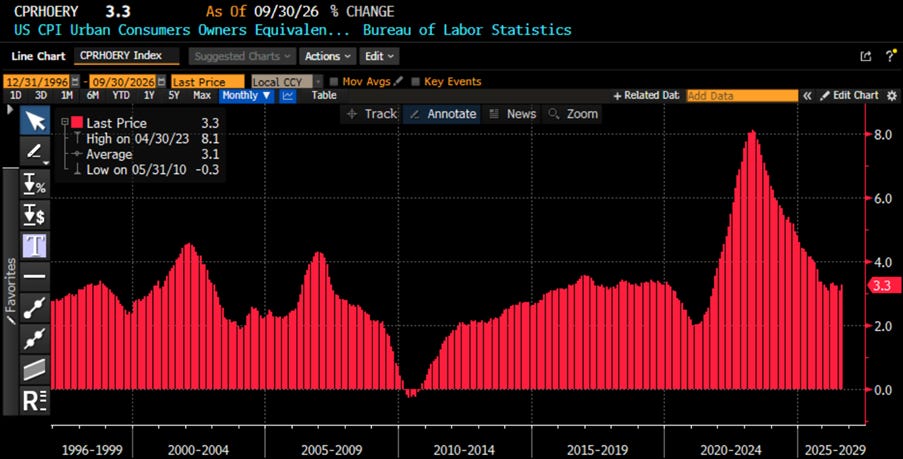
Then there’s the slow giant. Owners’ equivalent rent, the imputed rent homeowners supposedly pay themselves and about a quarter of the CPI basket, rose 3.3% YoY in September. It’s well off the 8.1% peak of April 2023, but the long glide down has stopped. OER has sat flat at around 3–3.3% for more than a year, stubbornly above its 3.1% average since 1996, and September’s bar ticked up again. The “shelter disinflation” that was meant to bring core back to 2% has turned out to be a plateau, not a slope. Rate hikes can’t help here. They freeze construction, keep owners locked into cheap mortgages and shrink the supply of homes, which keeps rents firm. With energy rising, core goods waking up and shelter refusing to fall, the Fed’s disinflation story has run out of chapters.
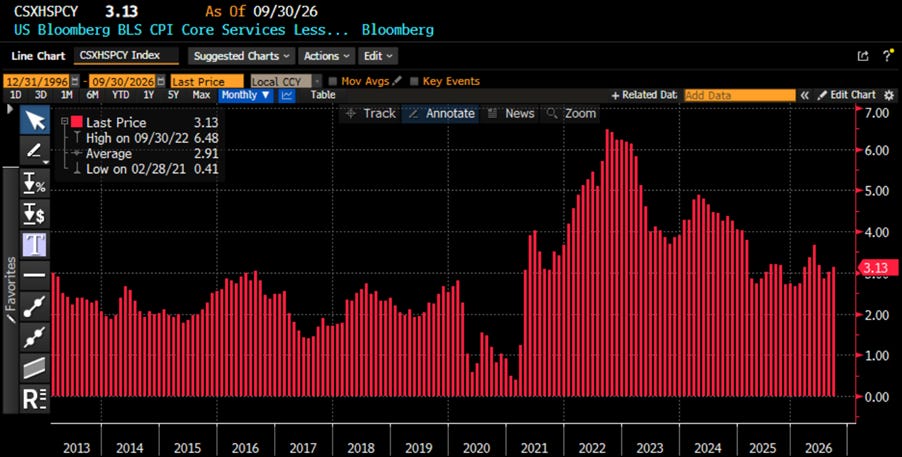
Strip out food, energy, goods and shelter and you reach supercore, the Fed’s favourite gauge of wage-driven services inflation. It rose to 3.13% YoY in September, its second consecutive monthly increase and back above its 2.91% average since 1996. It’s also well above the 2–2.5% range of the pre-pandemic decade the Fed still treats as normal. Far from the 6.48% peak of September 2022, yes, but supercore hasn’t converged on 2% so much as settled in at 3%. The spring spike to nearly 4% faded in summer, and that dip was hailed as victory. The bars are now climbing again. When even the layer furthest from the oil well won’t cool, the supply shock is no longer knocking at the door. It’s already in the living room.
Thoughts.
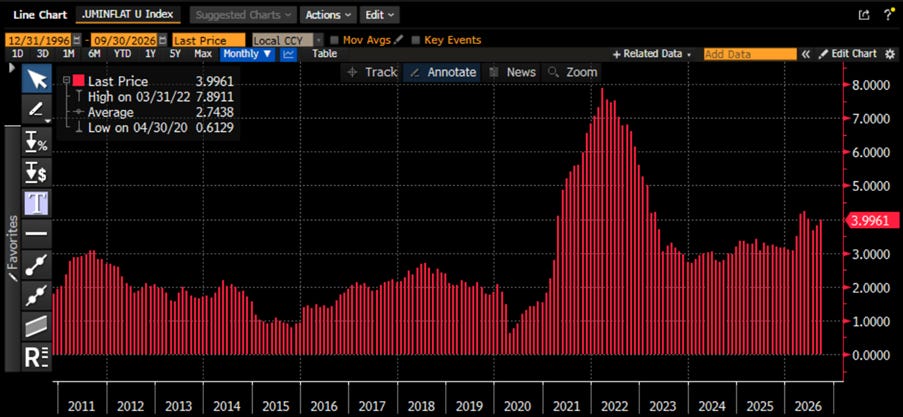
For those who still hope it’s all just noise, there’s the underlying inflation gauge, the measure built specifically to ignore the noise. It has just hit 4.0%, roughly double the Fed’s target and well above its 2.74% average since 1996. The spring scare (about 4.2%) was dismissed as a blip. The summer dip (about 3.7%) was celebrated as a trend. September’s rebound is presumably a rounding error that turned up with luggage. Before 2020 this gauge spent a decade lounging between 1% and 3% like a pensioner on a deckchair. Since 2023 it has refused to go below 3%, which makes it less a guest overstaying its welcome and more a tenant who has changed the locks. Yes, it’s a long way from the 7.9% peak of March 2022. So is the Moon, but nobody calls that “back on Earth.” The trend is your friend, they say. This one has moved in, eaten your food, and is now asking about the Wi-Fi password.
US Umbrella inflation Index (Average of CPI; Core CPI; PPI; Core PPI; Core PCE, 1-year consumer inflation expectations)
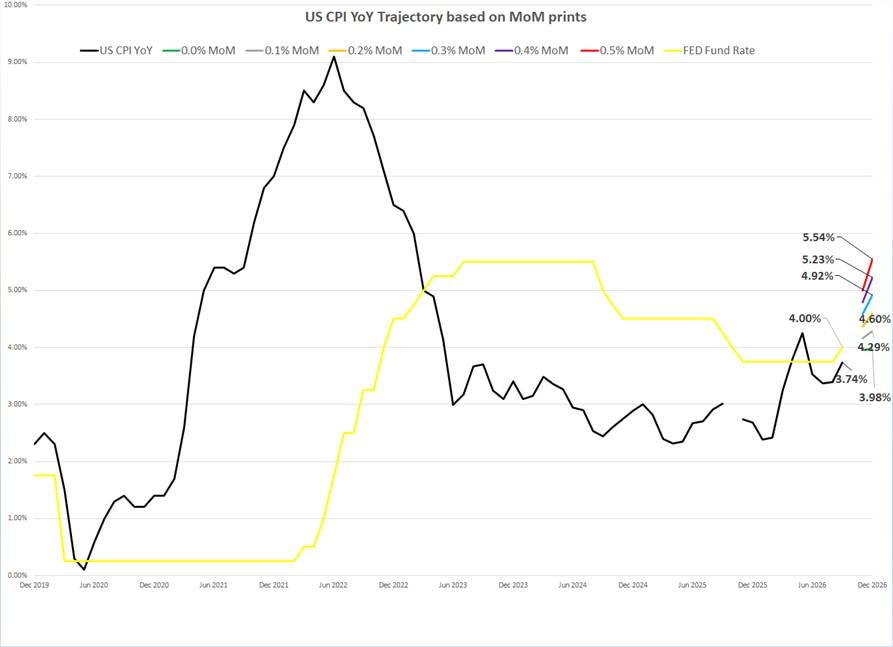
Now for the arithmetic, which unlike the Fed doesn’t do forward guidance. Headline CPI ended September at 3.74% YoY. To see where it goes, any primary school student with a pocket calculator can ran the maths for October to December. If prices don’t rise at all for three months, YoY inflation still finishes the year at 3.98%, because last autumn’s soft readings drop out of the comparison. At a modest +0.2% a month it reaches 4.60%. At +0.3%, the pace core has just managed without trying, it hits 4.92%. Repeat September’s energy party at +0.4% to +0.5% and it ends the year at 5.23% to 5.54%. The Fed funds rate, freshly nudged up to 4.00%, needs zero monthly inflation for the rest of the year just to stay level with it. That’s a policy of hoping the prices take a holiday, in a year when energy cancelled all leave. In real terms the Fed isn’t tightening. It’s standing still while inflation runs past it.
Every month, a statistical agency distils the chaos of 330 million wallets into a single, tidy figure, and every month the financial media treats that figure as a verdict on reality. Inflation is 3%. Inflation is 4%. Inflation is “coming down.” Anyone has yet to meet a single household that actually pays the Consumer Price Index. Families pay rent, groceries, fuel, insurance premiums and phone bills. The CPI is the weighted average of those, and like all averages it has the unfortunate habit of describing no one in particular.
A man with one foot in boiling water and the other in ice is, on average, comfortable. That is the CPI in a sentence — or, as regular readers know it, the CPLie. It is not a lie because the arithmetic is wrong. It is a lie because it pretends inflation is one force, moving at one speed, with one cause and one cure. In reality inflation is a stack of distinct layers, each with its own drivers, its own time lags, and its own immunity to monetary policy.
Six layers make up roughly three-quarters of the typical consumer basket: Energy, Food, Housing, Healthcare, Transportation and Communication. Peel them apart and the picture changes completely. The layers that matter most to survival are the ones least responsive to interest rates, and the ones most exposed to the thing the world currently has in abundance: war.
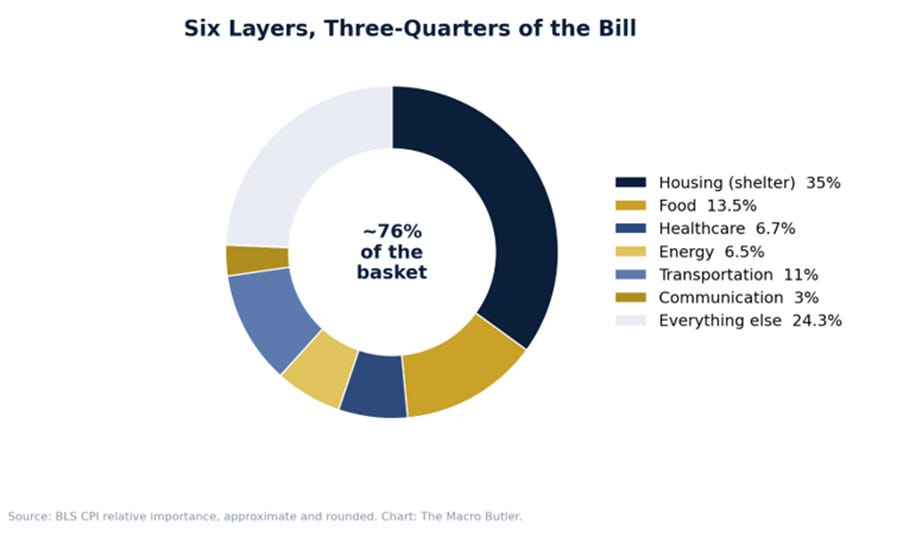
The retiree in Florida, the commuter in Ohio and the renter in New York each live inside a different inflation rate. The retiree’s basket is heavy in healthcare and insurance. The commuter’s is heavy in fuel and vehicle costs. The renter’s is dominated by shelter. The headline number is a compromise between three people, and like most compromises it satisfies none of them.
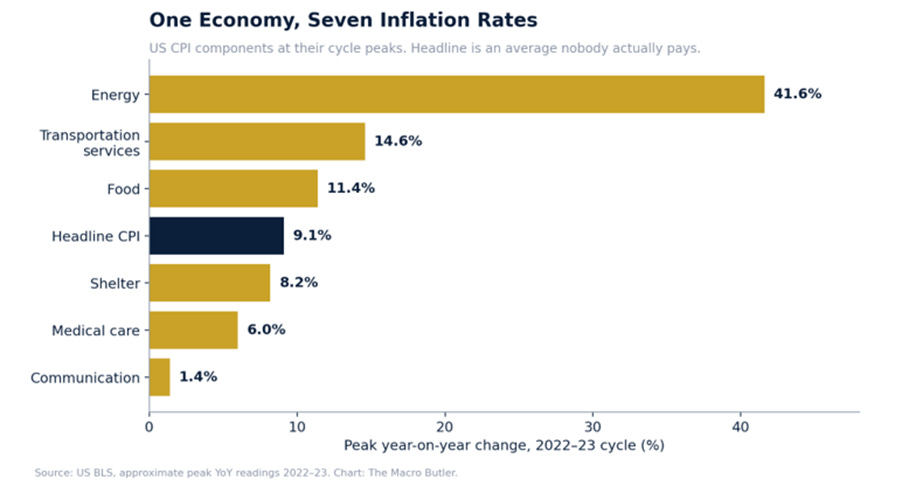
The 2022–23 inflation wave is the best recent laboratory. At the peak, headline CPI printed 9.1%. Energy, meanwhile, was up more than 40% year-on-year, food above 11%, transportation services near 15%, while communication barely moved. Same economy, same central bank, same currency — seven different inflation rates.
Layer 1 — Energy: The Mother of All Prices
Energy is the smallest-looking layer and the most powerful. Its direct weight in the basket is modest, but it is an input into every...
Read more and discover how to trade it here: https://themacrobutler.substack.com/p/the-cp-lie-onion
Visit The Macro Butler Website here: https://themacrobutler.com/
Join The Macro Butler on Telegram here : https://t.me/TheMacroButlerSubstack
If you want to be ready for what is coming visit The Macro Butler Website :
Join The Macro Butler on Telegram here : https://t.me/TheMacroButlerSubstack
Learn the principles behind:
📈 Investing & Portfolio Building
🌍 Economics & Market Cycles
💡 Smarter Financial Decision-Making
Whether you’re starting your investment journey or looking to sharpen your financial knowledge, The Macro Butler gives you the framework to think differently about money.
👉 Start Learning Now
https://themacrobutler.com/financial-academy/
You can contact The Macro Butler at info@themacrobutler.com

Disclaimer
The content provided in this newsletter is for general information purposes only. No information, materials, services, and other content provided in this post constitute solicitation, recommendation, endorsement or any financial, investment, or other advice.
Seek independent professional consultation in the form of legal, financial, and fiscal advice before making any investment decisions.
Always perform your own due diligence.