


AI’s Next Bottleneck Is Cash

Orders Aren’t Cash
The AI buildout has a financing problem. Thursday’s selloff sharpened the question investors now need to answer: where will the cash come from to build everything that’s been promised?
We’ve argued that earnings results supported a continuing AI buildout. Funding the next wave of construction is the next test. A customer can want more computing capacity while its provider struggles to finance the equipment needed to deliver it.
We remain bullish on the buildout. But the next round of winners will need customers who can pay, projects that can secure financing, and enough profit left after the financing bill.
CoreWeave’s Backlog Comes With A Bill
CoreWeave (CRWV) rents access to AI computing capacity. As Zero Hedge reported on Thursday, Bernstein estimates it still needs to raise $76 billion to serve its committed backlog. Goldman Sachs models roughly $20–23 billion in new debt in illustrative backlog scenarios that include customer prepayments. The estimates depend on different assumptions about capital spending, customer advances and hardware life. The amount and cost of future funding are central to both analyses.
Backlog is a promise to deliver computing capacity. Fulfilling that promise requires spending on facilities and equipment before collecting all the revenue. Signing more contracts can increase the immediate financing requirement.
CoreWeave’s own August financing announcement illustrates another pressure point: its $2.6 billion facility has an approximately five-year maturity, while the underlying customer contracts average about three years. It priced at SOFR, a short-term interest-rate benchmark, plus 5.50 percentage points. Renewing those contracts, or finding replacement customers, matters to repaying the debt.
Even Meta Needs More Capital
This extends well beyond one cloud operator. Meta Platforms (META), the owner of Facebook and Instagram, describes forecasts requiring hundreds of billions of dollars in additional capital over several years, beginning as early as fall 2026, in its October 21st SEC filing.
Its special committee explicitly discusses raising money before competing companies absorb available capital. It also recognizes that borrowing on the scale management envisages could hurt the company’s credit ratings. The proposed non-voting share class would give it another way to raise equity while preserving Mark Zuckerberg’s control.
Meta’s plans show that the ambition to spend remains enormous. Financing that ambition can mean higher interest expense, more shares outstanding, or a slower construction schedule. Each path changes the return available to shareholders.
Nebius Found A Lender
There’s also fresh evidence of financing getting done. On October 22nd, AI cloud provider Nebius (NBIS) announced a $3.5 billion facility from Citi for data-center development, graphics processing units, or GPUs, and general corporate purposes.
The senior secured facility matures in 364 days. It initially charges Term SOFR plus 2.75%, with the spread rising as high as 3.50%, subject to adjustments. That buys time and near-term capacity; further financing will be needed for the next phase of growth.
Nebius also identifies customer prepayments and operating cash flows as funding sources. The buildout has several financing channels. The investment question is which companies can access enough capital, on workable terms, to complete their plans.
Follow The Cash To The Suppliers
That’s why we’re still interested in the companies supplying chips, memory, power equipment and connections between machines. Funded construction creates business for them. Project delays or cancellations work through the same chain in reverse.
For a supplier, we want to understand who its customers are, how their projects are funded, and how much cash its own sales generate. Then we assess valuation, look for a recovery signal from our quantitative screens, and examine the options pricing. A lower share price becomes an opportunity when the business and the entry setup support it.
We’ve Traded The Connections, Too
Credo Technology Group (CRDO) supplies high-speed connectivity products that help server racks and accelerator clusters communicate. Buying more AI computing capacity increases the need to move data efficiently through those clusters.
Credo appeared among Portfolio Armor’s daily Top Names, our ranked stock-selection list. On August 15th, 2025, we sent subscribers this trade. The entry card shows the original maximum net debit of $3.10:
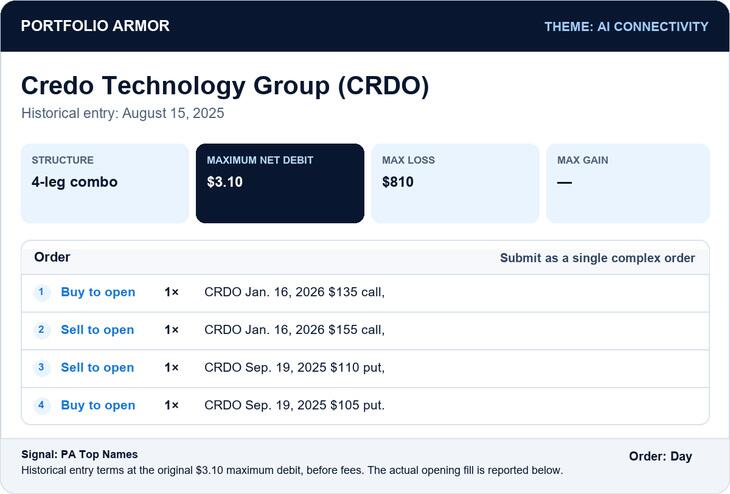
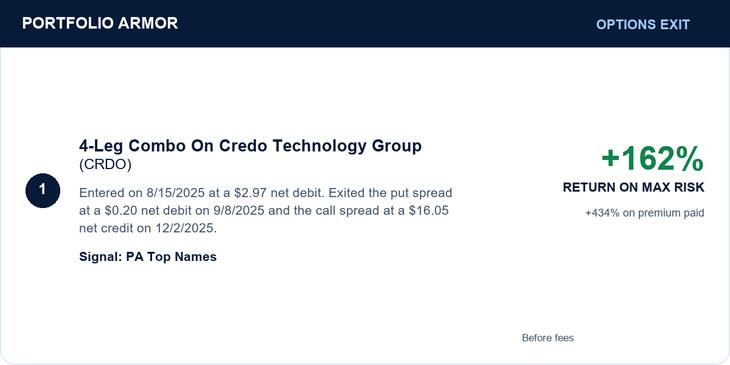
Our actual fill was a $2.97 net debit, putting the original maximum risk at $797 for one combination. We bought back the put spread in September and sold the call spread on December 2nd. Here’s the outcome:
Finding The Next AI Bottleneck
We’ll keep looking for companies whose products earn a place in the next wave of investment—and whose stocks and options offer compelling setups. Credo shows how that approach can turn a less obvious part of the buildout into a profitable trade.
If you’d like a heads-up when we place our next AI-related trade, become a free subscriber below. Paid subscribers receive our actionable trade alerts before we enter our trades.
To see how our stock selection and options approach fit together, start here: