


The Army’s CFO Just Told Wall Street Where the Next Government-Backed Boom Is Going
On Monday the Army’s top financial officer published an opinion piece in The Hill with a blunt headline: without private capital, the U.S. will miss its window to rebuild the military.
Most people will skim it as another “Pentagon wants help” story. That misses what actually happened.
The author is Marc Andersen, the Assistant Secretary of the Army for Financial Management and Comptroller. He is the Army’s CFO. Before that he was a senior partner at EY, where he built the firm’s federal consulting business, and a venture partner at IronGate Capital Advisors, which invests in national security technology. This is a man who understands how capital markets price risk, and he is the person who signs off on where the Army’s money goes.
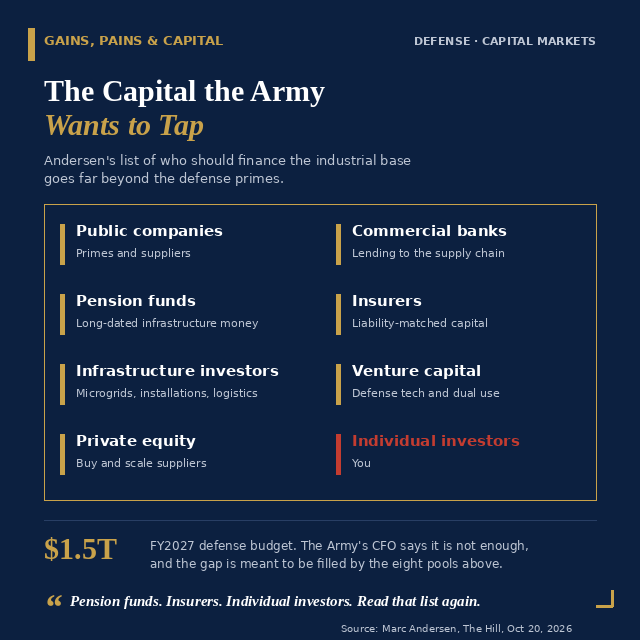
Here is what he wrote. The FY2027 defense budget is $1.5 trillion. By his own account, that number is not enough to do the job. So he is calling for a “national security capital strategy” that pulls in public companies, commercial banks, pension funds, insurers, infrastructure investors, venture capital, private equity and individual investors.
Read that list again. Pension funds. Insurers. Individual investors.
The constraint on American rearmament has changed. For eighty years the question was how much Congress would appropriate. Andersen is saying the appropriations fight is no longer the bottleneck. The bottleneck is whether private markets will finance the industrial base, and whether Washington can structure the deals so that they do.
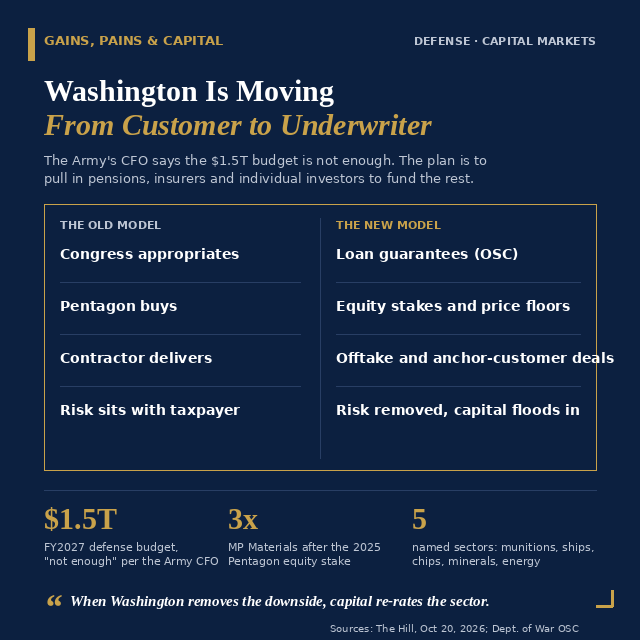
That is a very different role for the government. It is moving from customer to underwriter.
Regular readers will recognize this. For the past year I have been writing that the United States is running a wartime economy: state-directed spending and production, the Defense Production Act, critical minerals, the AI buildout with the Pentagon as first customer. The pushback I get is that a wartime economy needs wartime money, and Congress will never appropriate it. Andersen just answered that. The money does not have to come from Congress. It comes from the private sector, with Washington structuring the deals so the private sector is willing to put it up. That is how every wartime economy in American history has actually been financed, from war bonds sold to households in the 1940s to the government-guaranteed plant expansions that built the arsenal of democracy. The Army’s CFO is describing the 2026 version.
The pieces of this are already in place. The Department of War’s Office of Strategic Capital provides loans and loan guarantees to companies in critical supply chains. The Army launched its own Strategic Capital Initiative this spring, inviting industry to co-invest in energy, logistics and supply chains, the organic industrial base, facilities, advanced manufacturing and critical minerals, with the Army acting as anchor customer or co-investor. Earlier this month the Pentagon and the Small Business Administration signed an agreement routing small defense suppliers from the Economic Defense Unit into SBA-backed lending.
Andersen’s piece ties those programs together into a single idea: the government uses its authorities, its assets and its demand signals to lower uncertainty, and that unlocks pools of private money many times larger than anything in the budget.
This is also where the wartime economy meets the Everything Bubble. For 15 years the Federal Reserve was the backstop for every asset class. What Andersen is describing is the state becoming the backstop for entire industries. The mechanism is different. The Fed used interest rates and its balance sheet. This uses loan guarantees, offtake agreements, equity stakes and procurement commitments. But the effect on prices is the same. When the government removes the downside from a sector, capital floods in and valuations re-rate before the first dollar is actually deployed.
We already have a test case. In 2025 the Pentagon took an equity stake in MP Materials, guaranteed a price floor for its rare earth output, and committed to buy the magnets it produces. The stock more than tripled in a few months. Nothing about the mine changed. What changed was that Washington removed the risk.
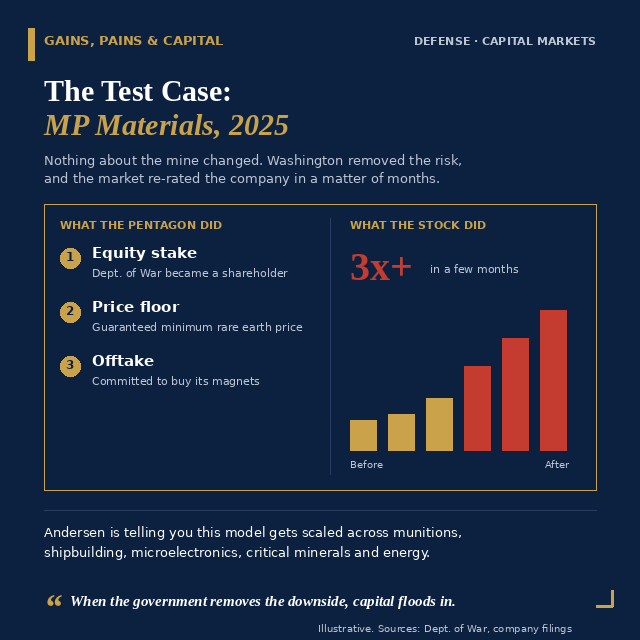
Andersen is telling you that model is going to be scaled across the defense industrial base. His own words were that markets will embrace long-term opportunities tied to big shifts in capital flow if they believe the return multiple is unprecedented, and he pointed at the technology sector as proof.
So the question for investors is not whether this happens. The Army’s CFO just put it in print. The question is where the demand signal lands first.
The areas Washington has already named are munitions, shipbuilding, microelectronics, critical minerals and materials, and energy infrastructure on military installations. Those are the sectors where a loan guarantee, an offtake contract or an anchor-customer commitment can show up in a filing and change what a company is worth overnight.

Two things are worth keeping in mind.
First, this is bullish for a specific slice of the market. The money that flows into these sectors comes from somewhere. Pension funds and insurers that commit capital to a defense infrastructure fund are taking it from something else.
Second, a government-backed sector is still a sector with government as a counterparty. Programs get renamed, priorities shift, and administrations change. The companies that do well here are the ones that get real contracts and real capital commitments. Announcing that you are in a favored industry is worth nothing.
This is the wartime economy we have been positioning for in Private Wealth Advisory for the past year. The portfolio already holds names in critical minerals, energy and the AI and defense buildout, and we are watching the Strategic Capital programs closely for the next ones.
If you want to see how we are approaching this, I have put together a special report called Survive the Inflationary Storm. It lays out the macro backdrop, including why the shift to a state-directed economy is inflationary, and names five investments positioned to benefit, three core holdings and two speculative plays with the potential to be huge winners.
It normally sells for $499. I’m releasing 100 copies free to Gains, Pains & Capital readers today, and when they’re claimed the offer closes.
To pick up your copy, Click Here Now!
To your health and wealth,
Graham Summers, MBA
Chief Market Strategist
Phoenix Capital Research