


BALLOTS, BULLETS & BULLION
Confucius said a ruler needs three things: food, weapons and the people’s trust. Asked which to drop first, he said weapons, then food, but never trust. Modern democracies have found a shortcut: run out of food, and the trust leaves with it.
Every election is a referendum on the household budget. Voters claim to care about values, identity and the fate of democracy. Then the booth curtain closes, and the hand holding the pencil is the same one that paid for groceries, rent and petrol that week. Political scientists call this retrospective economic voting. The Macro Butler calls it politics’ oldest law: the wallet is the only party that never loses.
2024 proved it. Half the planet went to the polls and held an incumbent massacre. For the first time on record, the governing party in every developed democracy that voted lost vote share. Britain’s Conservatives suffered their worst defeat in 190 years. Japan’s LDP lost its majority, India’s BJP lost its outright majority, and South Africa’s ANC lost the majority it had held since Mandela. Germany’s coalition collapsed under energy bills, and America evicted the party that brought it 40-year-high inflation. Voters rarely read manifestos. They always read receipts.
None of this is new. Argentina’s 100%+ inflation produced a president with a chainsaw. Weimar’s hyperinflation produced something far worse than a chainsaw. Bread prices helped light the fuse of 1789. Rome kept its mob quiet with bread and circuses, because emperors knew that an empty stomach is the most radical activist ever born.

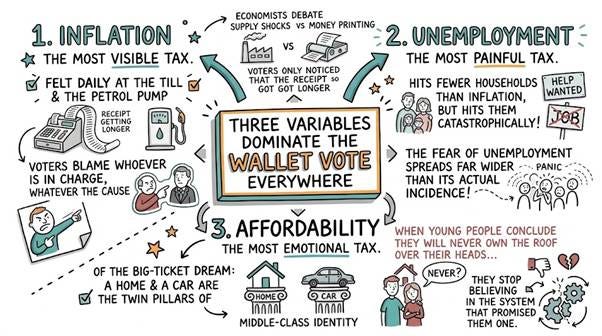
Three variables dominate the wallet vote everywhere:
Inflation is the most visible tax. It is felt daily at the till and the petrol pump, and voters blame whoever is in charge, whatever the cause. Economists debate whether supply shocks or money printing drove prices; voters only notice that the receipt got longer.
Unemployment is the most painful tax. It hits fewer households than inflation, but it hits them catastrophically, and the fear of it spreads far wider than its actual incidence.
Affordability of the big-ticket dream is the most emotional tax. A home and a car are the twin pillars of middle-class identity. When young people conclude that they will never own the roof over their heads, they stop believing in the system that promised them one.
Combine the first two and you get the Misery Index, invented by economist Arthur Okun in the 1960s: the unemployment rate plus the inflation rate. Add the third and you get what The Macro Butler calls the Kitchen-Table Index: the share of a median paycheck required to keep a family housed, mobile and fed. When that number rises, incumbents fall.
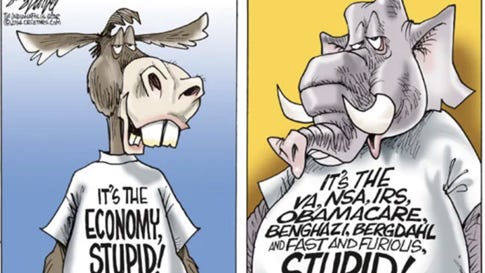
In 1992, George H. W. Bush looked unbeatable. After the swift Gulf War victory a year earlier, his approval had hit 89%, then a Gallup record. The heavyweights of the opposing party took one look and stayed home. An obscure Arkansas governor named Bill Clinton didn’t get the memo. Clinton’s strategist, James Carville, pinned a handwritten note to the campaign wall in Little Rock to keep everyone on message. One line became immortal: “The economy, stupid.” America had just come out of a recession, unemployment was above 7%, and voters felt poorer while their president posed with the victory parade. Clinton talked paychecks. Bush talked about a new world order. The paychecks won.
https://politicaldictionary.com/words/its-the-economy-stupid/
In plain English: forget the speeches, the scandals and the foreign adventures. People vote on one question: am I richer or poorer than before? If the answer is poorer, the boss gets fired. It’s a shareholder meeting after a bad quarter, with flags.
The lesson ages well. Bush Senior proved that a winning war can’t save a president from a losing economy. The 47th US president is testing the sequel: what happens when the war is unpopular and it wrecks the economy? Military glory is a sugar rush; the grocery bill is a chronic condition.

The United States Constitution staggers its elections like the layers of a fortress. The president serves four years. Members of the House of Representatives serve two. Senators serve six, with one-third of the Senate up for election every two years. The result is that halfway through every presidential term, in the November of the second year, Americans vote again on the entire House and about a third of the Senate, without the president on the ballot. These are the midterm elections.
On 3 November 2026, all 435 House seats and 35 Senate seats (33 regular seats plus special elections in Ohio and Florida, created when JD Vance and Marco Rubio left the Senate) are up for grabs, along with 36 governorships and thousands of state legislative seats.
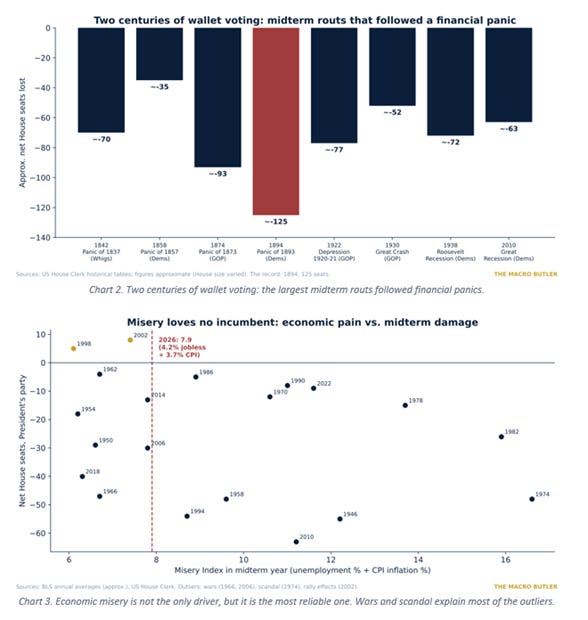
The midterm cycle has one iron rule: the president’s party almost always loses. Since the Second World War, the party holding the White House has lost House seats in all but two midterms (1998 and 2002), and the average loss since 1934 is roughly 27 seats. Why?
The referendum effect. Without the president on the ballot, the midterm becomes a verdict on his performance. Voters do not compare two candidates; they grade one incumbent.
The enthusiasm gap. Angry people vote; satisfied people go to the beach. The opposition is energised; the governing party’s base is complacent or disillusioned.
The surge-and-decline effect. A winning presidential candidate drags marginal members of his party into Congress on his coattails. Two years later, without the coattails, those marginal seats fall back.
The balancing instinct. Many moderate voters, distrustful of concentrated power, deliberately hand Congress to the other party to put a check on the White House.
The economy. Midterms land just as the policies of the new administration have had time to bite, and before any benefit has had time to show.
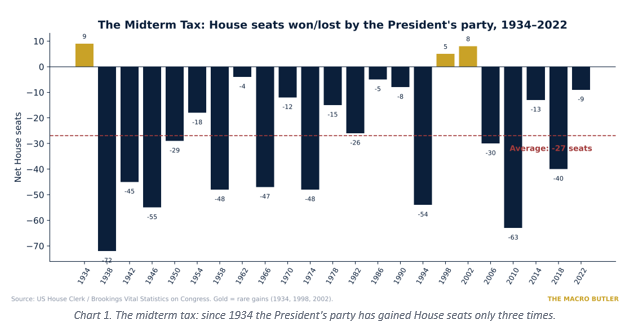
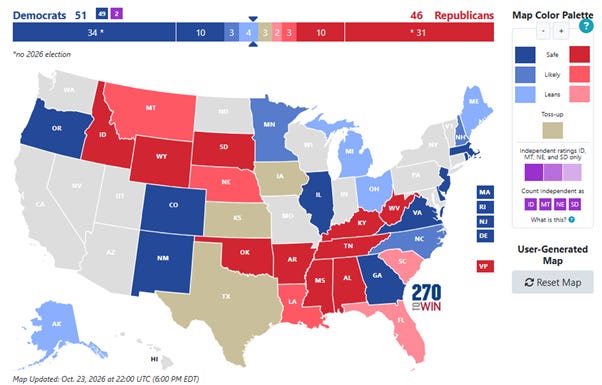
The Senate is less predictable, because only a third of the seats are contested and the map may favour one party regardless of the national mood. In 2026, Republicans hold 53 seats to the Democrats’ 47 (including two independents). Democrats need a net gain of four seats to take control, because Vice-President Vance would break a 50-50 tie. At the start of the cycle, forecasters called that task herculean. A few days before the vote, the prediction markets no longer agree.
https://www.270towin.com/2026-senate-election/fiftyplusone-2026-senate-forecast
America held its first congressional elections in 1788–89, before parties existed to blame. Once they did exist, a pattern set in: every major financial panic has been followed by a midterm massacre of whoever was holding the keys.
The 19th century: panic, then purge
1838 & 1842. The Panic of 1837 arrived weeks after Martin Van Buren moved in: cotton crashed, land speculation burst and the national bank was gone. Van Buren’s Democrats bled in 1838 and he was evicted in 1840. The Whigs who inherited the mess lost about 70 seats in 1842. Hot potato, meet the next pair of hands.
1858. The Panic of 1857 flattened Buchanan’s Democrats and paved Lincoln’s road to the White House.
1862. Civil War plus paper “greenbacks” plus inflation: even Lincoln lost 20+ seats. Sainthood does not cover the grocery bill.
1874. Jay Cooke’s railroad empire collapsed, and Grant’s Republicans lost about 93 seats. Democrats took the House for the first time since before the Civil War.
1894. Railroads failed, gold ran out and the Treasury had to borrow from J.P. Morgan. Cleveland’s Democrats lost about 125 seats, still the all-time record. Their recovery took a generation.
The 20th century: depressions, wars and stagflation
1922. Prices fell by a third in the 1920–21 depression. Harding lost 77 seats two years after a landslide.
1930 & 1938. Hoover lost 52 seats after the Crash. FDR tightened too early, sent unemployment back toward 19% and lost 72. Even the New Deal had a returns policy.
1946. Price controls came off and inflation went above 8%. Truman lost 55 seats and both chambers to a two-word slogan: “Had enough?”
1958. Ike’s recession cost 48 seats.
1974 & 1978. Watergate helped, but so did the oil shock and double-digit inflation: 48 seats. Carter lost 15 in 1978, a down payment on 1980.
1982. Volcker’s medicine pushed unemployment to 9.7% and Reagan lost 26 seats. He won 49 states two years later. Timing is everything: suffer early, campaign late.
1994. The recovery wasn’t felt in the kitchen. Gingrich’s revolution took 54 seats and ended 40 years of Democratic control.
The exceptions that prove the rule
1998. 4.5% unemployment, 1.6% inflation and a roaring stock market: Clinton gained five seats with impeachment on the horizon. Voters forgive a lot when their 401(k) smiles.
2002. Post-9/11, Bush gained eight. The only time since WWII that flag-waving beat the cycle.
The 21st century: same movie, new cast
2006. Iraq turned from triumph to quagmire and Republicans lost 30 seats and Congress. The rally fades; the bill doesn’t.
2010. Unemployment near 10% and millions of foreclosures cost Obama 63 seats, the worst since 1938.
2018 & 2022. Trump lost 40 seats despite a good economy: personality has a price too. Biden lost only nine despite 8% inflation, rescued by Dobbs and some memorably weak opponents. Even iron laws rust occasionally.

If the business cycle is the first engine of midterm outcomes, the war cycle is the second. And the two are not independent: wars are inflationary by nature. Governments print currency and borrow to pay for them, divert labour and materials from civilian to military use, and disrupt...
https://t.me/TheMacroButlerSubstack/3282
⏳ Offer ends November 4, 12:00 AM EST
👉 themacrobutler.com/financial-academy/
You can contact The Macro Butler at info@themacrobutler.com

Disclaimer
The content provided in this newsletter is for general information purposes only. No information, materials, services, and other content provided in this post constitute solicitation, recommendation, endorsement or any financial, investment, or other advice.
Seek independent professional consultation in the form of legal, financial, and fiscal advice before making any investment decisions.
Always perform your own due diligence.