


The House Always Owes
What’s behind the numbers?
On October 28, the Federal Reserve did what central banks do best when they can’t decide: it held a meeting, announced it would hold fewer of them, and promised more data. The committee kept the fed funds rate at 3.75% to 4.00% by a vote of 10 to 2. Governor Lisa Cook and Cleveland Fed President Beth Hammack dissented in favour of a quarter-point hike, so this time the hawks lost a vote rather than an argument.
The statement says officials hope “the accumulation of more information” will guide their next move, which is central bank for “we’ll know it when we see it, possibly in December.” It then closes with “The committee will deliver price stability,” a sentence that reads like a courier’s promise: no date given, and the parcel is already late.
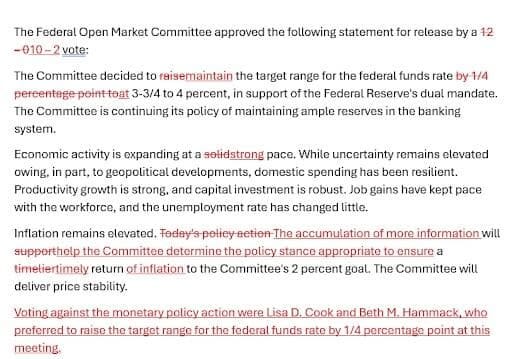
Chairman Kevin Warsh’s press conference offered something for everyone. Hawks heard “readiness to act as circumstances require,” plus a reminder that the Fed had “shown our willingness to act” in September. Doves heard him reject the idea that the economy is overheating. Everyone else heard a man describing a strong economy, sticky inflation and a policy rate going nowhere, all with a straight face. The statement upgraded growth from “solid” to “a strong pace,” and spending was “resilient.”
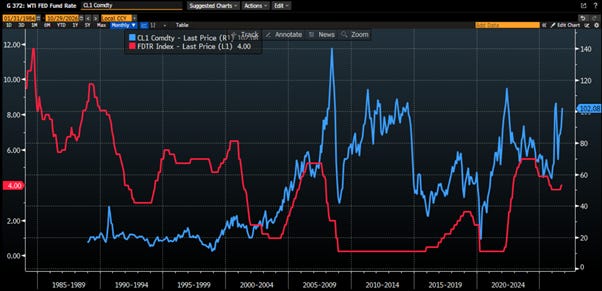
The data hardly pleads for patience. September CPI rose at its fastest pace in five months. The obvious culprit is energy, pushed up again by the Iran war, but the report also showed broad-based inflation across goods and services, which is what happens when a “relative price change” refuses to stay in its lane. Warsh said the Fed’s job is to make sure energy prices don’t spread across the economy. His audience may notice they already have.
WTI Price (blue line); FED Fund Rate (red line).
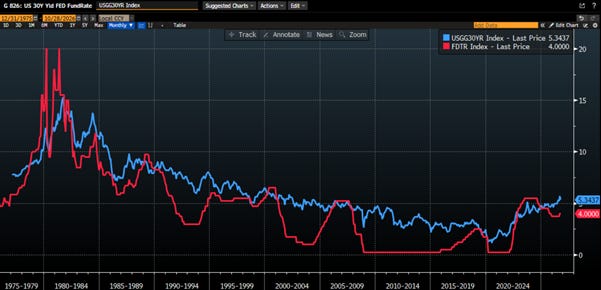
The finest moment came on financial conditions. In August the Chair said conditions were hard to describe as tight. Since then, the 10-year has gone through 5%, mortgages have reached 7.45% and the 30-year bond has visited levels last seen when flip phones were fashionable. On Wednesday Warsh conceded that conditions are “tighter,” and then added that he was “unwilling and unable to call them tight.” It is the monetary equivalent of a man up to his knees in water declaring the basement damp. The bond market has done the tightening; the Fed is still deciding what to call it.
US 30-Year Yield (blue line); Fed Fund Rate (red line).
Then came the real news, tucked into the back of the press conference like a dessert nobody ordered. The Fed will keep eight meetings a year, but not all of them will decide anything. From 2027, one of the eight will be devoted to “broad monetary policy strategy,” with no vote and no statement. In 2028 that rises to two. Rate decisions go from eight to seven, then six. Warsh explained that the committee needs time to think about “the left side of the decimal point,” meaning big questions rather than quarter-points. It is a noble aim. The Macro Butler notes only that the left side of the decimal point is where the inflation rate has lived for five years. There is precedent. In 2014 Warsh reviewed the Bank of England’s transparency practices, and the Bank cut its policy meetings from twelve to eight. The ECB went to a six-week cycle in 2015. Mr Warsh, it seems, is the Marie Kondo of central banking: he takes each meeting in his hands, asks whether it sparks joy, and thanks it for its service. To put the market’s question politely: why hold eight meetings if one of them announces nothing? Less politely, it’s a meeting that is all agenda and no minutes of consequence, a lunch where nobody orders.
Getting to Wednesday was a ride in its own right. After the September hike, futures put the odds of another move this month above 70%. Then New York Fed President John Williams and Vice Chair Philip Jefferson said September had “bought time,” and the odds fell below 30%. On 16 October Warsh said the world had “broadly conformed to our expectations,” which markets took as the Fed’s way of saying “stand down.” By Wednesday morning the odds were under 10%. Traders still expect a December hike but have trimmed bets for 2027, and futures no longer fully price three more increases this cycle. The Fed calls this forward guidance. In practice it is backward guidance: the market leads, and the Fed confirms.
The politics deserve a footnote, since they are rarely only a footnote. The hold came less than a week before the midterm elections, with Democrats favoured to take the House amid wide discontent over the economy. Governor Cook, meanwhile, dissented in favour of tighter policy while still contesting The Manipulator In Chief attempt to remove her. The White House has scheduled a hearing in early November on mortgage-fraud allegations she has long denied, and she has said she cannot attend. A central bank whose governors vote with one hand and defend their seats with the other is not a picture of calm independence. Lenders have noticed, and they price it.
For investors the takeaway is unchanged from “The House Always Owes.” The Fed sets the price of one night, and from 2027 it will set it slightly less often. The long end is still decided by inflation, supply and trust, and none of those took Wednesday off. When officials need more data, more meetings and more time to think, the market needs only one thing: a higher yield. Gold and energy producers don’t require a strategy session to do their job.
Thoughts.
On 8 September, at Southern Methodist University in Dallas, Treasury Secretary ‘Scrooge’ Bessent borrowed a line from the casino floor: “I am the house now.” He meant the yen. The bond market assumed he meant bonds, which was fair: he had just spent three weeks buying back long-dated Treasuries to keep yields down. The 10-year closed the next day at 4.83%. A week later it was above 5%. By 24 September it was reported at 5.20%, the highest since 2007, and the 30-year reached 5.56% four days after that. Thirteen days after declaring himself the house, the Secretary reportedly admitted he cannot set the equilibrium price.
The Macro Butler has served in enough great houses to know the type.

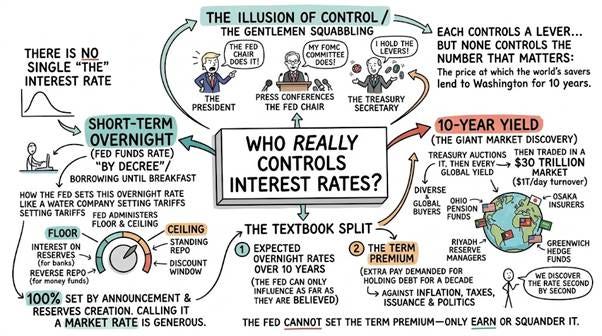
The episode deserves more than a chuckle, because it settles a question most investors get wrong: who really controls interest rates? The President thinks the Fed Chair does, hence the shouting. The Fed Chair thinks his committee does, hence the press conferences. Since September, the Treasury Secretary thinks he does, hence the casino patter. Each controls something. None controls the number that matters: the price at which the world’s savers will lend to Washington for ten years. What follows covers who holds which lever, why the levers are shorter than their owners believe, why war shortens them further, and what to own while the gentlemen squabble over the furniture.
First, there is no such thing as “the” interest rate. There is a curve of them, running from one night to thirty years, and the two ends have little in common. The overnight rate, officially the federal funds rate, is what banks charge each other to borrow reserves until breakfast. Only the Fed can create or destroy reserves, so it sets their price the way the water company sets its tariff: by announcement. The FOMC publishes a quarter-point range and keeps the rate inside it with rates it administers itself. Interest on reserves sets the floor for banks, the reverse repo facility sets it for money funds, and the standing repo facility and the discount window cap the top. Over one night inflation can’t do much damage, the borrower is a bank with an account at the Fed, and the Fed decides how much of the thing being lent exists. That makes it the one interest rate in America set by decree. Calling it a market rate would be generous.
The 10-year yield is a different animal. The Treasury auctions the bond, and it then trades in a market of more than $30 trillion that turns over roughly a trillion dollars on an ordinary day. Nobody announces its yield. Pension funds in Ohio, insurers in Osaka, reserve managers in Riyadh, hedge funds in Greenwich and anyone else with money and an opinion discover it every second. The textbook splits it in two. One part is the average overnight rate the market expects over ten years, which the Fed can influence only as far as the market believes it. The other is the term premium: the extra pay a lender wants for handing over money for a decade and putting up with whatever inflation, taxes, new issuance and politics turn up in the meantime. The Fed can’t set the term premium. It can only earn it or squander it.
This matters because the real economy borrows at the long end. Nobody buys a house with an overnight loan. Freddie Mac’s research finds that moves in the 10-year explain about 98% of weekly changes in the 30-year mortgage rate since 1990. That is why mortgages cost about 7.45% in late September while the Fed’s policy rate was still below 4%. Corporate bonds are priced off Treasuries. Analysts value equities with the 10-year, and property valuers use it too. So, the rate the Fed controls matters least to Main Street, and the one Main Street cares about most is out of the Fed’s reach. He who rules the night does not rule the decade.
US FED Fund Rate (blue line); US 10-Year Yield (red line).
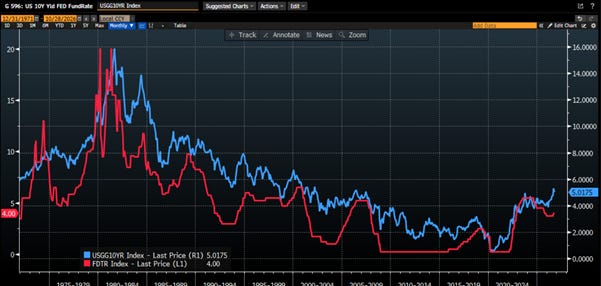
Here is what the Fed actually did this year. Under Kevin Warsh it held the target range at 3.50% to 3.75% all summer. On 29 July it voted 9 to 3 to stay put, with three dissenters asking for a hike, and the 30-year yield closed near 5.23%, a 19-year high. On 16 September the committee finally raised rates to 3.75% to 4.00%, by 12 votes to 0. It was the first hike since July 2023. The median projection pencilled in one more quarter-point, and the committee’s own forecasts don’t see 2% inflation until 2029.
Meanwhile, at the long end, the 10-year averaged 4.02% in the last week of February, when the little excursion in the Middle East began. It hit 4.66% in late July, 4.83% on 9 September and 5.20% on 24 September. The Fed moved a quarter-point, once. The market moved more than a full point, starting in March, without asking anyone’s permission. By the time Warsh-ington acted, the bond market had already done the tightening and was waiting politely for the Fed to notice.
That is the usual sequence, though central bankers rarely mention it at dinner parties. Bills and 2-year notes price the next few meetings before they happen. On 28 August, after one hawkish speech from the Chair, the 2-year jumped almost 12 basis points in a day and futures put the odds of a September hike above even. By the time the 16 September hike arrived, every desk called it fully...
Read more and discover how to trade it here:
Visit The Macro Butler Website here: https://themacrobutler.com/
Join The Macro Butler on Telegram here : https://t.me/TheMacroButlerSubstack
If you want to be ready for what is coming visit The Macro Butler Website :
Join The Macro Butler on Telegram here : https://t.me/TheMacroButlerSubstack
Learn the principles behind:
? Investing & Portfolio Building
? Economics & Market Cycles
? Smarter Financial Decision-Making
Whether you’re starting your investment journey or looking to sharpen your financial knowledge, The Macro Butler gives you the framework to think differently about money.
? Start Learning Now
https://themacrobutler.com/financial-academy/
You can contact The Macro Butler at info@themacrobutler.com

Disclaimer
The content provided in this newsletter is for general information purposes only. No information, materials, services, and other content provided in this post constitute solicitation, recommendation, endorsement or any financial, investment, or other advice.
Seek independent professional consultation in the form of legal, financial, and fiscal advice before making any investment decisions.
Always perform your own due diligence.