


Reset in Peace?
Every fiat currency is a promise. Every promise has an expiry date. History has never once failed to collect.
A currency reset is the moment a monetary system is forced to admit what markets already know: the money in circulation is worth far less than the promises denominated in it.
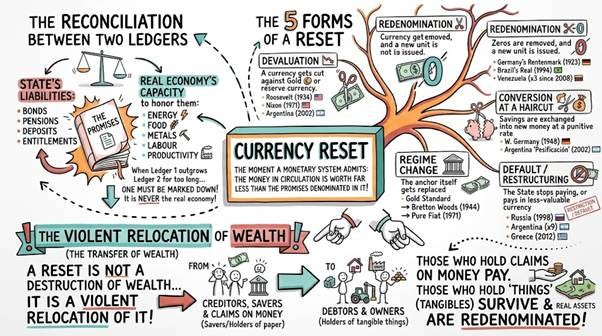
It is the accounting reconciliation between two ledgers. On one side sit the state’s liabilities: bonds, pensions, deposits, entitlements. On the other side sits the real economy’s capacity to honour them: energy, food, metals, labour, productivity. When the first ledger outgrows the second for long enough, one of them must be marked down. It is never the real economy.
A reset can take several forms, often in combination:
- Devaluation. The currency is cut against gold or a reserve currency. Roosevelt in 1934, Nixon in 1971, Argentina in 2002.
- Redenomination. Zeros are removed and a new unit is issued. Germany’s Rentenmark in 1923, Brazil’s Real in 1994, Venezuela three times since 2008.
- Conversion at a haircut. Savings are exchanged into the new money at a punitive rate. West Germany in 1948, Argentina’s “pesificación” in 2002.
- Regime change. The anchor itself is replaced. Gold standard to Bretton Woods in 1944; Bretton Woods to pure fiat in 1971.
- Default or restructuring. The state simply stops paying or pays in a currency worth less. Russia 1998, Argentina nine times, Greece 2012.
The common thread is a transfer of wealth. Those who hold claims on money pay. Those who hold things are redenominated and survive. A reset is not a destruction of wealth so much as a violent relocation of it, from creditors to debtors and from savers to owners.
The second common thread is denial. No finance minister has ever announced a reset in advance. The pattern is always the same: “There will be no devaluation,” followed by a long weekend.

Currency resets are not rare accidents. They are the normal ending of fiat experiments, and history offers a long, repetitive catalogue. The table below lists the major episodes, the mechanism used and the trigger behind it.
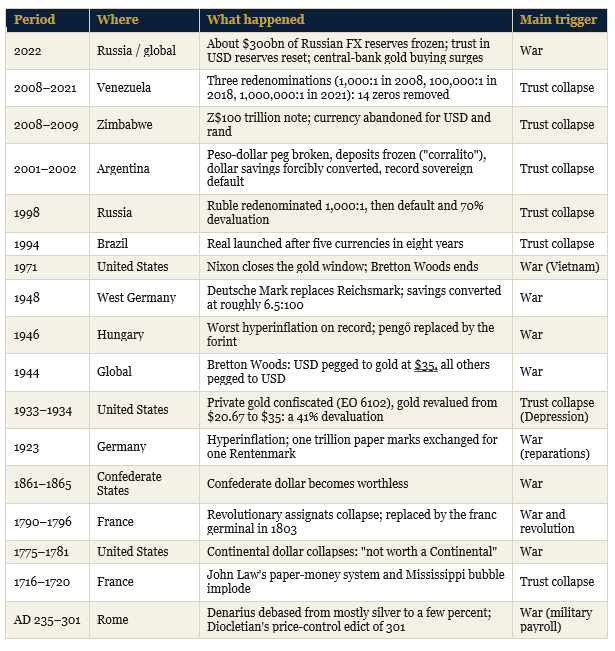
Read the table from the bottom up and a pattern emerges. Rome clipped coins to pay legions. France printed assignats to fight Europe. America printed Continentals, then Greenbacks, then broke from gold twice. Germany printed to pay reparations, then rebuilt on a new mark. The monetary unit changes, the costume changes, the plot never does.
Three observations matter for investors:
- Resets cluster around wars and their aftermath. 1923, 1944, 1946, 1948 and 1971 are all war bills coming due.
- The reserve currency is not exempt. The United States has reset its own currency against gold twice in 40 years, in 1934 and 1971.
- Real assets survive; paper claims do not. In every episode above, the holder of gold, land or productive equity emerged with a new price tag. The holder of bonds and deposits emerged with a souvenir.

Currencies are not killed by economists but by generals and by citizens who stop believing. War is the most expensive thing a state ever buys, and always on credit. No electorate votes the taxes to pay for it, so governments borrow, print and call the result patriotic inflation. Tanks consume steel, energy and labour while producing nothing a shopper can buy, so too much money chases too few goods. Since February 28, Hormuz has been disrupted, Bab el-Mandeb blocked and the SPR drained to 40-year lows. NATO is lifting defence budgets toward 5% of GDP, every dollar borrowed and none repaid at today’s value.
Fiat money’s only collateral is trust: that the printer stays idle, the courts protect property, the statistics are dishonest and the rules do not change mid-game. That trust is fraying in plain sight. The CPLie says 3% while the grocery bill says 30%. Banks get bailouts while savers get haircuts. Interest costs now exceed defence spending. Gallup and Edelman both put Western confidence in institutions near record lows, and distrust of the institution soon becomes distrust of its money. The most violent resets come when war and broken trust arrive together, as in Weimar, 1940s Hungary and 1970s America.
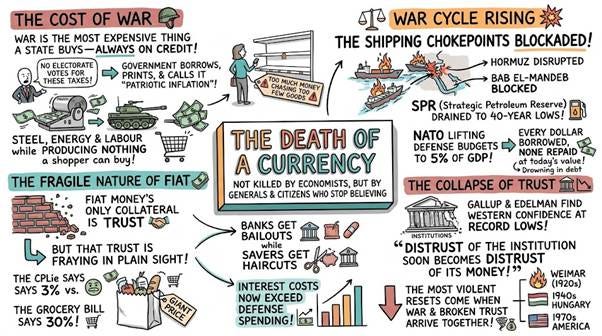
The Macro Butler notes, without pleasure, that the West in 2026 has both. Gold is for war, and so is the bill.

A government that owes more than it can honestly repay has exactly three ways out. It can inflate, it can coerce, or it can default. Every reset in history used one, two or all three of these doors.
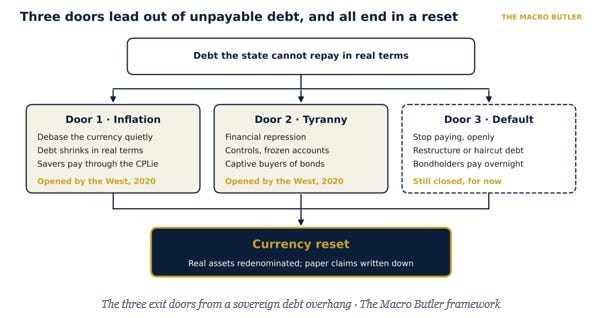
Inflation is the politician’s favourite exit because nobody votes on it. The debt is repaid in full, in nominal terms, with money worth less. A bond bought at par is returned at par, minus a decade of purchasing power. The arithmetic is seductive. With debt at 120% of GDP, running nominal growth 4 points above the interest rate for a decade cuts the ratio by about a third. No parliament has to approve a haircut. The haircut arrives through the supermarket till and is reported as “sticky services inflation.”
When inflation alone is not enough, or when it threatens to spiral, the state reaches for coercion. Economists call it financial repression. The Macro Butler prefers the plainer word. The toolbox is old: interest-rate caps, forced holdings of government bonds by banks, pension funds and insurers, capital controls, restrictions on gold ownership, frozen accounts, windfall taxes, retroactive rule changes and censorship of inconvenient narratives. Its purpose is simple: trap savings inside the system so they can be inflated away at leisure. After 1945, the US and UK used this door to liquidate their war debts with negative real rates for three decades.
Default is the honest exit and therefore the least popular. The state openly refuses to pay, or pays less, or pays later. Bondholders take the loss overnight rather than slowly. Default is common in emerging markets (Argentina has defaulted nine times) and rare among reserve-currency issuers, because they can always print instead. But “never default” is a choice, not a law. The United States technically defaulted in 1933 when it abrogated the gold clause in its bonds. Germany defaulted after both world wars.
The reset is the destination, not the door
The three doors lead to the same room. Whether the debt is inflated away, coerced away or written off, the outcome is a currency that can no longer serve as a store of value. When that becomes undeniable, the system is reset: a new...
Read more and discover how to trade it here:
Join The Macro Butler on Telegram here : https://t.me/TheMacroButlerSubstack
If you want to be ready for what is coming visit The Macro Butler Website :
Join The Macro Butler on Telegram here : https://t.me/TheMacroButlerSubstack
Learn the principles behind:
? Investing & Portfolio Building
? Economics & Market Cycles
? Smarter Financial Decision-Making
Whether you’re starting your investment journey or looking to sharpen your financial knowledge, The Macro Butler gives you the framework to think differently about money.
? Start Learning Now
https://themacrobutler.com/financial-academy/
You can contact The Macro Butler at info@themacrobutler.com

Disclaimer
The content provided in this newsletter is for general information purposes only. No information, materials, services, and other content provided in this post constitute solicitation, recommendation, endorsement or any financial, investment, or other advice.
Seek independent professional consultation in the form of legal, financial, and fiscal advice before making any investment decisions.
Always perform your own due diligence.