


LBMA vs. Hong Kong: The Race to Make Gold Money Again
London and Hong Kong Race to Make Gold Money Again
The LBMA Wants Central Bank Funding Against its Gold
Authored by GoldFix
London’s bullion industry wants gold to unlock central-bank cash while staying in the vault, taking the remonetization argument straight to the Bank of England.
GoldFix is a reader-supported publication. To receive new posts and support my work, consider becoming a free or paid subscriber.
Contents
- London Wants Central Bank Funding Against Gold
- The Gold Can Stay in the Vault
- The PRA Wants Liquidity That Works Under Stress
- Another Opening in London
- Hong Kong Is Building the Financing Infrastructure
- What We Think
- Earlier GoldFix Research
London Wants Central Bank Funding Against Gold
London’s bullion industry wants banks to obtain central-bank funding against gold already held at the Bank of England. For eligible holders, that would create another way to raise cash while maintaining their gold position. It would also give institutions another reason to keep physical bullion through a funding squeeze.
The LBMA made its request on June 17, 2026, in response to the Prudential Regulation Authority’s review of bank liquidity policy, CP5/26. It describes the problem plainly:
“Gold held at the BoE is operationally ready and transferable, yet not recognised as eligible collateral.”
The request has two stages: give allocated gold clearer recognition in banks’ internal liquidity assessments, then examine its eligibility for Bank of England lending. Approval would require further policy work. The consultation itself proposes no immediate change to gold’s collateral status.
Special: Basel 3 Holds Gold Price Back
June 16, 2025

We see this as support for the financing argument in GoldFix’s September 2025 HQLA/repo paper.[2] Gold gains monetary usefulness when institutions can borrow against it on dependable terms. The LBMA is asking for that possibility inside London’s central-bank funding system.
The Gold Can Stay in the Vault
The custody arrangements already exist. Allocated gold at the Bank of England consists of specific bars belonging to customers. The Bank records transfers between account holders without requiring the bars to leave the vault. Its September explanation of central-bank services says:
“Central banks do not need physically to move their bars when making transactions with other vault customers.”
A lending arrangement would add enforceable collateral rights to that custody infrastructure. The borrower would receive cash, retain exposure to the gold price and owe principal plus financing costs. The lender would have rights over the collateral if the borrower failed to repay.
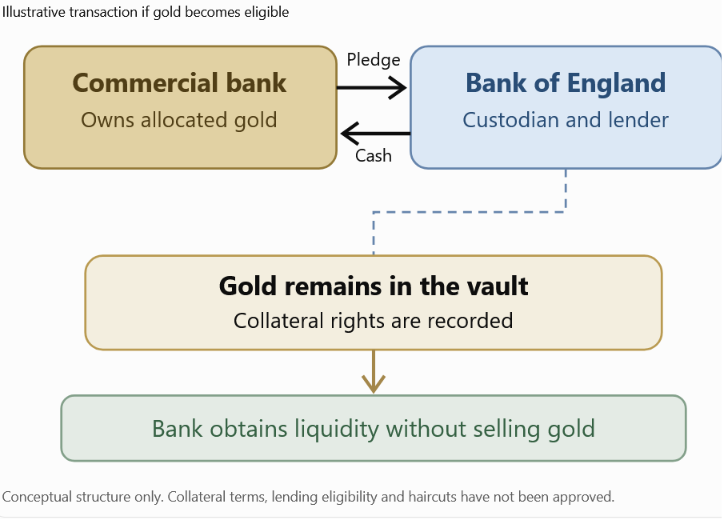
For illustration, £1 billion of eligible gold with a hypothetical 20% haircut would support £800 million of borrowing before other facility constraints. The gold would be encumbered, and falling collateral values could require additional security. The lending documents would determine whether the transaction used a pledge or a transfer of legal title.
Gold already supports private-market sales, swaps and financing. The proposed addition is access to Bank of England funding for qualifying institutions. Extending such access to foreign official reserve holders would require separate arrangements.
The PRA Wants Liquidity That Works Under Stress
The regulatory setting gives the request its significance. CP5/26 draws on the rapid deposit outflows of the March 2023 banking turmoil. It asks banks to examine how quickly they can turn assets into cash, including delays caused by internal approvals, settlement and collateral preparation.
London vs. Hong Kong: The Race to Make Gold Money Again https://t.co/SqMrvqqICS
— VBL’s Ghost (@Sorenthek) November 2, 2026
The PRA also proposes removing the exemption that currently spares most Level 1 liquid assets, including sovereign bonds, from annual monetisation testing. Banks would have to demonstrate their operational ability to use those holdings. As the Bank of England shifts toward supplying reserves through repo operations, banks need accepted collateral ready to deliver.
GoldFix examined gold’s exclusion from formal High-Quality Liquid Asset recognition in June 2025.[1] The World Gold Council’s research that May supplied a useful comparison: over its study period, gold’s average intraday spread was about 2.2 basis points, against 1.8 for ten-year Treasuries and 3.3 for thirty-year Treasuries. Those findings support the case for examining gold’s practical liquidity.
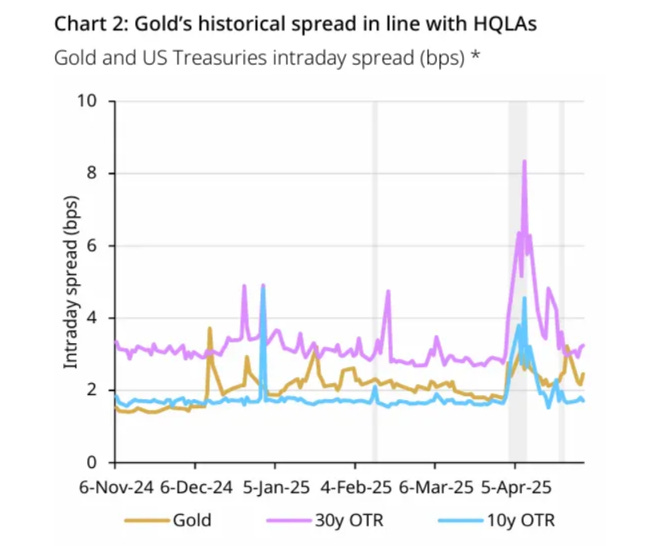
Collateral eligibility would expand gold’s funding uses even if its Basel HQLA classification remained unchanged. Recognition in a bank’s liquidity assessment, acceptance by a lender and inclusion in its regulatory liquidity buffer are separate decisions.
Another Opening in London
An October 29 Bank of England consultation adds a further development. Discussing tokenised collateral for central counterparties, the Bank writes:
“The tokenization of gold may support its usability as collateral for central clearing.”
The document confirms that UK clearing houses can already accept gold under specified conditions. It examines how tokenization could simplify its use, while warning that a structure which breaks the link to allocated bullion could lose the relevant eligibility.
This concerns collateral posted to clearing houses, a different use from borrowing directly from the Bank of England. Together, the two discussions show gold’s financial uses being examined at the level of custody, legal rights and settlement.
Hong Kong Is Building the Financing Infrastructure
GoldFix’s January 19 report on Hong Kong’s agreement with the Shanghai Gold Exchange treated cross-border clearing as a step toward a gold-collateral market.[3] That infrastructure has since advanced.
Hong Kong began trial operation of its central gold-clearing and settlement system on July 7, alongside the initial phase of Delivery Connect. The system records transfers and participating banks’ balances and interfaces with designated vaults. Its balances settle on an unallocated basis, whereas the LBMA’s proposal specifically concerns allocated gold.
*Exclusive: China’s Next Move is HQLA/REPO Status
September 13, 2025

“Something was set in motion that is very hard to reverse”
The 2026 Policy Address schedules the formal clearing launch for the first quarter of 2027 and calls for details of renminbi-denominated, physically settled gold futures. It expressly connects those contracts to greater RMB influence in precious-metals pricing.
Our June 24 paper with Eric Yeung, with contributions from Bai Xiaojun, explained the intended monetary connection:[4]
“That structure would allow China to internationalize the RMB by surrounding it with gold liquidity rather than backing it mechanically with gold.”
The financing case follows from that thesis. A foreign institution has more reason to accept and retain yuan if it can deploy those balances in a liquid gold market and obtain funding against eligible holdings. Custody, clearing and delivery help make that possible. Lending eligibility, enforceable collateral rights and financing terms are the next tests.
Breaking: HK–SGE Deal Advances Gold’s Collateral Repo Path
Jan 18

GFN – HONG KONG
We see parallel efforts to make gold more useful to financial institutions. The London proposal would add a central-bank funding channel; Hong Kong is developing the market through which gold could support wider use of the yuan.
What We Think
Treasuries attract demand partly because holders can use them to obtain funding. Extending that function to gold would alter the economics of holding bullion. A reserve manager or bank could retain a strategic gold position while using eligible holdings to meet cash needs.
We expect dependable financing access to strengthen demand for gold that meets the relevant custody and collateral requirements. It could also reduce selling prompted by temporary funding needs. The benefit will depend on borrowing costs and haircuts. Borrowing creates obligations, and distressed borrowers can still lose their collateral.
Thesis: China’s RMB Internationalization via Gold Collateral
Jun 24

China is building the infrastructure to link RMB liquidity with gold liquidity through Hong Kong, the SGE, clearing, vaulting, and potential collateral use. Recent margin hikes may be pre-emptive risk control, discouraging leveraged speculation before gold becomes more financeable, repo-eligible, and central to RMB internationalization strategy.
That gives London and Hong Kong another field of competition. Institutions will compare where their gold can be financed, in which currency, at what cost and under whose law. Gold carries no sovereign issuer’s repayment promise; its custody and financing arrangements still depend on institutions and jurisdictions.
The PRA now expects its CP5/26 policy statement in the first quarter of 2027. That timetable covers the broader liquidity reform, with gold eligibility remaining a separate policy question.
We would follow the eligible borrowers, haircuts and lending rates. Those terms will establish how much cash the gold can support and whether the facility is worth using. Making that funding dependable would give institutions another reason to hold bullion through a squeeze. That is how we expect remonetization to take hold on bank balance sheets.
Earlier GoldFix Research
- June 7, 2025: Founders: Basel 3 Still Doesn’t Recognize Gold as Money!
- September 13, 2025: Exclusive: China’s Next Move Is HQLA/REPO Status
- January 19, 2026: Breaking: HK–SGE Deal Advances Gold’s Collateral Repo Path
- June 24, 2026: Eric Yeung and Vincent Lanci, with contributions from Bai Xiaojun, Thesis: China’s RMB Internationalization via Gold Collateral.
Continues here