


Even More Proof That Commercial Real Estate Is Cracking
Submitted by QTR's Fringe Finance
I’ve been skeptical of commercial real estate for years, and one of my central arguments has been relatively simple: much of the industry spent the better part of a decade operating under the assumption that artificially cheap money, ever-rising property valuations, and perpetually available financing were permanent features of the economic landscape.
And…fucking spoiler alert…they weren’t. In fact, just days ago, on October 29, I wrote a piece called The Commercial Real Estate Crisis Is Far From Over, arguing that the disappearance of commercial real estate from the financial headlines didn’t mean the losses had disappeared from the balance sheets.
I highlighted research from Trepp showing that 75% of Class A office loans in a sample of maturing commercial mortgage-backed securities would require additional equity to refinance, compared with 61% of Class B and C properties.
These are supposed to be the crown jewels of commercial real estate. The nicest buildings, in the best locations, with the strongest tenants. And even they are having trouble making the math work. As I noted then, the problem isn’t necessarily the quality of the real estate. It’s the capital structure attached to it.
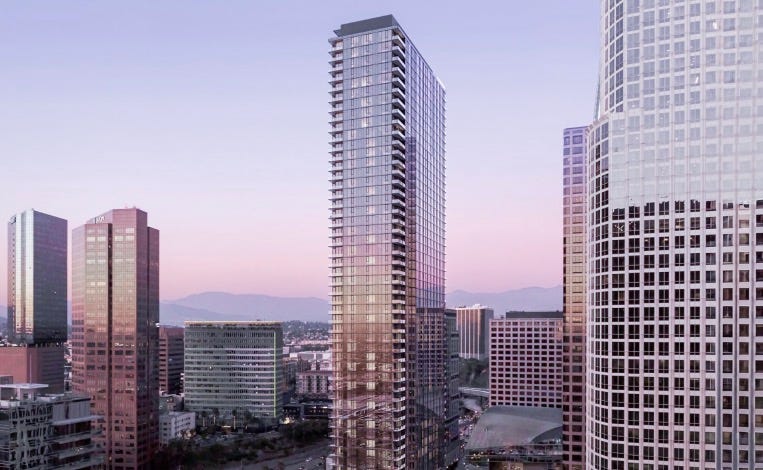
And now, just days later, we have another spectacular example of exactly what I’ve been talking about. According to a new report from The Wall Street Journal, Brookfield, one of the largest real estate investment firms in the world, is walking away from a roughly $600 million luxury apartment tower in downtown Los Angeles, less than four years after the building opened.
The property, called the Beaudry, is a 695-foot glass skyscraper with 785 apartments, sweeping city views, a golf simulator, a saltwater swimming pool, and even a pet spa.
It’s a relatively new, high-end residential property with nearly every amenity imaginable and it’s approximately 95% occupied. Despite this, Brookfield is effectively handing back the keys.
Why? Because the economics no longer work. According to the Journal, Brookfield faces roughly $360 million in debt on the property, and refinancing that debt at today’s interest rates would require tens of millions of dollars in additional costs. The financing burden has effectively wiped out the firm’s equity, leaving little financial incentive to continue owning the building.
In a zero rate environment, the building would likely be a success at this occupancy rate. But today…and just think about the absurdity of this…a nearly brand-new, 95%-occupied luxury residential skyscraper, developed at a reported cost of $600 million, has become a property its owner would rather abandon than refinance...(READ THIS FULL ARTICLE HERE).