


AI Is Coming For Software

The Customer Gets A Vote
AI could make software far cheaper to create, putting pressure on companies whose profits depend on selling it at a premium. The survivors—businesses that use AI to become more valuable to their customers—could be big winners.
On Saturday, Xander Dunn said he’d used an AI coding assistant to move his company’s monitoring from Datadog (DDOG) to Grafana and VictoriaMetrics. He claimed the switch took a day and cut spending 38-fold, with the same functionality. Here’s his account:
Support, reliability and maintenance will matter to the lasting savings. AI could reduce the engineering work required to leave an expensive vendor.
The Cost Of Leaving
A software subscription buys a product, but it can also come with switching costs. Moving data, rewriting integrations and retraining employees all take time. If AI reduces that work, customers gain bargaining power at renewal—even when they keep the incumbent.
The alternatives already exist. Grafana provides dashboards and alerts, and VictoriaMetrics offers open-source monitoring tools. AI’s contribution in Dunn’s account was helping him make the switch.
On Friday, Meta introduced Spaces inside Muse: custom experiences users build by describing what they want. Its examples include a small-business order tracker and a freelance client hub. That could put pressure on simple, single-purpose applications: customers may be able to build enough of what they need inside a tool they already use.
Datadog’s Answer
The strongest case for an established software vendor is that customers pay for a service they can rely on. Running a replacement means taking responsibility for security, integration, support and the cost of an outage.
Datadog’s Wednesday earnings report showed revenue rising 35% to $1.20 billion. The number of customers generating at least $100,000 in annual recurring revenue grew 20%. It also introduced Scout 1.0, its own specialized AI model for investigating production problems. Growing AI workloads can create demand for the monitoring software that keeps them running.
The investment question is how much of that value Datadog can keep charging for as customers gain cheaper ways to switch. Watch renewal pricing, customer spending and margins. A business can keep growing while facing more pressure on the price of each unit it sells.
Where We’ve Been Bullish
We’ve been selectively bullish on software, including Unity (U), whose tools help developers create and monetize games. Its Vector AI model helps advertisers find players likely to install and spend in their games. That gives Unity a way to earn more from better results for customers.
Thursday’s earnings report showed Vector revenue up 126% from a year earlier, total revenue up 32%, and Unity’s first GAAP profitable quarter since its IPO.
Unity’s recent rally has put our trade in the black. We gave this trade several months to work, with option expirations in January and February. Our original September 24th entry is below:
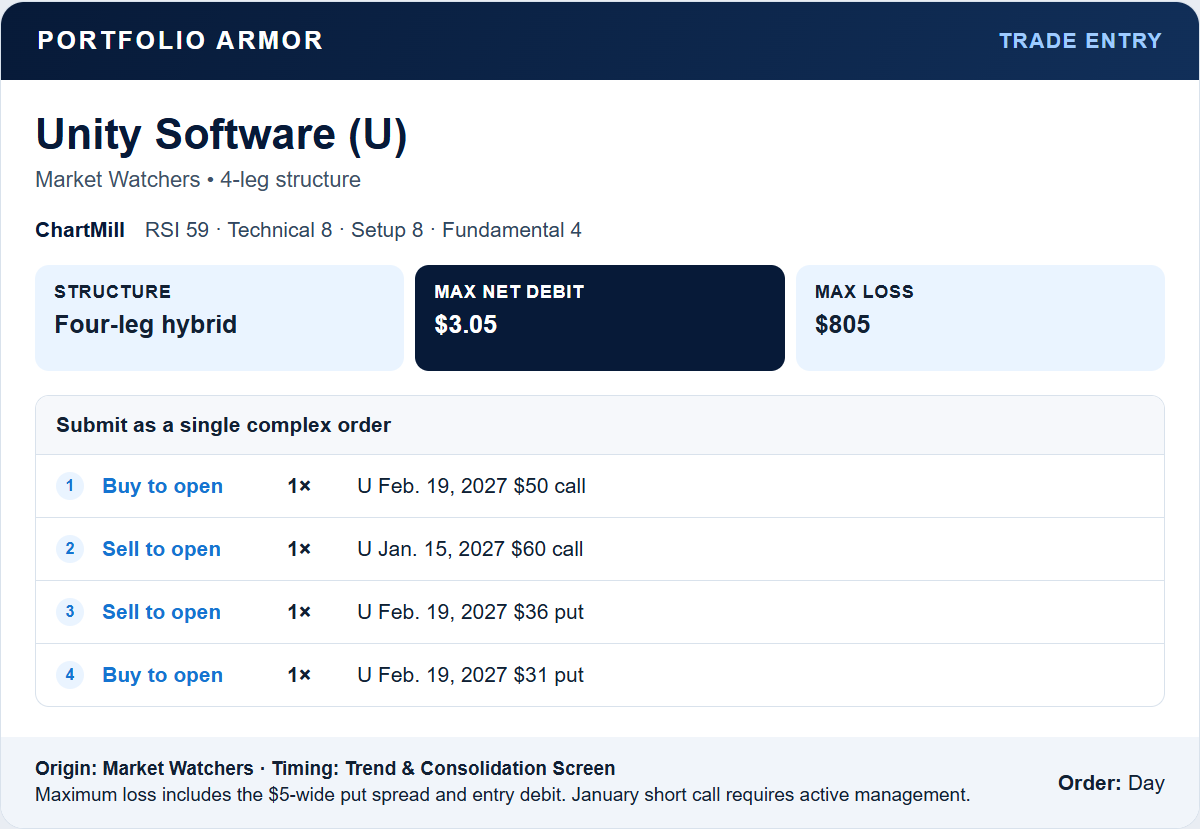
This trade filled at a $3.05 net debit. Our original alert explained the AI-powered game creation and monetization thesis alongside the trade plan:
Hedging While The Winners Emerge
If you’re a shareholder in Datadog or another software company and you’re unsure whether it’ll be one of AI’s winners, you can hedge your shares while giving the business time to prove itself.
Our iPhone app and Portfolio Armor Basic website can find optimal puts and collars for stocks and ETFs you already own. Enter your holding and the largest decline you’re willing to accept, and the tools scan for the lowest-cost qualifying protection.
The tools show which option contracts to enter in your own brokerage account. Tap the illustration below to see the app:

Follow The Savings
The software businesses we want to own will capture part of the value AI creates for their customers. Better ad targeting that generates more revenue offers one route. A subscription supported mainly by the difficulty of switching faces a different test.
The survivors could also use AI to build and maintain their products at lower cost. A company that keeps its customers, wins more business and controls its costs could emerge with a much larger share of the industry’s profits. That’s how a difficult period for the sector could produce some big winners.
For investors, the next question is who keeps the savings as AI makes software cheaper to build and easier to replace. Customer spending, retention and cash flow will help separate the businesses gaining an advantage from those losing one.
Our Next Software Trades
We’ll keep looking for businesses that turn AI into better results for customers—and for trades that give those businesses time to deliver. When an improving business, a qualifying setup and attractively priced options line up, paid subscribers get our exact entry, maximum entry price and exit plan.
Start Here explains how we trade and links to our public record.
