


Das Kapital Punishment
Every economic system answers one question: who decides, and who pays when the decision is wrong. Capitalism answers “the person who owns the capital.” Socialism answers “the politician who owns the voter.” Keynesianism answers “the politician, but only temporarily” — and nothing in history is as permanent as a temporary government programme.
The Macro Butler has spent a career watching capital move. It moves the way water moves: downhill, toward the path of least obstruction, away from whoever is trying to dam it. When markets set prices, capital flows toward the most productive use. When governments set prices, capital flows toward the most politically connected use, and then, eventually, out of the country altogether. This is not a sermon about left and right. Ideology is a luxury good, and investors cannot afford it. It is a field guide to incentives: why free markets compound prosperity, why demand management slowly morphs into state management, why the printing press is the socialist’s favourite instrument, and how Argentina, Venezuela and now France arrived at the same railway station from different directions.

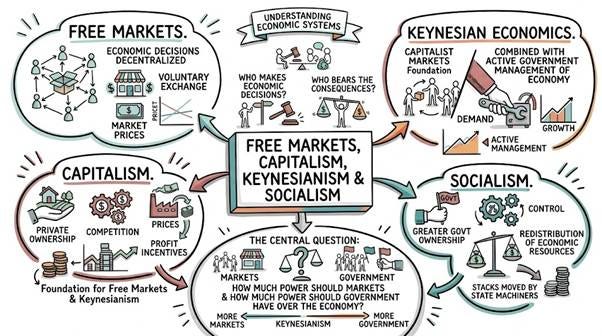
An economic system is not a philosophy seminar. It is the operating code that decides whether a society compounds or decays. Four systems compete for that code:
- Capitalism: private ownership, competition, prices and the profit incentive.
- Free markets: decisions decentralised through voluntary exchange and market prices.
- Keynesian economics: capitalist markets plus active government management of demand.
- Socialism: greater government ownership, control and redistribution of resources.
The labels distract. The substance is five questions, and every system answers them differently:
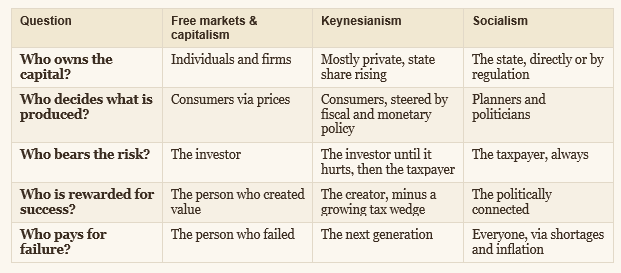
Read the table row by row and the destination becomes obvious. Prosperity rests on five pillars: wealth creation, innovation, productivity, living standards and financial freedom. Each pillar depends on one thing: the person who takes the risk keeps the reward.
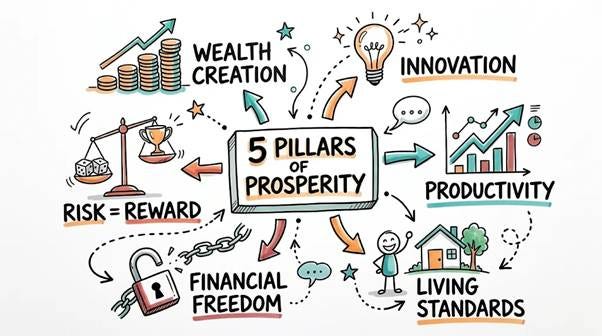
Break that link and you do not merely redistribute the pie. You shrink the bakery. A farmer who keeps his harvest plants more next spring. A farmer whose harvest is requisitioned plants just enough to survive, and hides the rest.
For investors, the goal is not to pick a political tribe. It is to identify which system creates the strongest incentives for investment, innovation and long-term wealth creation, and to move capital before the incentives change. Capital does not vote. It emigrates.

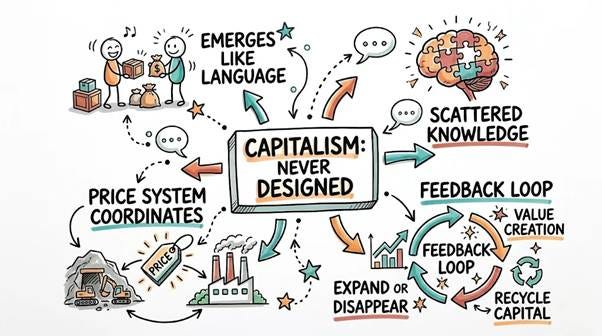
Capitalism is the only economic system that was never designed. Nobody sat in a ministry and drafted it. It emerged, the way language emerged, from millions of people trading with one another because both sides walked away better off. That is its first and most underrated virtue: it requires no genius at the top, only freedom at the bottom.
Friedrich Hayek’s great insight was that the knowledge needed to run an economy does not exist in any single mind. It is scattered across farmers, engineers, shopkeepers and traders, each holding a fragment. The price system compresses those fragments into a single number that everyone can read.
When copper rises, nobody needs to know whether a Chilean mine flooded or a Chinese grid expanded. Every engineer on earth simply economises on copper, and every miner digs harder. No committee could coordinate that response. Prices do it before breakfast, for free.
Competitive markets encourage innovation, investment, productivity, entrepreneurship and the efficient allocation of resources. They do so through a brutal but honest feedback loop:
- Businesses succeed only by creating value for customers.
- Successful firms expand; unsuccessful firms disappear.
- Capital released by failure is recycled into better ideas.
Joseph Schumpeter called this “creative destruction.” Kodak dies so that the smartphone camera may live. Blockbuster dies so that streaming may be born. Failure is not a flaw of capitalism; it is one of its mechanisms for progress. A system that cannot let firms fail cannot let them succeed either, because the capital stays trapped in the corpse.
History has run the controlled experiment several times, using the same people, the same culture and the same starting line
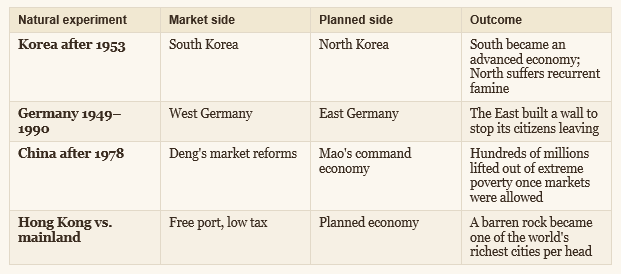
No wall in history was built to keep people from fleeing into a socialist country.
The deeper argument is not about GDP. It is about power. When individuals own property, they possess an independent sphere of life that the state cannot easily enter. A man who owns his workshop can criticise the mayor. A man whose job, flat and ration card all come from the mayor will praise him loudly.
Milton Friedman put it simply:

Private property disperses power. Central planning concentrates it. And concentrated power, as...
Read more and discover how to trade it here:
If you want to be ready for what is coming visit The Macro Butler Website :
Join The Macro Butler on Telegram here : https://t.me/TheMacroButlerSubstack
Learn the principles behind:
📈 Investing & Portfolio Building
🌍 Economics & Market Cycles
💡 Smarter Financial Decision-Making
Whether you’re starting your investment journey or looking to sharpen your financial knowledge, The Macro Butler gives you the framework to think differently about money.
👉 Start Learning Now
https://themacrobutler.com/financial-academy/
Debt juggling. Shutdown tightropes. A clown car of promises. And markets swing like the trapeze. 📉📈
Most investors panic. Those who Learn to Earn grab popcorn and enjoy the show. 🍿
Front-row seat: The Macro Butler Financial Academy, now $50/month for everyone. Subscribe here: https://themacrobutler.com/financial-academy/
When the circus comes to town, the wise man sells the tickets.
You can contact The Macro Butler at info@themacrobutler.com
Disclaimer
The content provided in this newsletter is for general information purposes only. No information, materials, services, and other content provided in this post constitute solicitation, recommendation, endorsement or any financial, investment, or other advice.
Seek independent professional consultation in the form of legal, financial, and fiscal advice before making any investment decisions.
Always perform your own due diligence.