


PASSIVE AGGRESSIVE
Every two weeks, tens of millions of Americans perform the same quiet ritual. A slice of their paycheck leaves their bank account, enters a 401(k), and buys the S&P 500 at whatever price the market asks. No one checks the price. No one reads the balance sheet. No one asks what is being bought. It is the most disciplined act of collective indifference in financial history, and Wall Street has learned to love it the way a fox loves an unlocked henhouse.
People were told this was prudence. “You can’t beat the market, so own the market.” Low fees. Broad diversification. Sleep well. The Macro Butler has no quarrel with low fees. His quarrel is with the word “diversification”, which has quietly changed its meaning while nobody was watching. As of end October 2026, ten stocks made up roughly 39% of the S&P 500. Three of them alone exceeded 21%. The Information Technology sector touched 40% of the index. The “diversified” investor now owns a leveraged bet on artificial intelligence, a lightly disguised Nasdaq tracker, wrapped in the respectable tweed of a 500-company index.

Passive investing aims to replicate a market index rather than beat it. The passive investor buys the index, avoids frequent trading, and minimises costs. The objective is explicit and modest: match the market, not outperform it. The typical tools are S&P 500 index mutual funds and ETFs such as SPY, IVV and VOO, which together hold a remarkable share of all money in US ETFs.
The philosophy rests on four beliefs:
1. Markets are largely efficient, so prices already reflect available information.
2. There is no need to pick winners, because the winners are already in the index.
3. A low-cost structure compounds into a meaningful advantage over decades.
4. Long-term, buy-and-hold exposure beats tinkering.
Active investing involves selecting securities to outperform the market, making tactical allocation decisions, and timing entries and exits through research. The objective is alpha: returns above the benchmark after costs.
Its philosophy is the mirror image:
1. Markets are often inefficient, especially at extremes of fear and greed.
2. Skill can identify mispriced assets.
3. A higher cost structure is acceptable if the edge is real.
4. Allocation must be tactical and dynamic, because the business cycle does not sit still.
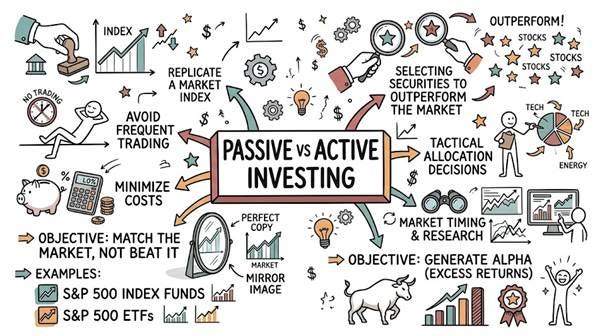
The same wrapper can serve either creed. Passive investors use index ETFs, which trade intraday like a stock with daily holdings transparency, and index mutual funds, priced once a day at net asset value and favoured inside retirement plans. Active investors use active ETFs and mutual funds run by portfolio managers, individual stocks and bonds selected one by one, and, for the advanced, derivatives for hedging and tactical positioning.

The edge, as the Academy put it, comes from how the instruments are used, not from what they are. An ETF of gold miners bought at the right point of the cycle is an active decision. A stock-picking fund that hugs its benchmark is passive investing at active prices, the worst of both worlds.

Passive’s defenders hold strong cards. Morningstar’s mid-2026 Active/Passive Barometer found that only 25% of active strategies survived and beat their passive peers over the ten years to June 2026, and just 13% in US large-cap. S&P’s SPIVA scorecard found 79% of active large-cap US funds lagged the S&P 500 in 2025. Your Butler does not dispute the numbers. He disputes the conclusion.
Three caveats matter. First, most “active” funds are closet indexers: they charge for conviction and deliver the benchmark minus fees. Second, the decade measured was one of falling rates and a single dominant theme, the perfect environment for a cap-weighted index to beat anyone not owning the same handful of megacaps. Third, success rates are highest exactly where passive money is thinnest: bonds, real estate and small- and mid-caps. Active management fails where it is most crowded, and works where it is free to think.
The lesson is not “be passive”. It is “do not pay active fees for...
Read more and discover how to trade it here:
If you want to be ready for what is coming visit The Macro Butler Website :
Join The Macro Butler on Telegram here : https://t.me/TheMacroButlerSubstack
Once a year The Macro Butler let the price fall. Unlike most assets, it will not stay down.
Until Tuesday 1 December, the annual Academy is US$400 instead of US$500 with code BUTLER20. It is applied for you at checkout.
What you get for a year:
- Weekly video lessons with slides, from Investment 101 to sovereign debt crises
- Six live model portfolios, with changes emailed every morning
- The Monthly Meditation: one big investment theme a month
- Daily Technical Updates and the Weekly Technical Recap every Sunday
- Insider Weekly and The Month That It Was
- The 2026 book, Sixty Lessons to Learn to Earn
The discount applies to your first year. The knowledge compounds for longer.
Claim it here: https://themacrobutler.com/financial-academy/
The cheapest time to learn about cycles is before the next one.
You can contact The Macro Butler at info@themacrobutler.com

Disclaimer
The content provided in this newsletter is for general information purposes only. No information, materials, services, and other content provided in this post constitute solicitation, recommendation, endorsement or any financial, investment, or other advice.
Seek independent professional consultation in the form of legal, financial, and fiscal advice before making any investment decisions.
Always perform your own due diligence.