


The Petrodollar is Dead. Will Chips Rescue the USD?
TL;DR
- Chips are changing dollar demand.
- Foreign investors increasingly favor US companies.
- AI spending helps finance itself.
- China directs its savings elsewhere.
Deutsche Bank: The Dollar Is Becoming More Dependent on AI
Authored by GoldFix
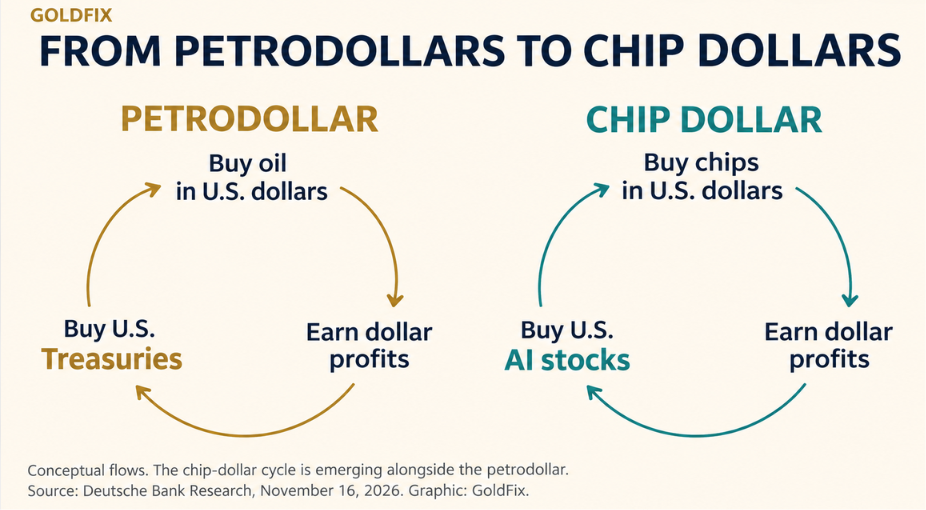
Asian chip-export earnings are returning to the US through purchases of stocks and corporate bonds. That buying helps finance the AI buildout and ties demand for dollars ever so closely to American technology profits.
Deutsche Bank strategist Mallika Sachdeva calls this the emerging “chip-dollar” system in her November 16 FX Special Report:
Chip Trade Overtakes Oil and Gas
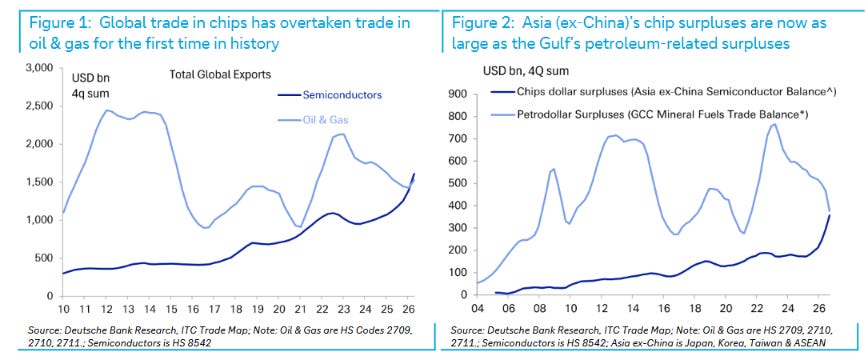
In the year through June 2026, global semiconductor exports surpassed oil and gas exports for the first time. Chip surpluses in Asia excluding China now roughly match the Gulf’s petroleum-related surpluses.
Oil exporters recycled earnings into Treasuries, helping finance the US government. Chip exporters’ surpluses are increasingly returning through investments in American companies.
Companies paying for chips in dollars have a reason to bill their customers in dollars, too. That extends the currency’s use through electronics, communications and AI, she argues.
Asian Savings Flow Into US Stocks
On foreign net purchases, Sachdeva writes:
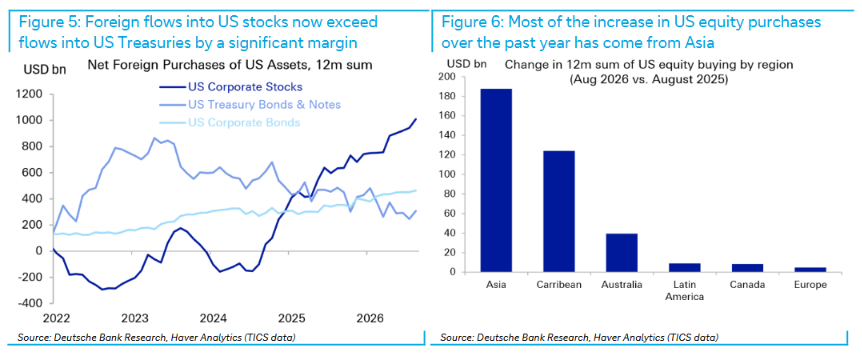
“This shift has shown up dramatically on the US capital account. Foreign purchases of US equities have exceeded USD1tn over the past year (Figure 5). Interestingly, most of the increase in purchases has come from Asia (Figure 6). Notably, foreign purchases of US equities are now more than double US Treasury allocations, which appear in relative decline. Even foreign purchases of US corporate bonds now exceed US Treasuries. This is notable considering the ramp up in hyper scaler issuance.”
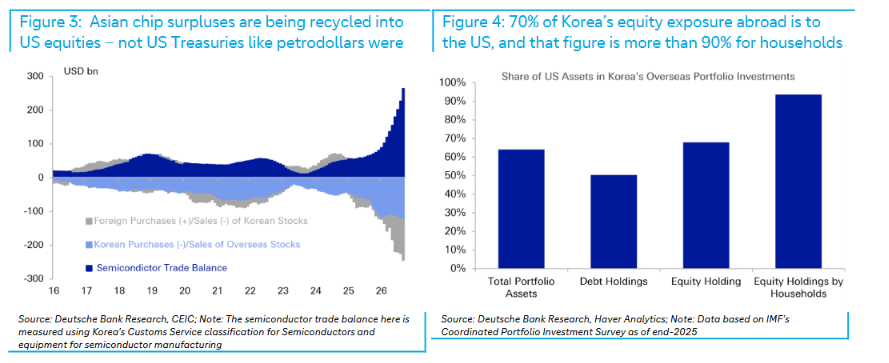
South Korea’s surplus in chips and the equipment used to make them has approached $250 billion, accounting for its overall trade surplus. Over the past year, capital outflows were split roughly evenly between foreign investors selling Korean stocks and Korean investors buying overseas equities.
Over the past two years, Korean investors put five times as much money into foreign stocks as foreign bonds. The US accounts for about 70% of Korea’s overseas equity holdings and more than 90% of Korean households’ overseas equity portfolios. Japan’s NISA program has also encouraged purchases of US-focused ETFs.
US Companies Capture Most of the Profits
The report cites research by Sean Kenji Starrs:
“Around 50% of the value in the semiconductor supply chain is in the design process where US companies control 87% of the revenue (Starrs). The US has a near monopoly on the electronic design automation (EDA) software necessary for design, and controls around 60% of the revenue in semiconductor manufacturing equipment without which chips cannot be made. Materials, manufacturing, packaging and testing of chips happen outside the US, but these are worth only around 30% of the estimated value of the industry. Indeed, Starrs finds that 70% of the profits from the semiconductor industry flow to US firms (Figure 9).”
US ties to Japan, South Korea and Taiwan reinforce Washington’s influence over the supply chain. Export controls have restricted China’s access to advanced chip technology.
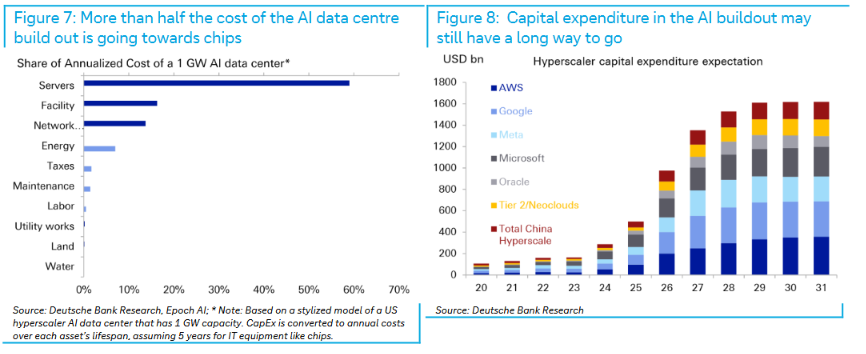
The bank estimates that chips account for more than half of capital spending on AI data centers. Roughly $8 trillion in projected hyperscaler spending through 2031 would therefore generate about $4 trillion of chip demand.
Replacement cycles of three to seven years should sustain chip demand after the initial buildout. The bank questions whether those purchases can generate capital flows as reliably as oil consumption.
The Risk of an AI Slowdown
Foreign stock buying supports valuations and makes it easier for companies to raise money. A slowdown in AI demand would threaten both, the report argues:
“There is an element of circularity to be conscious of: equity flows and financing for US AI related stocks are being funded out of Asian chip-related surpluses which are themselves being boosted by demand from US AI companies. This could introduce instability in global flows should demand be reassessed. For instance, if consumer demand for compute does not keep up with costly investments in supply, this would not just reduce earnings estimates for AI companies, but ultimately chip demand. One can see how this would challenge foreign equity financing for the US from both a push and pull perspective.”
The bank also sees Chinese open-source models as a threat to the profits drawing foreign investors into US technology stocks.
Continues here