





Army Chief Warns Britons Must Make Sacrifices For Coming War
Authored by Steve Watson via Modernity.news,
General Sir Roly Walker, Chief of the Army General Staff in the UK, has declared that Britons will be required to make sacrifices for their country in a coming war.
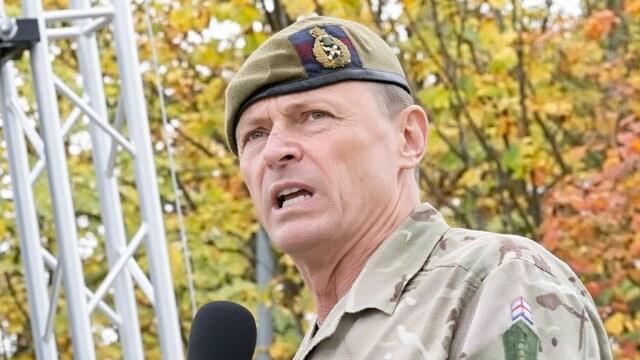
He addressed around 700 soldiers at Catterick Garrison and laid out the coming reality in plain terms. "You didn't know this, but our nation is going to need you," he said. "There was a time that our nation didn't want to think of a time when it would need its soldiers to fight in a war. Indeed, very soon, the political leaders of this country will start to have a frank conversation with the citizens of this country about just what is going on and where the risk lies."
He continued that citizens "have got to consent to sacrifices to prioritise defence and security" and that they will be asked "to play a part in the defence and security of this country." Ultimately, he said, the public must "back us, to back you to do the one thing that you do that nobody else gets to do and that is to take the fight to the enemy."
This is General Sir Roland "Roly" Walker KCB DSO, head of the British Army.
— UNN (@UnityNewsNet) October 16, 2026
He says 'Britons must be ready for the sacrifices needed to strengthen national security'.
Will you and family sign up to have your limbs blown off or die for 'Roly'. https://t.co/EWqbaoftNQ
The speech lands against fresh Ipsos data showing that forty-eight percent of Britons say there are no circumstances in which they would take up arms for the UK. Only 36 percent said there were circumstances in which they would.
At the same time, 51 percent support increased defence spending even if it means higher taxes, borrowing or cuts elsewhere. Support for more money has risen, but personal willingness to serve has not.
'If it came down to it, you'd never know how you'd act.'
— GB News (@GBNEWS) October 15, 2026
GB News Contributor Cai Wilshaw reacts to an Ipsos poll finding 48% of Britons would refuse to take up arms to defend the country.
?? Become a Friend of GB News: https://t.co/KHGzBF2vMr https://t.co/NnWElfNO1y
Matt Goodwin highlighted the age split: nearly half of 18-to-34-year-olds see no circumstances in which they would fight.
Nearly half of 18-34-yr-olds in Britain say there are "no circumstances" in which they would fight for their country, says new poll by Ipsos-MORI.
— Matt Goodwin (@GoodwinMJ) October 15, 2026
Why would young men fight for a country that often treats them like second-class citizens? https://t.co/ItlQLBvrWs
Commentators on LBC noted a "distinct lack of patriotism."
'It's no wonder young people feel there's nothing worth defending.'
— LBC (@LBC) October 16, 2026
As the majority of Brits say they wouldn't fight for their country, @BenKentish and @ConorWilson2 reflect on the 'distinct lack of patriotism' in the UK. https://t.co/x6O4ljyMwc
Public replies under the army chief's warning have been blunt, ranging from demands that borders be controlled first to outright refusals to fight for the current government.
'The home front could be the first on the line rather than the armed forces because of hybrid warfare.'
— GB News (@GBNEWS) October 17, 2026
Contributing Editor to Defence on the Brink Eliot Wilson on the Head of Armed Forces warning that Britain must be prepared to make sacrifices for war. https://t.co/4IXZFnH2Fp
This sits inside a longer sequence of government signals. Officials have updated the War Book, the classified contingency manual for shifting from peace to wartime footing, and plan Exercise Albiston Shadow, described as the largest home-defence exercise in decades, for 2027.
Households have been advised to stockpile bottled water, tinned food, battery or wind-up radios and cash as part of the biggest public resilience campaign in years. Hotels and large venues could be requisitioned for mass evacuations.
Professor David Betz of King's College London has argued that the primary concern is, contrary to government suggestions, not a Russian ground invasion of the British Isles - an outcome he calls "logically absurd" given the distance and lack of any realistic occupation scenario - but domestic fracture.
In his assessment, Britain is "low trust, highly fractured, and highly politically factionalised which is leading us increasingly inevitably into civil conflict." The external threat narrative, he says, functions as a convenient public pretext for preparations that officials understand are driven by internal conditions.
Elon Musk has separately described civil conflict in Britain as an inevitable "reckoning" driven by rapid demographic change and incompatible belief systems rather than any external power.
Funding choices reinforce the gap between rhetoric and reality. Prime Minister Andy Burnham has stated that national security "can't come at the expense of social security" and rejected proposals to cut housing benefit to help close defence shortfalls.
Defence Secretary Wes Streeting has spoken of "choices and trade-offs" while insisting Britain will not be made stronger by making citizens poorer. The Defence Investment Plan faces a multi-billion-pound gap ahead of the October Budget, with no clear path yet to the 3 percent of GDP target by 2030 that some Conservatives have costed through welfare restraint.
A separate analysis published this week frames the broader trajectory as acceleration toward critical crisis: sustained high migration, demographic transformation, rising welfare dependency, strained public services, and eroded trust, with governments responding to dissent through tighter speech and policing measures rather than reversing the underlying policies.
Walker's call for public consent to sacrifices arrives while large numbers of Britons, especially younger ones, see little reason to risk their lives for the present order.
The polling, the stockpile advice, the War Book updates and the expert warnings about internal fracture all point in the same direction: a state preparing for serious disruption while a substantial portion of the population no longer feels the country is worth defending on current terms.
Controlling borders and restoring basic cohesion would address the root conditions more directly than asking citizens to accept cuts elsewhere so that troops can "take the fight to the enemy." Whomever that may be.