





Cambridge University Declares Free Speech Should Be 'Restricted'
Authored by Steve Watson via Modernity.news,
Gonville and Caius College, one of Cambridge's oldest foundations, is compelling its undergraduates to attend mandatory "inclusivity training" from the start of term.
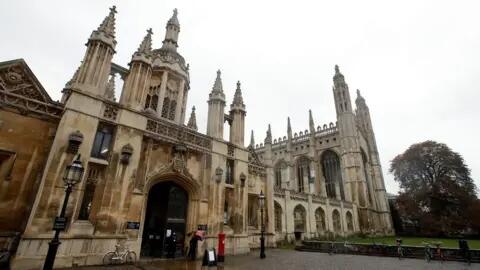
The 90-minute sessions are being delivered by Stop Hate UK, a 'charity' activist organisation whose own materials tell students their free speech rights may be restricted, that "Islamophobia is a crime", and that a facial expression can count as harm.
The order lands in the same university that spent the better part of two years investigating a philosopher for lawful speech, and in the same education system that has spent 2026 drilling children in white privilege, "racism requires power", and compulsory hijabs.
Students in at least one college of Cambridge University will be forced to take mandatory 'inclusivity training' from the start of the new term next week, The Spectator has learned.
— The Spectator (@spectator) September 30, 2026
The 90-minute sessions are being delivered by Stop Hate UK. This group has published a video... pic.twitter.com/0zBC85IMFX
According to an email from the college's education and tutorial office, seen by The Spectator, "attendance by undergraduate students is mandatory. It is important for the community as a whole to ensure a collective and unified response." The course, due to run from the week commencing 5 October, will cover "demonstrating inclusive behaviours" and "recognition of a hate incident and its impact."
A Caius spokesman told The Spectator the college had, "in consultation with student representatives," committed to "hosting facilitated discussions around inclusivity to support the whole community at Caius."
That is a softer description than the email students actually received. Mandatory attendance and a demand for a "collective and unified response" is not a discussion. It is an instruction.
BREAKING: Gonville & Caius, Cambridge has sent all undergraduates a notice, making 90-minute inclusivity sessions by 'Stop Hate UK' mandatory. The charity's materials are woke, defective and misstate the law on protected characteristics and Islamophobia. https://t.co/3ihJt4HxOG https://t.co/brE8VGChs4 pic.twitter.com/FruP9TpvBm
— Joe Rich (@Joe_Rich) September 30, 2026
Stop Hate UK has published a video telling university students they must always display "positive attitudes" and "use respectful and kind language that will not cause harm or offence."
Its syllabus for educational settings tells students that free speech should be "restricted by other duties, responsibilities, and legislative and contractual obligations," and teaches them how "opinions, attitudes and prejudice are influenced and shaped by unconscious bias, media bias, fake news, etc."
Andrew Gilligan, writing in The Spectator, put the obvious question: "How will students be required to 'demonstrate' that their behaviour is 'inclusive?'" The charity's own glossary supplies an answer of sorts. It speaks of "microaggressions" and "micro-inequities," including "unintentional comments" and "unconscious messages" that "devalue and discourage people... conveyed through facial expressions, gestures, tone of voice, choice of words."
Hate incidents, it says, can include "abusive gestures" or "malicious complaints about parking."
The Free Speech Union called the scheme another mark of Cambridge's intellectual decline, and of the way activist groups have been emboldened by the government's non-statutory "anti-Muslim hostility" definition.
Cambridge students are being forced to undergo "inclusivity training".
— The Free Speech Union (@SpeechUnion) October 1, 2026
At least one Cambridge college is requiring students to attend training delivered by Stop Hate UK. The group has posted a video on social media saying students should always display "positive attitudes" and... pic.twitter.com/Mq6ZVgwrMm
The use of "hate incident" rather than "hate crime" is the tell. Behaviour well below the legal threshold is being placed inside a disciplinary frame. That sits awkwardly beside the Home Office's own retreat. In March, Home Secretary Shabana Mahmood announced that non-crime hate incidents would be scrapped, saying: "Under these reforms, forces will no longer be policing perfectly legal tweets."
Caius is importing the logic the Home Secretary has just disowned, and making attendance compulsory.
If the syllabus is followed, one of the first things Cambridge students will be taught is "unconscious bias," a concept a UK government report has already found wanting. That review concluded that "evidence that [unconscious bias] training content and techniques 'works' is lacking," that such sessions "do not seem to be effective at improving diversity outcomes within workplaces," and that there was "potential for back-firing effects."
Most of the studies used to justify the training "did not use valid measures of behaviour change."
The Committee for Academic Freedom has gone further, and found legal errors in the provider's published materials. Age, a protected characteristic under section 4 of the Equality Act 2010, disappears from Stop Hate UK's list. The statutory category of "gender reassignment" is replaced with "gender identity," which, as CAF noted, "is not one of the nine protected characteristics named in the Act."
The Supreme Court held in 2025, in For Women Scotland, that "man," "woman" and "sex" in the Act carry biological meanings. Gender-critical belief is capable of protection under the Act, as Forstater established. Presenting a contested theory as settled law, then requiring students to attend, is not neutral instruction.
The Office for Students' Regulatory Advice 24 allows universities to require training that advances positions a person may disagree with. It does not allow them to "require training or induction that imposes a requirement on the person completing the training actively to endorse any viewpoint or value-judgement."
CAF has asked the obvious follow-up: whether Caius students will be expected to produce the promised "collective and unified response" by accepting the premises, for instance by labelling prescribed scenarios as microaggressions. The committee has invited students who are required to assent to anything to get in touch.
Stop Hate UK has claimed that "Islamophobia is a crime." It is not. Britain has no blasphemy law. The same organisation has treated truthful reporting on the Muslim grooming gangs scandal as a source of hatred, writing that "this leads to the formation of Anti-Muslim attitudes, subconscious biases and hate."
Its work on the subject cites the Centre for Media Monitoring, then part of the Muslim Council of Britain, an organisation successive governments have refused to engage with since 2009.
That is the same territory covered by Labour's non-statutory definition of "anti-Muslim hostility," which Communities Secretary Steve Reed sold as a tool "so we can take action to stop it," and which the Free Speech Union's Richard Holmes warned "risks hindering free speech under the law and legitimate criticism of Islamism." Schools were urged to monitor and report it.
Cambridge has form on this. Philosopher Nathan Cofnas was hired under Cambridge's 2020 free speech statement, then investigated for the better part of two years after publishing on hereditarianism and affirmative action.
The university eventually concluded that his views, "while seen by many as offensive, did not breach the law and did not contravene University regulations designed to uphold free speech." By then the contract had run out.
Cofnas's account of it was blunt: "I was betrayed the moment the administration determined that free speech was inconvenient for it."
Caius has form of its own. In 2022 the master and a senior tutor wrote to students about a Helen Joyce event on gender-identity ideology, saying they did not "condone or endorse" views they considered "offensive, insulting and hateful," and that the college would "continue to strive to make Caius an inclusive, diverse and welcoming home." The new sessions are that email turned into a timetable.
The pattern below the university line is the same. In Sheffield, school materials have told children that "black people can be racially prejudiced towards a white person which is wrong and totally unacceptable. However, this is not racism. Racism is racial prejudice plus power. In the UK, white people hold the cultural power."
In Barnet, a Labour council approved taxpayer funding for an Islamic primary that requires girls as young as seven to wear a hijab from Year 3. Stephen Evans of the National Secular Society called it "appalling that taxpayers are being asked to fund a school that forces girls as young as seven to wear the hijab."
Back at the University level, in Northampton, freshers were pointed at an Advance HE module on "Whiteness, Privilege and Belonging." The university said "inclusivity is one of our core values, and we make no apologies for that." Philip Kiszely, on TalkTV, answered that "there is NO WHITE PRIVILEGE in higher education. The anti-racism system is the problem, which is overtly racist."
A university that cannot tell the difference between a crime and a parking complaint, or between the Equality Act and a leftist activist group's preferred version of it, is not protecting its students. It is training them to treat argument as harm and dissent as a hate incident.
The Office for Students now has a complaints scheme under the Higher Education (Freedom of Speech) Act. Caius has just given its undergraduates a reason to use it.