





The Education Cartel And The Blue State School Scam
Authored by Jonathan Turley via JonathanTurley.org,
Below is my column in the Hill on the education cartel and how it is destroying our K-12 school system. After decades of bloated budgets and failing scores, our school system is now less popular than Cuba and communism. It is a particularly telling comparison in Chicago where union members went to Venezuela to praise the worker's paradise of the Maduro regime while the school system dumped U.S. bonds in opposition to the American "regime." Generations of inner-city children are being left without a future due to the failure of our school system, which prioritizes its own survival over its students.
Here is the column:
"In the first place, God made idiots," Mark Twain once wrote in an 1879 travel book. "That was for practice. Then he made school boards."
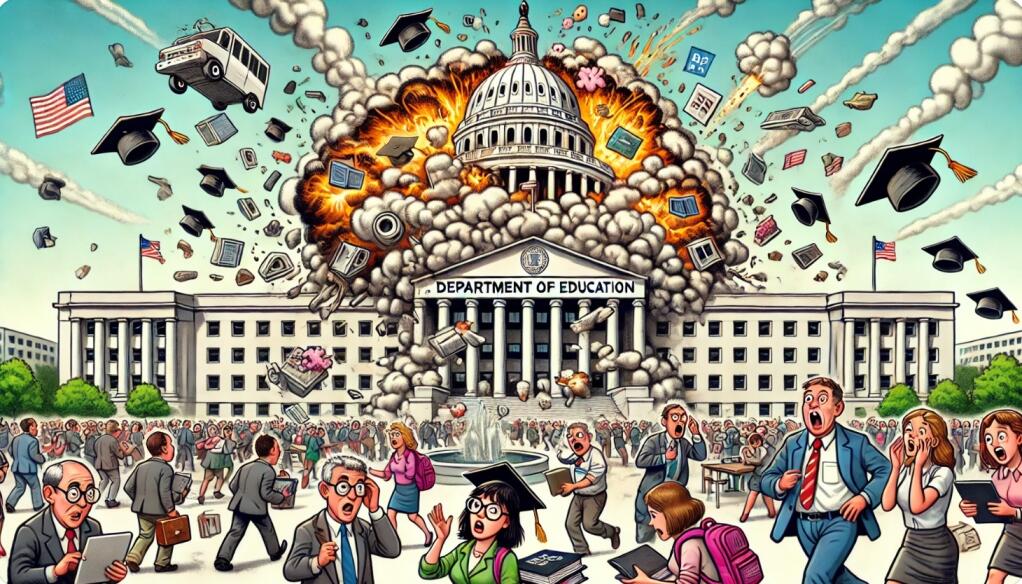
It appears that most Americans now agree with him. New polling shows that K-12 education has now reached a record low in the number of people who are even "somewhat satisfied" with the state of education in the U.S.
What is most troubling is that the near-total contempt for our school system does not make a bit of difference. Families and students have become largely irrelevant to an education cartel, a self-sustaining, self-perpetuating political alliance of unions and politicians.
According to Gallup, only 32 percent of American adults say they are "completely" or "somewhat" satisfied with the quality of K-12 education. That is the lowest figure in Gallup's 27 years of asking the question. Public satisfaction with the school system has dropped almost 20 points since just 2024.
For many of us, neither the drop in public support is surprising. The collapse comes at a time when universities are reporting that college students are entering higher education without basic math and other skills.
We have also seen the dismal decline in standards at elite universities like Harvard, where faculty have been compelled to teach high school-level math classes to students.
In May, faculty in the University of California system (which eliminated standardized testing to achieve greater equity in admissions) reported an alarming lack of math knowledge among new students.
Most recently, a University of California, San Diego, faculty report found a nearly 30-fold increase since 2020 in incoming students whose math skills fell below a high-school level.
For many of us, neither the drop in skills nor public support is surprising. For generations, the public school system has failed students in major cities. Despite massive budget increases, actual test scores continue to fall or remain at subpar levels.
In a prior column, I was particularly moved by the frustration of a mother in Baltimore who complained that her son was in the top half of his class despite failing all but three of his classes. Her story led to my changing my view of school vouchers. Despite my long support for public schools, I believe vouchers may be the only way to wrest control away from the education cartel by introducing real competition based on academic performance.
Faced with low proficiency scores, teachers' unions and school administrators have continued to lower proficiency requirements. They are simply pushing students out the door without basic skills, robbing these kids of any chance to break out of cycles of poverty and unemployment. When confronted with their poor performance, school board members have declared meritocracy to be a form of "white supremacy." Gifted and talented programs are being eliminated in the name of so-called "equity."
In any other field, such generational failure would be unthinkable. No business or enterprise could sustain itself. However, that is the point. There is little competition in this system. Blue states have largely blocked voucher systems while protecting teachers from performance-based standards.
Actual students have become irrelevant to budgets. In Chicago, there are schools that remain open despite 80 percent vacancy rates. One school, Frederick Douglass Academy High School has only 27 students, or 2 percent of its building's capacity. The school system spends $55,000 for each student at Frederick Douglass Academy.
Overall, 35 percent of Chicago schools are half full or less. But that did not stop the schools from spending a couple million on transcendental meditation sessions or giving teachers and students days off to join May Day protests (with city-subsidized buses).
According to a recent study, in 2025, Chicago Teachers Union spent a record $4.2 million on politics and lobbying but less than 18 percent on representing teachers. This included massive contributions used to elect former teacher and union organizer Mayor Brandon Johnson, a former organizer for the union. Johnson, in turn, has effectively turned over his office to the far-left union.
In economics, there are few scourges older and more damaging than the cartel, which uses its power over an area to create "higher prices, lower quality, and stifled innovation." There is a natural tendency for people to form such groups to stifle competition and feather their own nests. Adam Smith warned that "People of the same trade seldom meet together, even for merriment and diversion, but the conversation ends in a conspiracy against the public."
The Education Cartel is becoming one of the greatest and most insidious forms of such anti-competitive conduct. Teacher unions have used hundreds of millions of dollars in campaign contributions to acquire unchallenged power in blue states where they can dictate ever-increasing salaries, pensions, and budgets. One estimate found that, since 2015, the nation's two largest teachers unions - the National Education Association and the American Federation of Teachers - spent $669 million on federal campaigns and another $336 million on state and local campaigns.
Figures such as Randi Weingarten with the American Federation of Teachers effectively made their unions piggy banks for the Democratic Party and appear at far-left rallies to support Democratic causes. In return, Democratic leaders give this cartel most everything that the demand, including barring competition in the form of public vouchers or tying budgets to improving the education of actual students.
It is a closed circuit. Democratic leaders increase school budgets and salaries and the unions then send back hundreds of millions to fund Democratic campaigns.
If you want to understand the priorities of the unions, just watch one of National Education Association head Becky Pringle's unhinged speeches. Her declarations that the union will "win all of the things" clearly did not include educational improvements for students.
A recent study found that blue states with strong teachers' unions overwhelmingly have worse student literacy scores than red states. At least eight of the ten states with the worst literacy scores were liberal districts with politically powerful teachers' unions, according to the Progressive Policy Institute.
For example, in New York, more than half of third- to fifth-grade students failed their reading proficiency exams this year. And it isn't about money: The state spends almost $37,000 per student to fund this bloated, poor-performing bureaucracy. But the unions also pump political contributions into the campaigns of Democratic leaders in every election, and nothing changes.
In the meantime, historically poor states like Mississippi and Arkansas, with relatively new voucher and performance-based systems, are showing major improvements in scores among their students. Yet when these same policies are proposed in blue states, they are routinely blocked by the powerful teachers' unions.
Many liberals instinctively support unions and schools despite their costs. Recently, former New York Times journalist (and now Howard University Journalism Professor) Nikole Hannah-Jones drew criticism over an exchange with her daughter when she discussed her disappointment that her daughter would not stay at a majority-black, inner-city school despite its poor conditions and resources. Her daughter finally insisted on going to a private school out of concern for her own future as opposed to what Jones called supporting "her life's work."
Most families do not have the resources of Jones to make that choice. They are captives to a system that appears entirely detached and unresponsive to their same concerns as Jones's daughter.
The mark of a cartel is that it controls competition while inflating profits or costs. However, the education cartel makes you long for the old oil or even drug cartels. The difference is that the education cartel actually charges cartel prices while producing diminishing products. It is like OPEC watering down the gas at the pump while pumping up the price. Everyone is getting windfall profits, from the unions to the politicians. Only the kids are being shortchanged by America's school system.
Jonathan Turley is a law professor and the New York Times best-selling author of "Rage and the Republic: The Unfinished Story of the American Revolution."