





"Escape Valve" No More: San Francisco Moves To End School Choice Lottery
Authored by Lear Zhou via The Epoch Times,
The San Francisco Unified School District (SFUD) board passed a resolution on Oct. 13 to replace the current lottery-based admission policy with a neighborhood-based system for elementary schools.
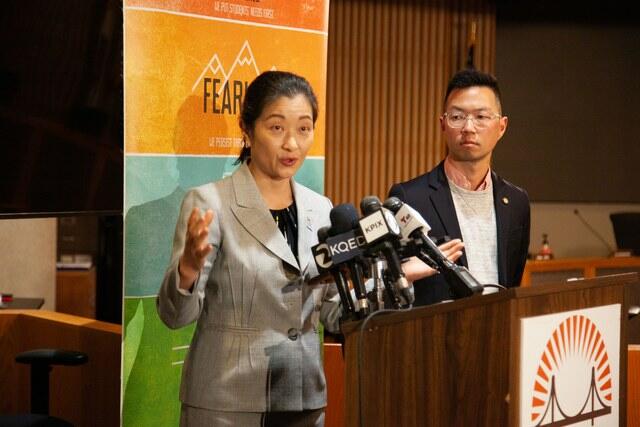
Board members voted 5-2 to develop a policy under which every student would be assigned to a neighborhood school based on their home address, with a seat guaranteed even if applying late. Programs such as language immersion, K-8 schools, and special education remain open to citywide students to apply.
There were two options up for the vote: Option B and Option C.
Option B would guarantee a seat at a child's neighborhood school for families who apply on time. Families could also apply to any other SFUSD school with available space, preserving broader citywide choice.
Option C would guarantee a neighborhood-school seat even for families who apply late. But families could apply elsewhere only to designated citywide programs, such as language immersion, K-8 schools, and special education programs.
SFUSD Superintendent Maria Su recommended option C, while the parents' survey favored option B.
About 65 percent of families responding to the survey did not believe the district would fulfill promises made in option C, according to Su.
"Option C will actually not let the district off the hook. It will require the district to be very intentional with how we resource our schools; it puts the responsibility squarely on the district to make sure that every single neighborhood school is worth choosing," Su told the board at the Oct. 13 meeting, promising that the schools have "safe, academically rigorous, and stable staffing by trusted adults."
The new policy would take effect in October 2027, following the board's approval on April 13, 2027, and would apply to the 2028-29 school year.
"Any district that goes through this type of turnover is at least going to take five to 10 years," deputy superintendent John Davis told the board.
"There's going to need to be a lot of difficult discussions to get a strong staff at schools that have historically been disinvested in, through their community, through redlining, through all the negatives that our society has imposed on folks."
Under the current student assignment system, families can list any number of schools on their application in order of preference, and are assigned to their highest-ranked choice if seats are available.
If more students request the limited number of available seats at a particular school, a series of preferences is weighted in a lottery-like selection process to determine who gets the spot.
"It is every parent's responsibility to think about what's best for their kid. It is our responsibility to think about what's best for all the kids," SFUSD commissioner Matt Alexander said.
"The choice system creates an escape valve for the families that have the most wherewithal, the most understanding, the most ability to navigate the system and escape from schools that are perceived to be bad."
SFUSD commissioner Alida Fisher, who voted no on Option C, criticized the change. "Saying it will take time and yet forcing families into a system where we know we can't within two years equitably resource those schools and put the programs into place." she said.
"Frankly, we are screwing over families in certain parts of the city. Neighborhood schools will by definition be segregated schools."
The current student assignment policy, which applied from 2011, was initially designed to "reverse the trend of racial isolation and the concentration of underserved students in the same school," but the city's public schools became more segregated than 30 years before, according to SFUSD.
SFUSD commissioner Supryia Ray, who also voted against option C, said the elephant in the room is that SFUSD is facing a 14,000 enrollment gap.
"There seems to be some idea here that if we force people to go to their neighborhood school, outside of maybe citywide schools, somehow this will fill up all these schools," Ray said.
If the board chose option B, Su said, "Families who do not trust their neighborhood schools will continue to leave those schools; those schools will stay under-enrolled. And that pattern impacts our southeast neighborhoods the hardest."
Su argued that by choosing option C, the district could keep the funds in the southeast neighborhood and consider merging schools in neighborhoods with few students.