





 Premium
Wall Street's Midterm Map Just Flipped - Here's What Goldman And JPMorgan See
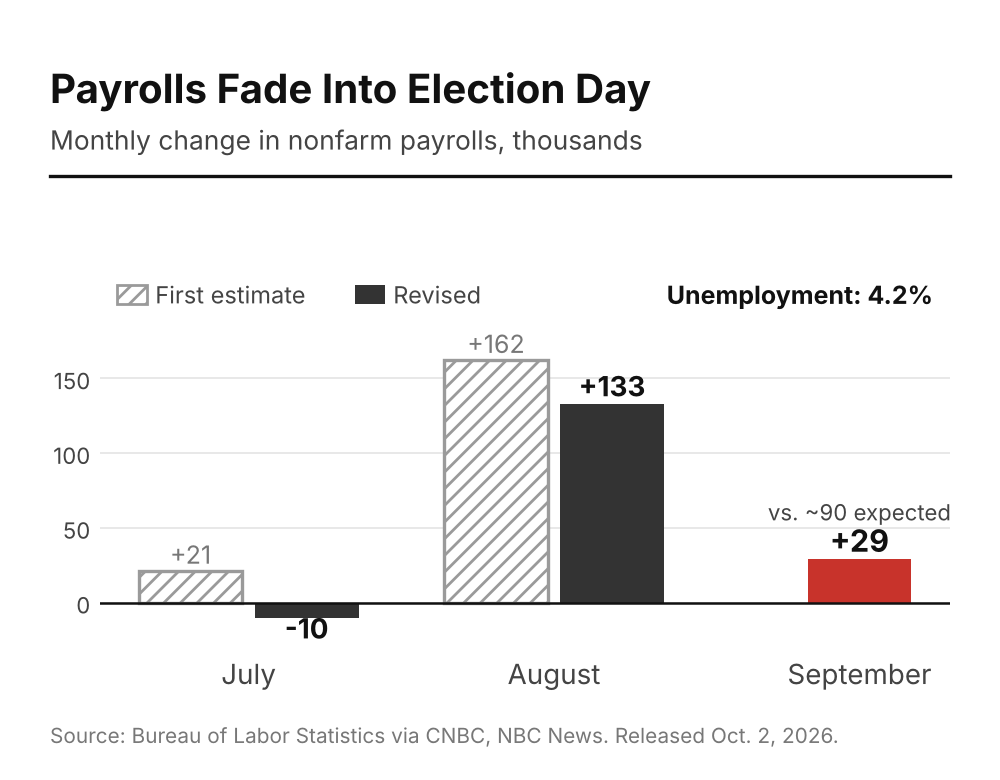
The last jobs report before Election Day landed this morning, and it did the White House no favors. The economy added just 29,000 jobs in September against expectations of 84,000, unemployment ticked up to 4.2%, and revisions erased 60,000 jobs from July and August, flipping July to a net loss. That lands on top of a Wall Street Journal poll putting President Trump's approval at 37%, the lowest for any president heading into a midterm in the Journal's surveys back to 1990, and a gasoline average of $4.41 after the most expensive September AAA has ever recorded. The Fed, now chaired by Kevin Warsh, raised rates in September for the first time since 2023.
Congress, meanwhile, has gone home. The Senate left town late Wednesday, and the next time senators vote, the country will know who won. Kalshi gives Democrats a 63% chance of taking the Senate and a 62% chance of sweeping both chambers, up 14 points on the Senate since mid-September.
The stakes, formal and otherwise, run as follows. The House: Republicans currently hold 218 seats to Democrats' 214. The Senate: where Democrats need a net gain of four against a 53 to 47 Republican majority. The power of the purse over an Iran war that has taken gasoline from under $3 in February to above $4.40. Confirmation power over every Trump nominee, Fed governors included. A December 11 government funding cliff. And the variable nobody on Wall Street can model: whether Pennsylvania Sen. John Fetterman, the Democrats' least reliable vote, is still a Democrat the morning a 51 to 49 majority depends on him.
JPMorgan's Market Intelligence desk and Goldman Sachs' Washington economists, Alec Phillips and Abhay Duggirala, both relaunched their election coverage this week & they largely agree with each other.
The scoreboard
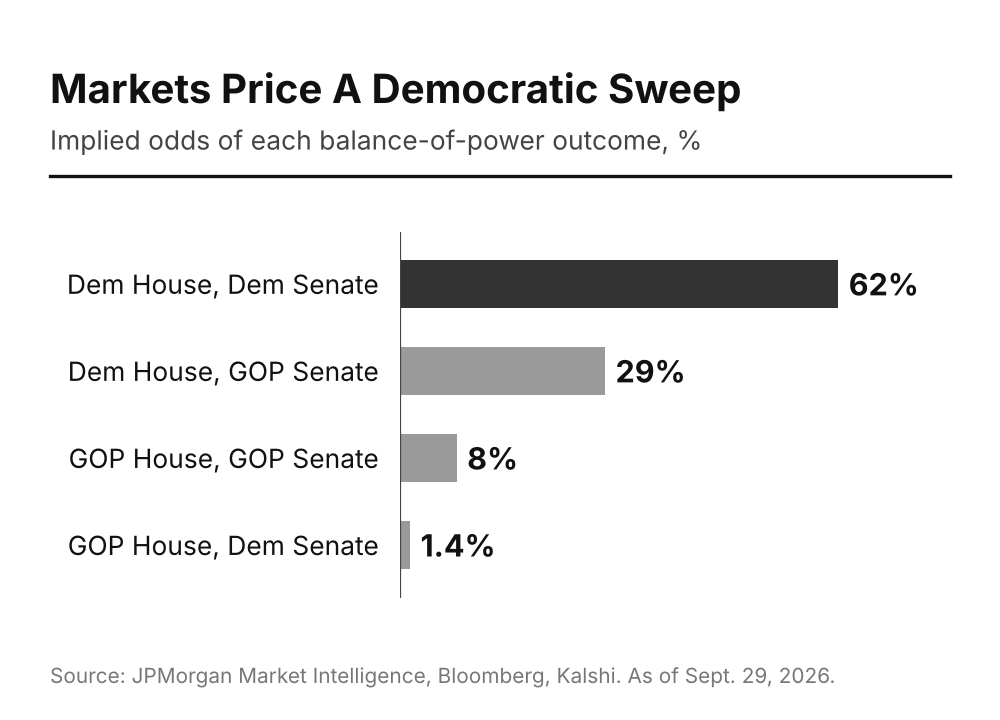
The House is barely contested. Prediction markets imply a better than 90% chance Democrats net the seats they need, and better than even odds they gain 24. Democrats lead the generic ballot by 8.5 points in Goldman's average, an 11 point swing from the 2.6 point margin House Republicans won by in 2024, and Republicans hold 26 seats Trump carried by less than that. As recently as July, JPMorgan's Joyce Chang still had Republicans favored to keep the Senate. JPMorgan's grid of betting-market odds sees a 62% chance Dems sweep both the House and Senate - up from around 52% two weeks earler, and a 29% chance of Dems grabbing the house and R's keeping the Senate.
Through time:
Why it moved: gasoline
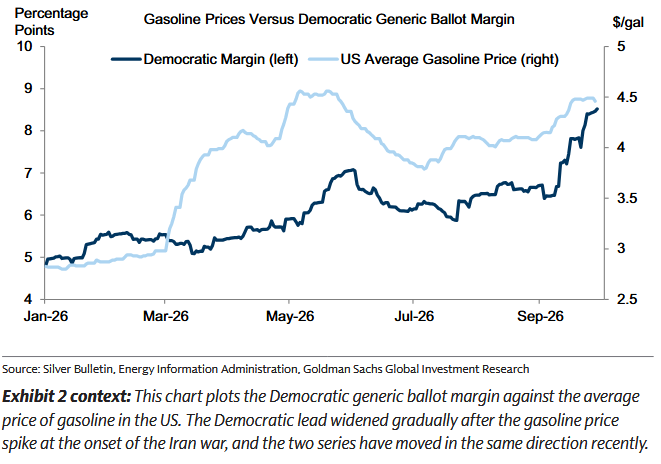
The most useful chart in Goldman's relaunch plots the Democratic generic ballot margin against the national gasoline price. The two have moved together for much of the year, with the Democratic lead widening after the pump spike that followed the start of the Iran war. September's average of $4.33 ran a full 50 cents above the prior September record, and the generic ballot hit a cycle high the same month.
JPMorgan, citing Pew, puts the economy at 29% as voters' top issue, with cost of living alone at 15%, well ahead of immigration at 7%. Goldman finds Trump's net approval deeply negative on exactly the two issues that rank highest, inflation and the economy, and JPMorgan flags an NPR survey in which 42% trust Democrats more on the economy versus 34% for Republicans. That is why today's payrolls miss matters more politically than economically. It is no recession, but it hands Democrats a fresh closing line, and with inflation still the Fed's priority, traders read it as cementing an October hold.
The Senate map
JPMorgan counts nine toss-ups: Alaska, Iowa, Kansas, Maine, Michigan, Minnesota, Nebraska, Ohio and Texas. It has dropped Georgia, New Hampshire and North Carolina from the battleground list, judging Democratic leads there too large.
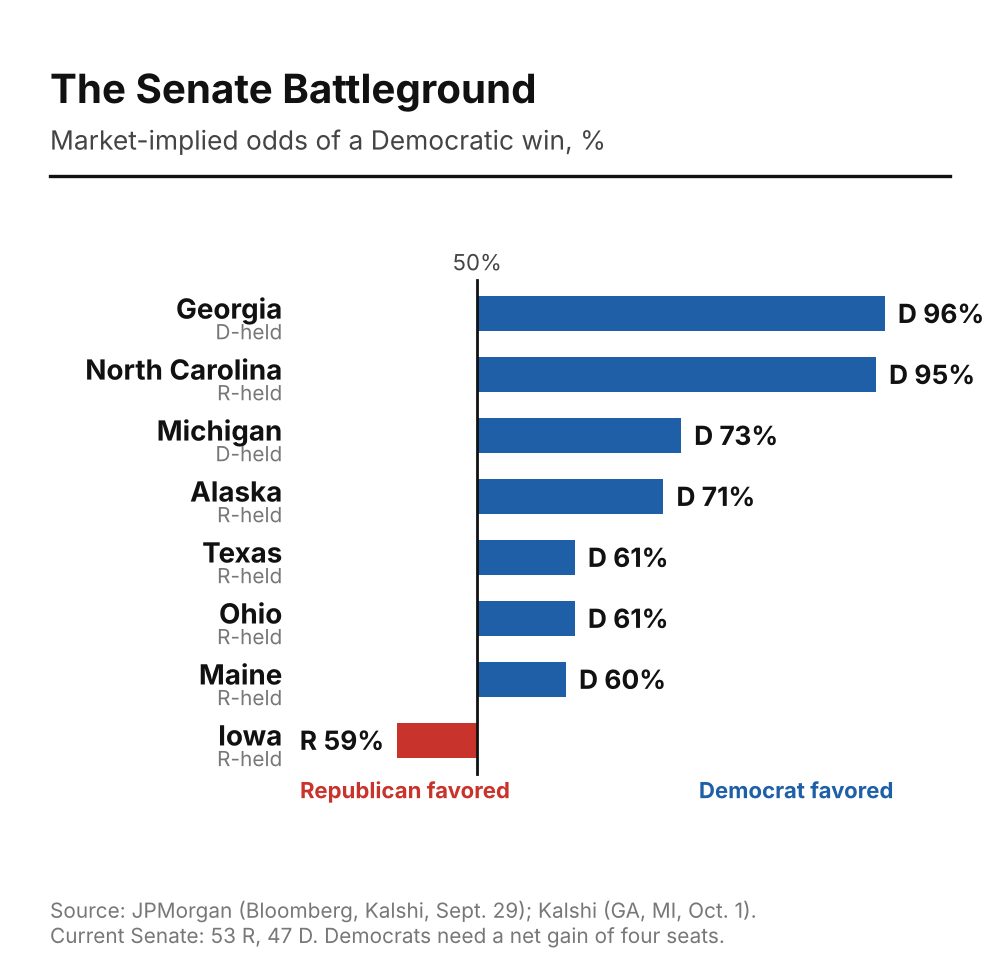
Texas is Goldman's marginal seat, the 51st, and Kalshi's most heavily traded race, with Democratic state Rep. James Talarico priced near 62% on Thursday against Attorney General Ken Paxton. Talarico leads 50 to 44 in Marist, though a Paxton internal poll has him up 48 to 45. On Wednesday the New York Times published audio of Paxton telling donors that Trump's Dallas midterm convention hurt GOP candidates: "Everybody's numbers dropped." His campaign dismissed the recording. Talarico has outraised him $72 million to $16.8 million, but a Thune-aligned super PAC has pledged $120 million, and Paxton just launched a $20 million affordability-themed ad buy, per Punchbowl News.
Maine is a polling coin flip. Sen. Susan Collins led former state Senate President Troy Jackson 49 to 46 in New York Times/Siena, while an AARP poll in the field the same week has Jackson up 50 to 47. In Iowa, one of the toss-ups where markets still favor the Republican, Rep. Ashley Hinson trails Democrat Josh Turek 50 to 42 in Marist after publicly breaking with Trump over the Iran war.
Ohio matters sooner than the rest. Former Sen. Sherrod Brown leads appointed Sen. Jon Husted by eight points in Marist, and because this is a special election, Husted's appointment ends December 15. If Brown wins and the result is certified, he could be seated in the middle of the lame duck, shrinking the GOP majority before the new Congress arrives in January.
Alaska is JPMorgan's favorite oddity: former Democratic Rep. Mary Peltola faces Sen. Dan S. Sullivan and a second Republican named Dan J. Sullivan, and the bank argues name confusion may split the GOP vote. One caveat: Alaska uses ranked choice, so voters can rank both Sullivans. The senator's bigger problem is that Peltola outpolled him 48% to 42.6% in the August primary.
Then there is Fetterman. JPMorgan says the real Democratic target may be more than four seats. Fetterman insists he is not a Republican, but asked at the Texas Tribune Festival last weekend whether he would be the 51st vote, he told CBS News, "Let's see what happens if I happen to be 51 - I don't know," and said of his plans: "Let's revisit after the midterm." Majority Leader John Thune has openly invited him over. A one-seat Democratic majority comes with an asterisk.
Follow the TV money
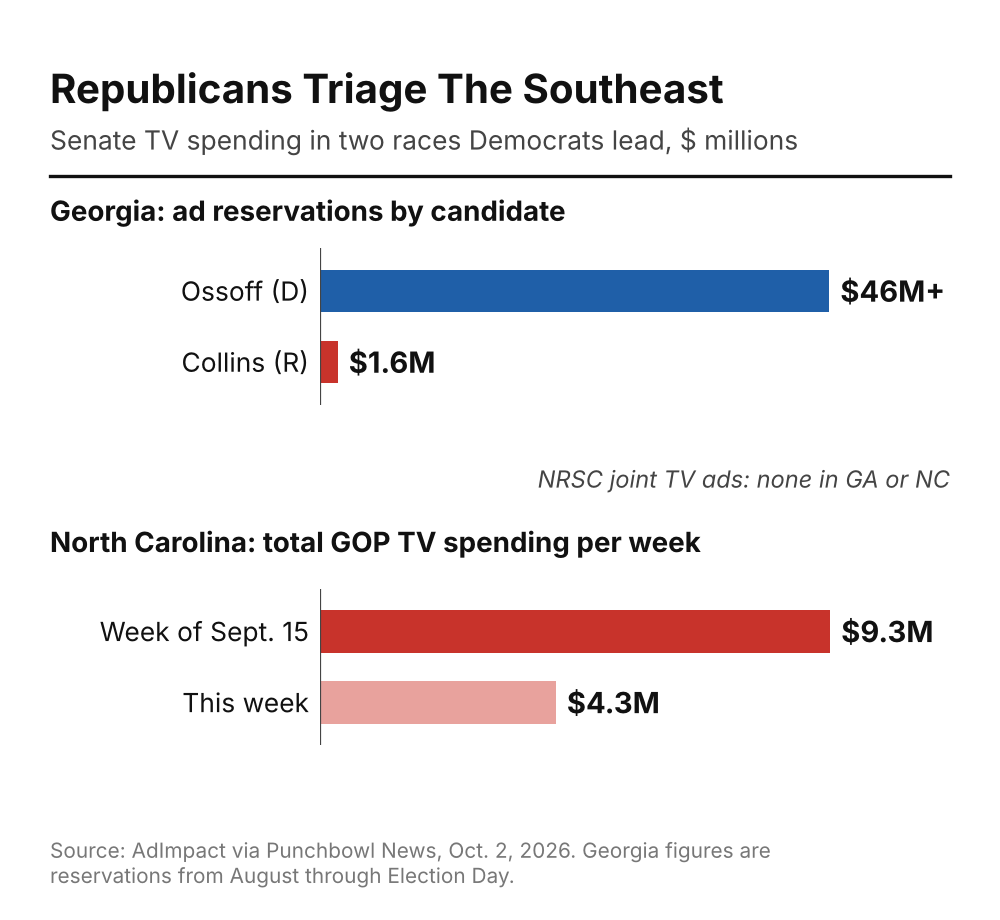
The sharpest reporting this week came from Punchbowl News, working from AdImpact data. The National Republican Senatorial Committee is running coordinated ads with GOP campaigns in Ohio, Maine, Alaska, Iowa, Michigan and New Hampshire, and none with its nominees in North Carolina or Georgia. Overall GOP spending in North Carolina fell from $9.3 million the week of September 15 to $4.3 million this week. In Georgia, Sen. Jon Ossoff has booked more than $46 million through Election Day to Rep. Mike Collins' $1.6 million. The Senate Leadership Fund still has $76 million reserved across the two states, and the NRSC has sent millions in direct mail, so neither race is abandoned. But the triage logic is plain: the map has moved into Texas, Iowa and Alaska.
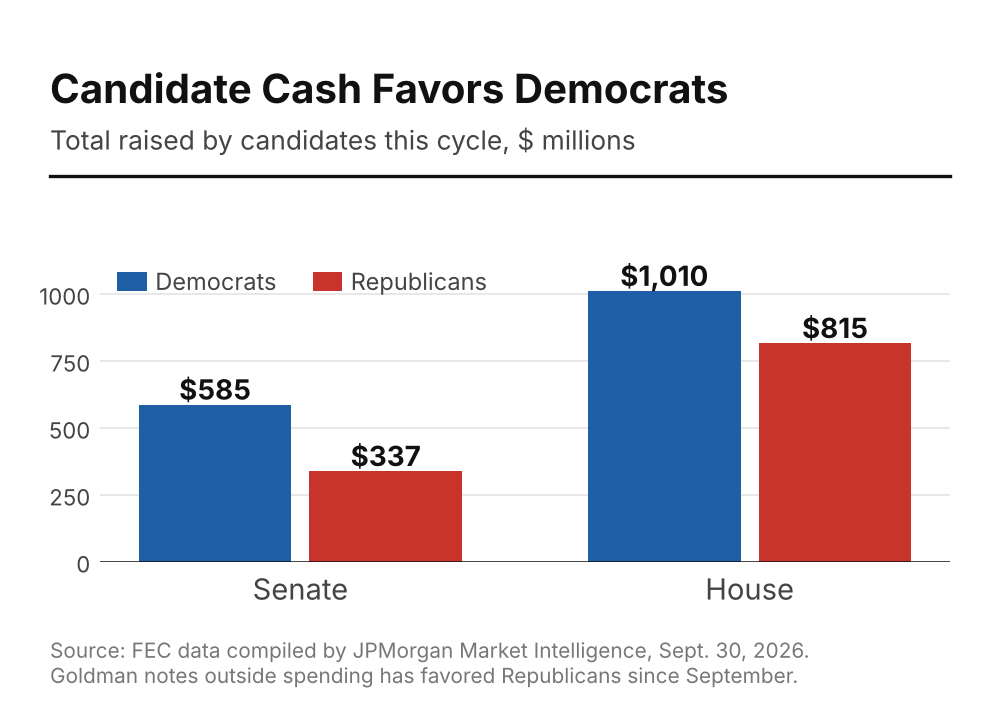
The broader money splits by type. Candidates favor Democrats: per FEC data compiled by JPMorgan, Democratic Senate candidates have raised $585.2 million to Republicans' $336.9 million. Outside money favors Republicans. Goldman finds the GOP outspending Democrats in most key Senate races, but only since September, so the polls may not yet reflect it. Two Supreme Court moves help party committees stretch their dollars: a June ruling, NRSC v. FEC, lifted caps on party spending coordinated with candidates, and a September emergency order in NRCC v. Brown reinstated FCC guidance giving those joint ads access to cheaper broadcast rates.
Leadership is on the line too. Thune was loudly booed in Dallas after months of Trump's fury over the SAVE America Act, and Punchbowl asks the obvious question: if the Senate falls, who pays? Minority Leader Chuck Schumer, battered by his base after a 2025 funding fight, is suddenly secure and says he will run for leader again.
The fight over the ballot
The administration lost the biggest round in mid-September, when the Supreme Court refused to lift an injunction blocking a Postal Service rule on mail ballots. That matters on the arithmetic: JPMorgan, citing MIT data, notes about 37% of Democrats voted by mail in 2024 versus 24% of Republicans. The Court did let the administration use DHS's SAVE database to check voter eligibility.
What it means for markets
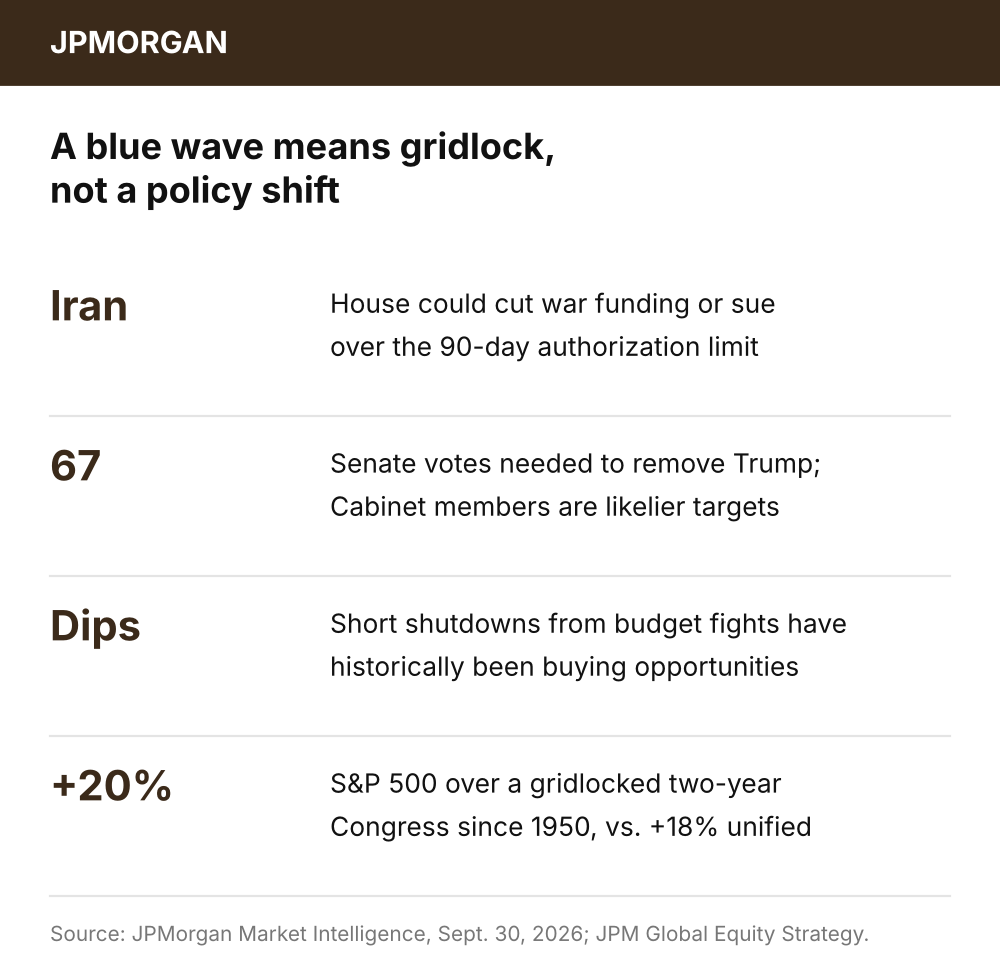
JPMorgan's answer is not much, and buy the dip. Democrats will not win the two-thirds majorities needed to override vetoes, so a wave produces gridlock like the final two years of Obama, Trump's first term and Biden. Since 1950, gridlock has coincided with S&P 500 gains of about 20% over a two-year Congress, versus 18% under single-party control.
JPMorgan lists what a Democratic Congress could actually do:
- Iran: block new war funding or sue under the War Powers Resolution's 60-day clock.
- Impeachment: likelier for Cabinet members than Trump, given the 67 Senate votes removal requires.
- Shutdowns: short budget standoffs, historically buy-the-dip events.
- Nominees: a Democratic Senate could force centrist picks.
A House squeezing Iran war funding is an oil story. The December 11 funding deadline lands in a lame duck already soured by Trump's "pocket rescission" of nearly $1 billion Congress had approved, which drew fire from Appropriations Chair Collins herself. And the Senate decides Fed confirmations. The Fed's inspector general this week found no criminal wrongdoing in the renovation Trump used to attack Jerome Powell. Powell's governor term runs to January 2028, so a Senate flip opens no seat by itself, but JPMorgan notes nobody knows whether he now steps down, or who would confirm his replacement if he does.
Gridlock is also an incomplete sector call. Punchbowl reports a bipartisan permitting bill, negotiated in part by Democratic Sens. Sheldon Whitehouse and Martin Heinrich, that would expand federal authority over interstate power lines and let states refer utilities to federal regulators over local transmission projects. Utilities that killed a similar deal in 2024 now have far less pull: the White House backs the bill, and Republicans have warmed to interstate transmission as a way to power data centers. Nothing needs a veto-proof majority to move a regulated utility's returns.
And Goldman?
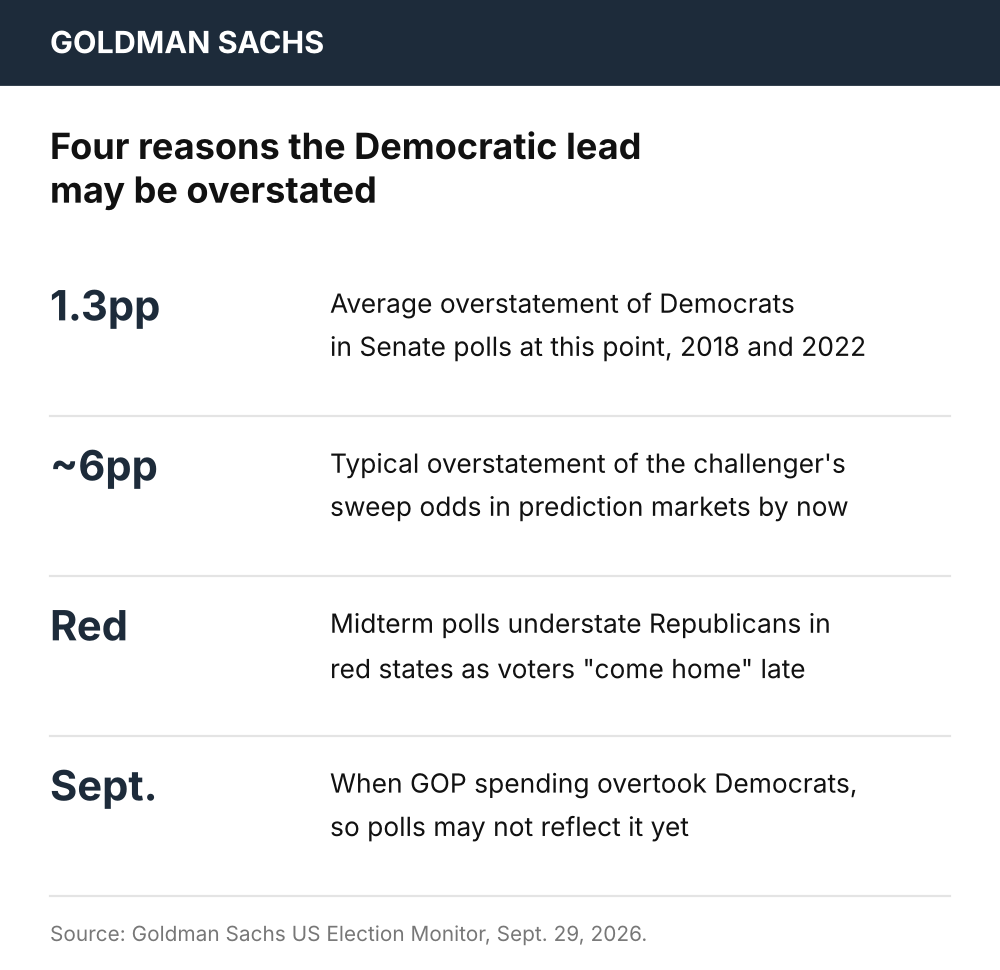
Having laid out the Democratic lead, Phillips and Duggirala did hedge a bit:
- At this point in 2018 and 2022, Senate polls overstated Democrats by 1.3 points on average.
- Challenger sweep odds have typically faded about six points between now and Election Eve.
- Midterm polls understate Republicans in red states, as voters "come home" late.
- GOP spending only overtook Democrats in September, so polls may lag it.
Perhaps most notably, most of the seats Democrats need sit in Republican-leaning states: Texas, Ohio, Iowa, Alaska. JPMorgan's table shows Democrats favored in four Republican-held toss-ups at odds of only 60% to 71%. None of this is a rule for marking down every poll, but shave a point or two off each and the 63% Senate number starts to look generous.
Bottom line
Thirty-two days out, the House looks settled and the Senate looks likely, not certain. JPMorgan's message is that the outcome barely matters for portfolios. Goldman's is that the outcome is less certain than the odds suggest. And Punchbowl's reporting shows the party committees, the people with the most money on the line, already voting with their TV budgets. Watch Texas early voting on October 19, the Fed later this month, and whether gas keeps sliding with crude back in the $90 range. Then watch Fetterman on November 4, and Ohio on December 15.