


Why Can't Farmers Butcher Their Own Animals? A New Bill Could Change That
Authored by Mollie Engelhart via The Epoch Times,
This past weekend, I was sitting at the Weston A. Price Foundation's Wise Traditions Conference when Rep. Thomas Massie (R-Ky.) took the stage. Before he could say a word, the audience rose to its feet in a standing ovation.
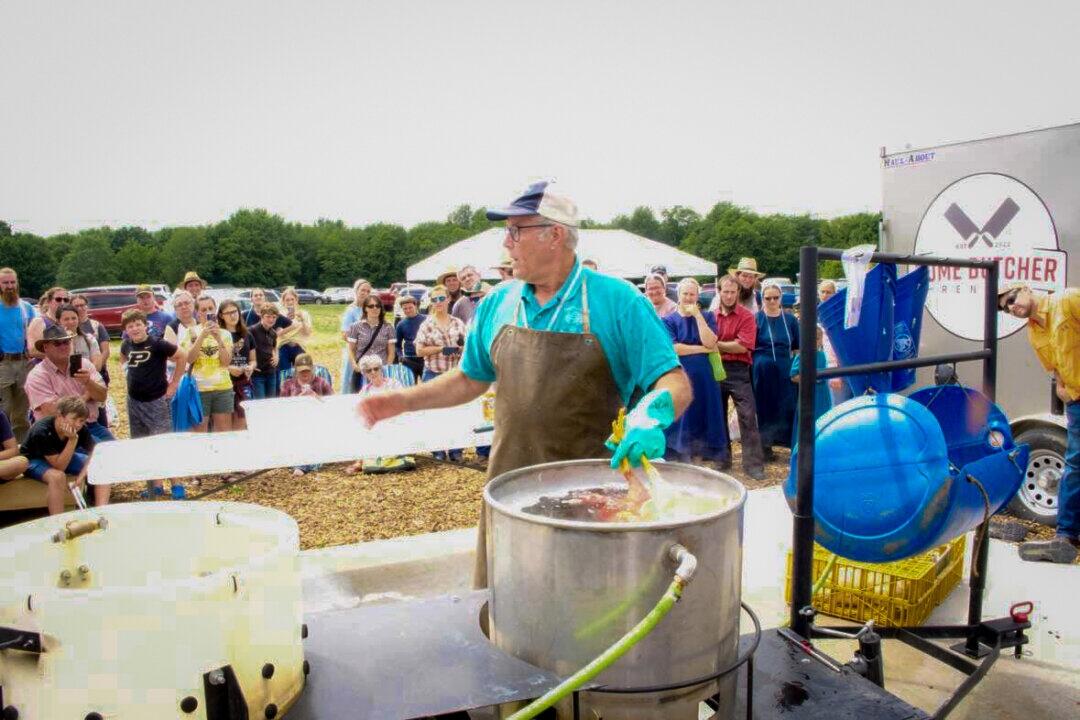
During his speech, he mentioned legislation he had introduced that would allow small American farmers to slaughter and process their own livestock and sell that meat directly to consumers without mandatory federal inspection.
I was stunned. Not because I disagreed with the legislation, but because I hadn't heard about it.
Just two months earlier, I had been with Massie at Joel Salatin's Polyface Farm when President Donald Trump posted on social media that he wanted to make it possible for farmers and ranchers to process their own meat.
I agreed wholeheartedly with the president's sentiment, and obviously Massie did too. But I remember having a conversation with the congressman that day about the reality of making such a change. The president could announce his intentions, but changing federal meat-inspection law would require an act of Congress, not simply an executive order.
I subsequently wrote an article about Massie's PRIME Act, legislation he has championed for years to expand opportunities for small-scale meat processing. With the president now publicly invested in the idea, I wondered whether we might finally have the political momentum to get meaningful meat-processing reform across the finish line.
Then life on the ranch continued. Animals needed feeding, fences needed repairing, customers needed serving, and thousands of dollars continued flowing out of our farming operation every time we took livestock to the butcher.
Meanwhile, Massie introduced the Red Meat Inspection Exemption Act, alongside Reps. Chellie Pingree (D-Maine) and Eric Burlison (R-Mo.).
Somehow, I missed it.
I raise cattle, pigs, sheep, and goats. I operate a farm store and restaurant, and I write about the obstacles facing American farmers almost daily. This particular issue is at the very center of my argument for food freedom. I believe farmers should have the right to raise animals, process those animals, and sell the meat directly to informed customers who choose to purchase it.
So when I heard Massie mention the bill, I was genuinely excited. After years of discussing this problem, there was finally new legislation specifically addressing on-farm slaughter and direct-to-consumer meat sales.
Why Can We Process Chickens but Not Cows?
Under existing federal law, qualifying poultry producers can slaughter and process thousands of chickens annually without continuous federal inspection. Some exemptions allow as many as 20,000 birds, depending on the operation and applicable state requirements.
Why chickens?
Anyone who has ever processed poultry knows that removing the intestines from a small bird without contaminating the carcass requires care. Chickens are well-known carriers of Salmonella and Campylobacter, two major causes of foodborne illness.
There is nothing inherently safer about a chicken than a cow.
Yet our regulatory system allows qualifying poultry producers to sell their products while generally prohibiting cattle, pig, sheep, and goat farmers from doing the same without inspected processing.
I am not suggesting we eliminate the poultry exemption. Quite the opposite. I am asking why we have not extended comparable opportunities to other livestock producers.
If we trust farmers to process thousands of chickens for their neighbors, why can't we trust them to process a handful of cattle?
The Forgotten Lamb and Goat Markets
One of the most significant consequences of this legislation could be its impact on American lamb and goat production.
In my area of Texas, the kill and disposal fee alone for a lamb is $130. That is before anyone cuts a chop, grinds the meat, or vacuum-seals a package.
Spread that $130 across 600 or 700 pounds of packaged beef, and it adds approximately 19 to 22 cents per pound. But spread it across the 30 or 40 pounds of meat you might get from a lamb or goat, and suddenly that same fee adds $3.25 to $4.33 per pound.
That is before additional processing charges, transportation, refrigeration, feed, labor, or the cost of raising the animal.
We have animals capable of turning grass and brush into valuable protein. We have farmers willing to raise them and consumers interested in buying locally produced meat. But the economics of getting those animals from pasture to plate can make the entire operation unprofitable.
Allowing farmers to process their own sheep and goats could open an entirely different economic opportunity for small livestock producers.
The Thousands of Dollars We Pay to Sell Our Own Meat
Every time I take animals to the processor, I write a check for thousands of dollars.
These are animals my husband and I have raised, fed, watered, and cared for, sometimes for years. We have invested in land, fencing, pasture management, equipment, veterinary care, and countless hours of labor. We have assumed the risks of drought, disease, predators, and fluctuating markets.
Then, when the animal is finally ready to become food, we must pay someone else a substantial percentage of what we expect to receive for that meat, before selling a single pound.
If my husband could process two steers a month for our farm store and restaurant, we could potentially avoid $3,000 in outside processing charges every month. That is $36,000 annually.
Of course, processing animals ourselves would still involve labor, equipment, sanitation, refrigeration, and other expenses. And the proposed legislation does not clearly establish whether meat processed under this exemption could be served in restaurants.
I am grateful to the representatives who introduced this legislation. It is a meaningful step toward restoring food freedom to American farmers. But I believe it is missing one important provision: restaurants.
If an on-farm restaurant or local restaurant wants to purchase meat directly from a farmer who raised and processed that animal, that should be allowed, provided the restaurant clearly discloses on its menu that the meat was farm-processed without government inspection.
Consumers would know exactly what they were purchasing and could make their own decisions. For a farm like ours, which operates both a farm store and a restaurant, that distinction is enormous. Without restaurant sales, we could not realize the full potential savings of processing our own livestock. With them, we could potentially keep $3,000 a month in our farming operation instead of paying it to outside processors. That is $36,000 annually that could go toward employees, infrastructure, and keeping our farm financially sustainable.
I am grateful to the legislators who are working to expand food freedom, and I respectfully urge them to include restaurants in this legislation. If food freedom is really about informed consent, why should that freedom disappear simply because someone chooses to eat their locally raised beef at a restaurant rather than cook it in their own kitchen?
I also believe we would recover more usable meat. My husband is meticulous about harvesting animals. He knows these animals, has cared for them, and understands the value of every pound. We have seen firsthand how much control a farmer loses when an animal leaves the property for processing.
The bill proposes exemptions involving 25 cattle, 60 pigs, 250 sheep, or 250 goats, although its eligibility rules are more complicated than simply counting animals. I would like to understand why Congress believes a farmer should be trusted to process 25 cattle but not 26.
A Me Neither Movement
Toward the end of Massie's speech, someone in the audience asked him what we could actually do. Could we vote our way out of the situation we find ourselves in?
His answer was no.
He talked about resistance. Be the person who refused to wear the mask on the airplane. Be the person who refused to participate in the COVID card system. Be the person who says no when everyone else is going along.
He also talked about refusing the photograph and body scanner at the airport. He mentioned that his wife never goes through the scanner.
From the audience, I yelled, "Me neither!"
Then other people started joining in. "Me neither! Me neither!"
Massie laughed and said from the stage that what we needed was a "Me Neither" movement, not a "Me Too" movement.
I have written before about refusing the body scanner and facial photograph at the airport. It is a small act of resistance, and sometimes an inconvenient one. But I believe freedom is something we practice, not simply something we vote for every few years.
And I think the same principle applies to food.
We can wait for Congress to pass the PRIME Act or the Red Meat Inspection Exemption Act. We can wait for the USDA to make exceptions, for politicians to recognize the struggles of small farmers, or for another election to deliver the changes we want.
But we also have to build the food systems we believe in. We have to buy from farmers, develop relationships with the people producing our food, and support the local infrastructure that allows communities to feed themselves.
I was standing with Massie at Polyface Farm two months ago, wondering how we could turn the president's words into legislation. This weekend, I learned that he had already taken that step.
Now Congress has an opportunity to act. But the rest of us have work to do, too.
Maybe food freedom needs a little more of the "Me Neither" movement.