





Jefferies Flags "Power Indicator" Of Soft iPhone 18 Demand In China
Edison Lee, Jefferies' head of China and Hong Kong technology and software research, is out with a note Monday morning warning that Apple's latest iPhone launch shows signs of softer demand, with weak Hong Kong resale prices suggesting consumers are pushing back against price hikes on premium models.
"Weak 18P/PM resale prices vs. 17P/PM remain our clearest sign of softer demand, despite a weekend rebound in lead times that could reflect tighter supply as DUO ramps," he wrote at the beginning of the note.
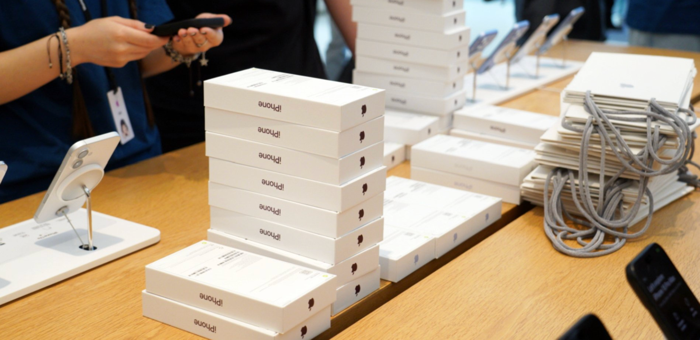
Lee points out that weak demand is most pronounced for the new premium iPhone 18 models:
Weak YoY resale pricing remains a powerful indicator of weaker 18P/PM demand vs. 17P/ PM. Our tracking shows 18P/PM resale-price trends in HK remain weak. iPhone 18P resale prices now imply discounts across almost all variants (Table 2). For 18PM, resale premiums fell sharply on day one and have since remained low or declined further (Charts 7-10). The only 18PM variant still commanding a meaningful premium is the 256GB model, at ~8% above Apple's official selling price. The 1TB/2TB versions are particularly weak, potentially reflecting two factors: 1) the US$400/500 price hikes may be too steep relative to consumers' perceived incremental value; and 2) Apple switched from TLC to lower-cost QLC NAND for the 1TB/2TB 18P/PM models, potentially making storage performance less attractive. As of Sep 27, 18PM resale premiums were meaningfully below those of 17PM at the same point last year, except for the 256GB model (Charts 1-2). Overall, resale pricing remains our clearest indication so far that 18P/PM demand is tracking weaker YoY.
Lead times rebounded over the weekend, an encouraging signal, but the improvement could be supply rather than demand driven. According to our tracking, lead times for both 18P/PM fell across almost all markets early last week before generally rebounding toward the weekend (Tables 1-2). As of Sep 27, 18PM lead times were longer YoY in HK/China and the US, shorter in the UK/Germany, and flat in Japan (Chart 5). For 18P, lead times were longer YoY in HK/ China, shorter in the US/Germany, and flat in the UK/Japan (Chart 6). The weekend rebound is encouraging and contrasts with the weaker resale-price signal. However, we would be cautious about interpreting it purely as a demand improvement, as supply could also be tightening as Apple ramps DUO production ahead of Oct 23 deliveries, with pre-orders starting Oct 16. We therefore view lead times as a more mixed signal than resale pricing at this stage.
DUO is generating lots of excitement, but China-specific eSIM restrictions could limit broader adoption. Given DUO's slim form factor, it is eSIM-only, similar to the 17 Air, which has not been selling well. Although eSIM was officially approved by China's MIIT last October, registration must be completed in person at operators' retail outlets. More importantly, China's DUO supports only two eSIM numbers, versus up to eight on eSIM-capable iPhones in HK. This matters because many Chinese consumers maintain multiple mobile numbers, partly because nationwide mobile-number portability was introduced only in 2019 and partly to separate work and personal communications. The restriction could be particularly inconvenient for frequent travelers. A DUO user already using two Chinese numbers who wants to add a third-party travel eSIM may need to suspend one domestic number first, requiring an in-person operator visit. The user would then need another in-person visit to reactivate the suspended number after returning to China.
We do not think this will necessarily deter high-end early adopters buying DUO as a status symbol, but the inconvenience could become a bigger obstacle to broader adoption, particularly if consumers expect Apple to introduce a second-generation, regular-sized foldable in 2027.
Bank of America analysts said last week that early iPhone sales data painted a mixed picture, with demand for the iPhone 18 Pro broadly in line with the comparable stage of the iPhone 17 launch cycle.
For John Ternus, new Apple CEO, this will be his first test of whether consumers will pay lofty premiums for incremental upgrades. Lee pointed to price hikes of $400 to $500 on the higher-end models as a potential deterrent. He also noted Apple's switch to cheaper QLC storage from TLC in the 1TB and 2TB Pro models could make storage performance less attractive.