





Nation's Largest Power Grid Declares Emergency As Hot Temps Collide With Maintenance Shutdowns
A short-lived heat blast across the Midwest and Mid-Atlantic overlaps with scheduled power plant shutdowns for seasonal maintenance on PJM Interconnection's grid, which serves 67 million people from the Mid-Atlantic to Chicago. PJM was forced to declare a low-level emergency for Tuesday and Wednesday as 60 gigawatts of capacity remained offline.
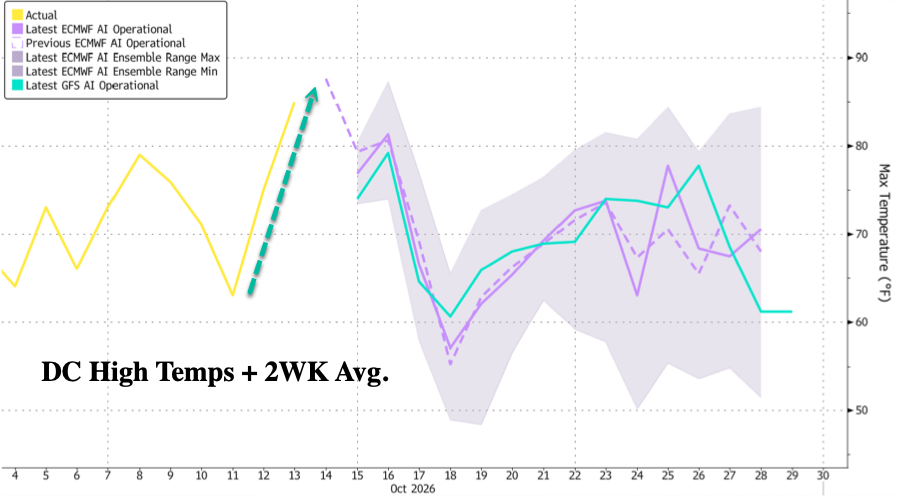
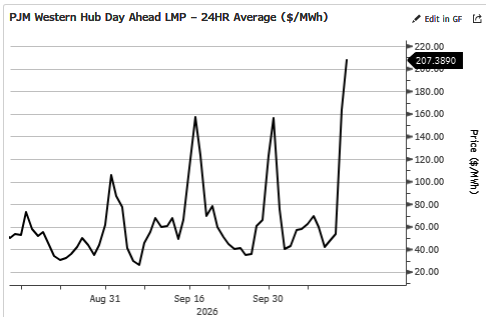
Bloomberg reports that the squeeze sent spot power prices skyrocketing across PJM's Western hub to $1,021 per megawatt-hour Tuesday afternoon, more than double the day-ahead average for that hour. Day-ahead prices for Wednesday jumped 28% to $295.83 per megawatt-hour, the highest daily average since mid-July.
"Unpredictable weather patterns are providing fewer days to perform important maintenance or construction on the generation and transmission equipment serving our footprint," PJM spokesman Jeffrey Shields told the outlet in an email.
Scheduled shutdowns of power plants or transmission equipment for inspections, repairs, and upgrades during seasonally low demand come as volatile weather tests the grid's reliability.
Delaying repairs can leave aging power plants more vulnerable to breakdowns during peak demand hours, especially when heating demand soars in the middle of winter.
"Unseasonably warm temperatures combined with generation outages and lower-than-normal wind generation are creating challenging grid conditions," Midcontinent Independent System Operator (MISO) spokeswoman McKenzie Barbknecht told the outlet. MISO's service area covers parts of 15 US states across the Midwest and South, plus Manitoba, Canada.
Beyond PJM's grid strain this week, lingering concerns about reliability persist and merely suggest the grid has less room for error this winter:
- A shrinking supply buffer: PJM's outlook for winter 2025–26 projected a reserve margin of 7,500 megawatts after expected outages, exports and other adjustments, down from 8,700 megawatts the previous winter. PJM warned that electricity demand was growing faster than new generation.
- Power plants failing during extreme cold blasts: During January 2026's Winter Storm Fern and its aftermath, generation outages averaged 18 to 19 gigawatts, exceeding PJM's seasonal expectations. Equipment failures were the leading cause.
- Fuel availability and scheduling: Tight NatGas supplies and limited scheduling complicated operations during that cold blast. PJM maintained reliability, but preserving adequate supplies required additional measures and substantial costs.
At the start of the week, the US Department of Energy issued an emergency order directing PJM to dispatch specified generating units and operate them as needed to maintain reliability through mid-month.