





Alibaba Unveils China's Most Powerful AI Chip In $53 Billion Gambit
Alibaba Group has unveiled the Zhenwu V900, an AI accelerator it calls China's most powerful, marking a major escalation in its effort to challenge Nvidia and build a vertically integrated artificial-intelligence stack stretching from chips and networking to models and hyperscale data centers.
Unveiled by CEO Eddie Wu at Alibaba's Apsara Conference, the new processor from the company's T-Head semiconductor division reportedly delivers three times the performance of the Zhenwu M890 introduced just four months ago. The V900 carries 216 GB of memory, 1,200 GB per second of inter-chip bandwidth and native support for low-precision formats including FP8 and FP4, allowing it to handle both model training and inference, according to Alibaba. (independent benchmarks have not yet been published).
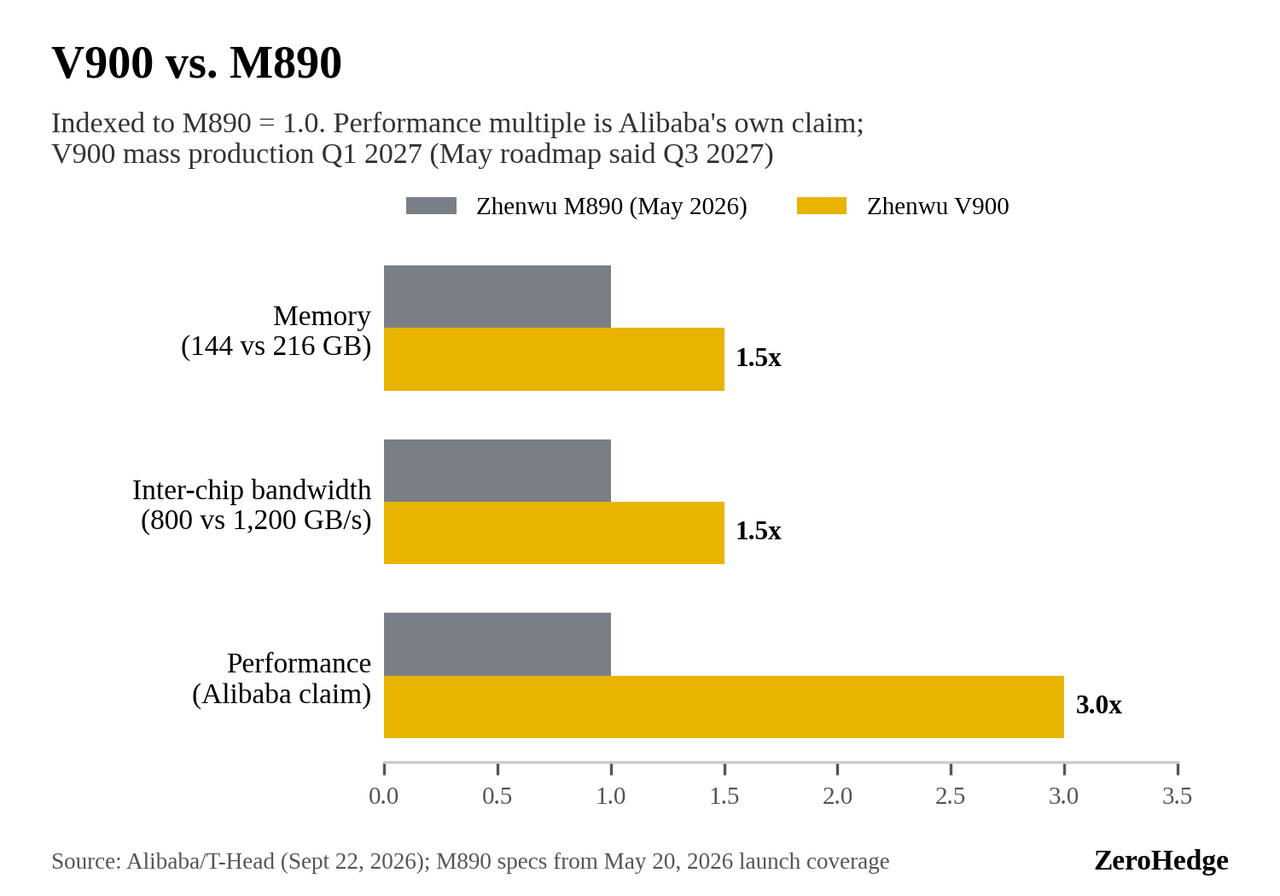
The V900 is scheduled to enter mass production and commercial release in the first quarter of 2027 - an acceleration from Alibaba's previous roadmap which had placed its next-generation accelerator in the latter part of next year.
The company says its upgraded supernode architecture can support clusters containing as many as 500,000 cards.
The hardware is part of a much larger full-stack strategy for Alibaba, which also says that their Qwen 4 AI model is currently in training, while its planned Qwen 4.5 and Qwen 5 generations are projected to scale to between 5 trillion and 10 trillion parameters. Its current flagship Qwen3.8-Max contains about 2.4 trillion parameters.
A 20-Gigawatt Bet
To support their goals, Alibaba obviously needs to undergo an enormous expansion of physical infrastructure.
Wu said Alibaba Cloud intends to operate more than 20 gigawatts of global data-center capacity by 2032. The company has not disclosed its current comparable base or a detailed site-by-site construction schedule, and the 20 GW figure measures electrical data-center capacity rather than a standardized quantity of AI compute.
Either way, these plans put Alibaba squarely inside the global hyperscaler infrastructure arms race - yet can they technically pull it off? As we recently noted, many of the world's announced AI projects face constraints that have little to do with model architecture: sufficient electricity, water, chips, networking gear, permitting, construction capacity and the ability to connect everything on schedule.
Alibaba's original commitment called for more than RMB 380 billion, or roughly $53 billion, of investment in AI and cloud infrastructure over three years - with chairman Joe Tsai reiterating that commitment in June. The company said in May that spending could ultimately exceed the original RMB 380 billion plan as AI demand accelerated. They then raised another HK$80 billion, approximately $10.2 billion, in an August share placement. According to Alibaba's SEC filing, roughly 60% of the net proceeds will expand global computing infrastructure, while approximately 40% will fund hyperscale AI data centers and upgrades to storage, databases and high-performance networking.
Citigroup analysts have reportedly estimated that infrastructure on the scale envisioned by Alibaba could eventually support roughly $160 billion in external cloud revenue.
Alibaba's own stated target is substantial enough: CEO Eddie Wu has said the company expects to surpass $100 billion in annual combined cloud and AI external revenue within five years.
The Spending Is Already Showing Up
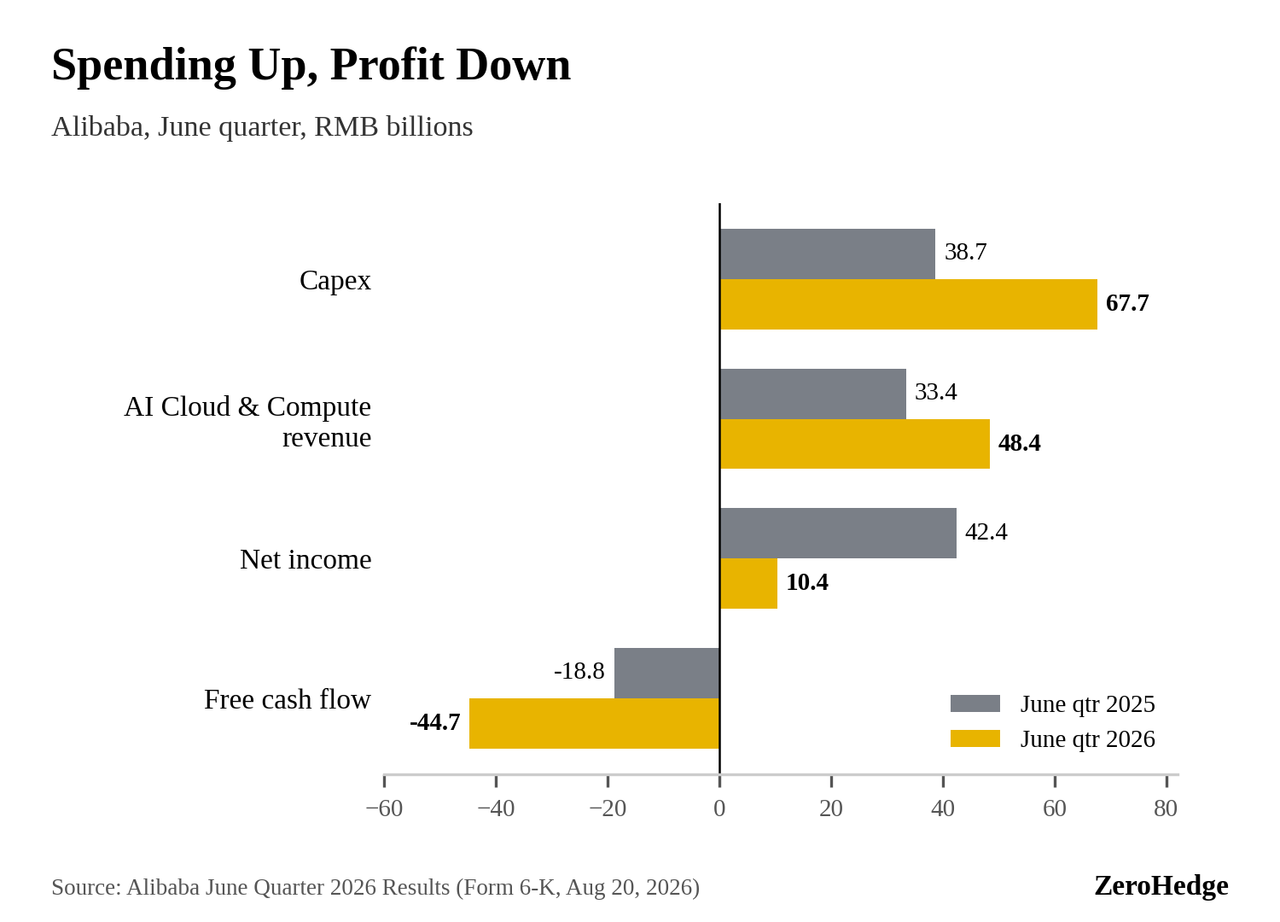
The near-term cost, for Alibaba anyway, is huge. They spent RMB67.7 billion, or almost $10 billion, on capital expenditures during the June quarter alone, a 75% increase from a year earlier. Free cash flow swung to an outflow of RMB44.7 billion, or about $6.6 billion, which Alibaba said was mainly attributable to increased cloud-infrastructure expenditure.
Headline net income fell 75% year over year to RMB10.4 billion, or about $1.5 billion. But attributing that entire decline to the AI buildout would be misleading. Alibaba said lower operating income was compounded by smaller gains from investment disposals and mark-to-market changes in its equity portfolio. On a non-GAAP basis, net income fell a less dramatic 38%, with technology investment cited as the primary drag.
The cloud business, however, is growing quickly. Alibaba's AI Cloud and Compute Services generated $7.14 billion in June-quarter revenue, up 45% year over year. AI-related product revenue alone reached $1.824 billion for the quarter, its twelfth consecutive quarter of triple-digit year-over-year growth.
On an annualized basis, Alibaba says AI-related product revenue had reached approximately $7.3 billion and is expected to approach $10 billion in the September quarter.
Management has also argued that the economics of the infrastructure spending are more attractive than the headline capex suggests. On its August earnings call, Alibaba said that at current gross margins it expects to recoup AI-related capex in roughly three years, potentially shortening the payback period to about 2.5 years as margins rise.
The silicon business has progressed rapidly as well. T-Head had shipped more than 560,000 Zhenwu chips by the spring, with more than 400 external customers across 20 industries. Alibaba now says the Zhenwu family is serving more than 650 customers spanning automobiles, finance, large language models, embodied intelligence, energy and manufacturing.
The Real Bottleneck
The greatest uncertainty may not be whether Alibaba can design competitive accelerators, but whether China can manufacture enough advanced silicon to support its ambitions.
As we recently noted, U.S. restrictions have limited Chinese access both to Nvidia's most advanced AI processors and to foreign foundry capacity used to manufacture cutting-edge Chinese designs. Those constraints have given Alibaba, Huawei and other domestic suppliers a powerful incentive to develop replacements.
Alibaba has not publicly identified the V900's foundry or manufacturing node, so it would be premature to state that SMIC will manufacture the processor. But the broader domestic supply chain remains constrained.
As we recently noted, SMIC has been able to manufacture 7-nanometer-class chips using sophisticated multi-patterning on deep-ultraviolet lithography systems, but China's advanced semiconductor industry still depends heavily on foreign equipment. Chinese chipmakers have accumulated years of ASML machinery while Huawei and domestic equipment suppliers race to build replacements, yet critical components including projection optics and high-power light sources remain difficult bottlenecks.
That means the challenge facing Alibaba extends well below the GPU architecture itself. Frontier-scale AI requires advanced logic, high-bandwidth memory, packaging, high-speed networking, optical components, cooling systems and enormous quantities of reliable electricity. Weakness anywhere in that chain can become the limiting factor.
And this is not merely a Chinese problem. As we recently noted, the global AI buildout is increasingly colliding with shortages of power, water, chips, fiber, construction resources and regulatory approvals. Twenty gigawatts on a presentation slide and 20 gigawatts of fully energized, chip-filled, revenue-producing data centers are two very different things.
GEOPOLITICS!
The timing of Alibaba's announcement is difficult to separate from the broader U.S.-China technology rivalry.
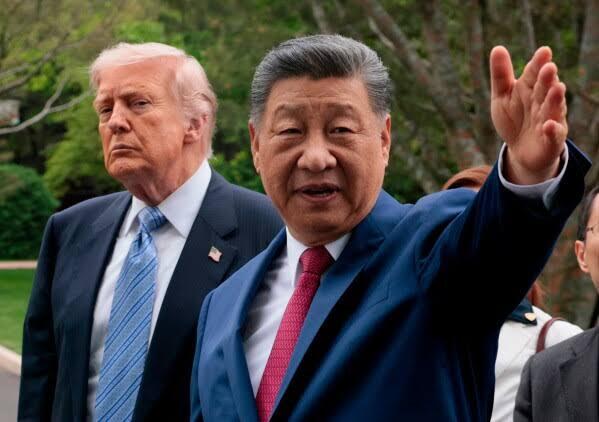
The V900 was unveiled just days before President Donald Trump is expected to host Chinese President Xi Jinping in Washington. As we recently noted, preparatory talks between Treasury Secretary Scott Bessent and Chinese Vice Premier He Lifeng produced plans for a new U.S.-China AI dialogue and a proposed notification mechanism for serious AI incidents. Advanced AI-chip export restrictions, however, were not part of that particular discussion.
Washington is attempting to limit China's access to the most advanced semiconductor technology while Chinese companies are simultaneously developing indigenous chips, deploying cheaper models and building increasingly large domestic compute systems.
Alibaba's V900 is therefore more than another accelerator launch. It is one component of an attempt to vertically integrate the entire AI stack: proprietary processors, networking silicon, storage controllers, massive clusters, Qwen foundation models, agent platforms and ultimately tens of gigawatts of cloud infrastructure.
China can manufacture enough advanced silicon, memory and networking equipment, secure enough power, and build enough data-center infrastructure to turn the roadmap into operating compute?