





Wall Street Converges On Almonty Investor Day As Pentagon's Tungsten Clock Ticks Down
We have highlighted "owning the bottlenecks" as one of our core themes (aside from nuclear, AI, etc.) as China tightens control over critical materials and the West races to secure conflict-free supplies ahead of a rearmament supercycle. Miners with operating assets and near-term delivery capacity are best positioned to capture the next leg of the cycle, as Western governments seek reliable and conflict-free supplies.
Mining equities have largely de-rated since their May peak, retracing the massive gains made in early 2025, when Beijing's restrictions on tungsten, germanium, gallium, and other defense-critical materials helped spark the rally. We view the pullback as a correction within a broader structural bull market, with the next phase likely to reward miners capable of converting ore into finished critical materials that meet the coming surge in demand from the defense industry.
We view tungsten, a defense-critical metal, as one of the most critical metals needed for the rearmament supercycle because of its high density, heat resistance, and performance in wear-resistant materials. This metal is commonly found in armor-piercing ammunition, missiles, interceptors, fighter jets, and bombers, and the list of defense applications is endless.
Ahead of Almonty Industries' Investor Day on Monday, Wall Street's mining and metals desks have been focused on the company's position as a leading Western-aligned supplier of conflict-free tungsten outside China. Analysts from Oppenheimer, D.A. Davidson, Cantor Fitzgerald, Stifel, Jefferies, and other firms are expected to attend.

With a supply agreement already locked with Pennsylvania-based Global Tungsten & Powders and its South Korean Sangdong mining operations ramping up, Almonty is positioned to benefit from rising demand for defense-grade tungsten as missile and bomb production expands.
Oppenheimer special situations analyst Ian Zaffino wrote on Thursday that, despite tungsten/APT prices moderating from $3,140 per MTU to $2,700 per MTU in the most recent week, "management believes upstream availability of concentrate remains tight, and should remain so, as US defense restrictions go into effect January 1, 2027."
Zaffino is referring to tighter U.S. defense procurement restrictions on tungsten scheduled to take effect on January 1, 2027. The requirements will soon extend beyond melting and manufacturing to include mining, refining, and separation, restricting covered tungsten products sourced through China, Russia, and other designated countries.
For example, processing Chinese- or Russian-origin tungsten in a third country would not, by itself, establish the needed compliance. This shift could strengthen Almonty's competitive position as its Sangdong operation ramps into Phase 2 production.
"Sangdong continues to ramp with its first shipment expected in late-October. This is slightly behind our initial assumptions and we therefore adjust our 3Q26E/4Q26E revenue/EBITDA," Zaffino said.
He noted that Almonty "has cash of ~$865M (net cash of ~$290M), which should fund projects including Sangdong Phase 2 and the oxide facility, as well as share buybacks."
Even though Zaffino lowered his 12-month price target from $25 to $19, reflecting lower peer multiples amid the selloff in mining stocks over the last several months, he said, "We believe shares are attractive (5.7x/4.2x FY27E/FY28E EBITDA), particularly as Sangdong ramps and supply remains tight."
Ahead of Investor Day on Monday, Zaffino outlined five key points:
The Sangdong processing plant received final certification (on 9/17) and is now able to produce concentrate. Grinding is at full throughput, and the company continues to optimize the flotation process. This should put Sangdong on pace to commence shipments in late October. We expect Sangdong Phase 1 to deliver ~640K tons of ore annually (or ~240K MTU of concentrate), worth ~$500M of revenues at current prices.
Outside of Sangdong, ALM has announced several projects to bring tungsten to market. In Rwanda, ALM will acquire, upgrade, and export existing ore, pre-concentrate, and tailings, with exports commencing in November. At Los Santos (Spain), ALM entered into a multi-year offtake agreement for the recycling of the existing tailings stockpile. The Montana/Gentung-Browns project represents longer-term optionality for US supply with "slow-and-steady" development.
While tungsten prices have moderated somewhat from their highs, supply fundamentals remain supportive. Tungsten/APT is $2,700/MTU, vs. ~$3,000/MTU from July through September. Western APT/oxide plants are operating at capacity under long-term contracts, which has limited their ability to absorb additional concentrate. As a result, concentrate prices have softened, even as availability of finished APT/oxide in the West remains constrained.
The company will host an investor day on 10/19. We anticipate an overview of the tungsten market and pricing, and operational updates across the portfolio. ALM should report 3Q26 results in mid-November. For 3Q, we now estimate revenue/EBITDA of C$49M/$25M (vs. C$75M/$47M previously), vs. the Street's C$94M/$66M. We forecast revenue/EBITDA increases to C$75M/$57M in 4Q26 (vs. C$110M/$99M previously), as Sangdong ramps towards full Phase 1.
Overall, ALM is set to start shipments from South Korea in late October and is well positioned with additional supply/offtake arrangements. Tungsten fundamentals remain healthy, and we anticipate supply will remain tight ahead of US defense procurement rules that cover recycled material as well. We believe catalysts remain, including the investor day, Sangdong's shipments, buybacks, and the ramp of Phase 2 at Sangdong.
Below are Zaffino's updated base-case assumptions, upside and downside scenarios, and upcoming catalysts:
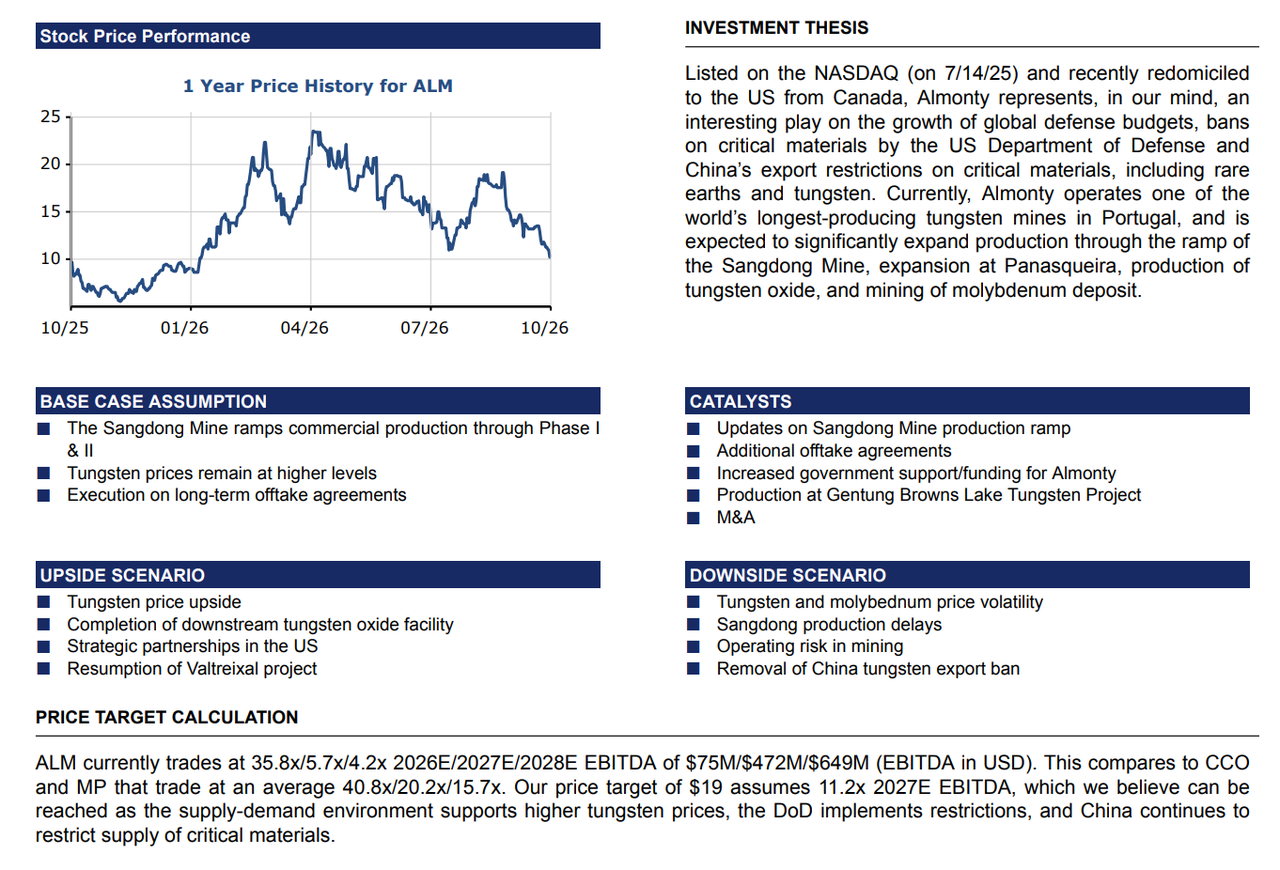
Separately, Bank of America metals and mining analyst Lawson Winder wrote on Thursday that Monday's Investor Day in New York could provide greater clarity on tungsten market conditions and execution of Sangdong's Phase 2 expansion:
- Tungsten market fundamentals: Management commentary on the sustainability of current tungsten pricing, long-term incentive pricing, the evolution of contract structures (including price floors), the durability of the current defense demand cycle, customer negotiations, and spot vs. contract exposure.
- Sangdong Phase 1 ramp-up: We see Q3'26 primarily as a re-risking quarter for ALM, as it ramps up Phase 1 of its new Sangdong tungsten mine in Korea. On 23-Sep-26, ALM announced first production for Sangdong Phase 1. On 29-Sep-28, CEO Lewis Black said the mill was operating 13 hours per day / 7 days per week, and it would move to 24-hour days / 7 days per week "over the coming days." We expect the market to watch for a clear statement that the mine is operating continuously, with a timeline to nameplate capacity (around 1,100 tonnes per day (tpd)).
- Sangdong Phase 2 expansion: Update on engineering work, capital requirements, underground development milestones, and key gating factors to increase processing capacity to roughly 1.2m tpa and double concentrate production.
- Sangdong molybdenum project: Progress of the 12,000-meter drilling program and the timeline for the announcement of updated reserves and resources.
- Gentung Browns Lake (Montana): Current permitting and development status at Browns Lake. Potential for funding support and/or an offtake agreement from the U.S. Department of War (DoW).
- Note that ALM is scheduled to host an investor day in New York on Monday, October 19. Many of these issues and more could also be addressed there, in advance of the Q3'26 results release.
On the timing of the Western rearmament cycle, Bernstein's European aerospace and defense analyst Adrien Rabier wrote late last month that the order boom is expected to begin in 2027 and extend through 2030 (read the report).