





Spot Is Four Times The Hurdle: What $50 Billion-A-Gigawatt Neocloud Rents Say About The AI Revenue Gap
In the AI trade, everyone wants to know what a gigawatt is worth.
Thanks to a chart buried on page 7 of Goldman's latest SpaceX note, we now have an answer, or rather three of them: $40-50 billion a year if you rent it out short-term, $20-30 billion if you rent it out long-term, and roughly $12 billion if you're a hyperscaler who simply needs to earn a decent return on it. The gap between those numbers is where the entire debate over AI revenues, and the $1+ trillion a year of capex now chasing them, really lives.
Here is the chart in question, from Goldman internet analyst Eric Sheridan's Q3 preview of SpaceX (SPCX) published on Monday (available to pro subs):
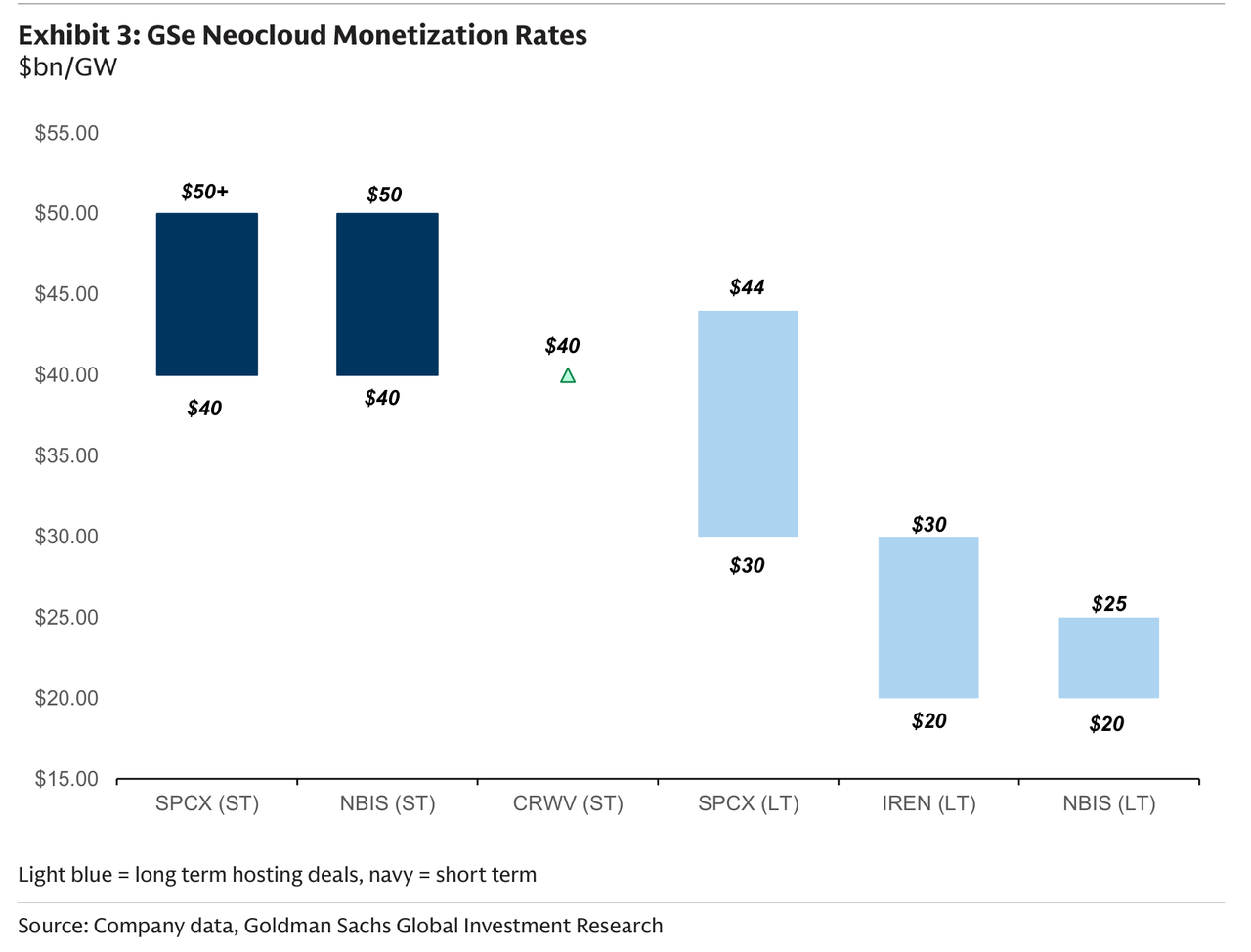
The navy bars are short-term capacity deals, the light blue ones are long-term hosting contracts. And the message is unambiguous: right now, compute is so scarce that whoever owns a powered, GPU-filled data hall can name their price... as long as the buyer only has to commit for a few months.
Regular readers know we have been warning since last October that the AI buildout runs on debt, and more recently that it runs on revenue numbers nobody can quite pin down. Below we walk through what the neocloud rate card tells us about the economics of AI compute, why it can't be extrapolated to the rest of the buildout, and where the tension between neocloud revenue, hyperscaler revenue and actual end-user revenue lies.
The Rate Card: Spot $50, Term $20
Start with what Goldman actually found. SpaceX, which now houses xAI's Colossus compute, announced two more hosting deals in the past quarter (one on its Q2 call, one at Goldman's own Communacopia conference in September), and told investors they are "monetized at the high end of the ~$30-50bn/GW range" it has historically discussed. And SpaceX is not alone:
Nebius (NBIS...) disclosed in August that short-term capacity deals in Q3 are being priced at ~$40-50bn/GW while CoreWeave (CRWV...) disclosed similar ~$40bn/GW pricing for its recent short-term capacity deals... Longer-term capacity deals across the industry continue to vary by company but pointing to ~$20bn/GW as a sustainable pricing floor at current rates. IREN (IREN...) disclosed in August that recent 3-year contracts are being priced at >$20bn/GW with active discussions at ~$25bn/GW, while NBIS disclosed longer-term deals being priced at similar ~$20-25bn/GW rates.
Deutsche Bank's Edison Yu goes even further. In his "Got compute?" note (also available to pro subs), Yu backs out the GPU-hour pricing of each SpaceX deal and gets $50-51 million per MW for Google and Reflection AI, and $60-61 million per MW for the two undisclosed customers, i.e., as much as $61 billion per gigawatt, renting out GB300s at nearly $14 an hour:
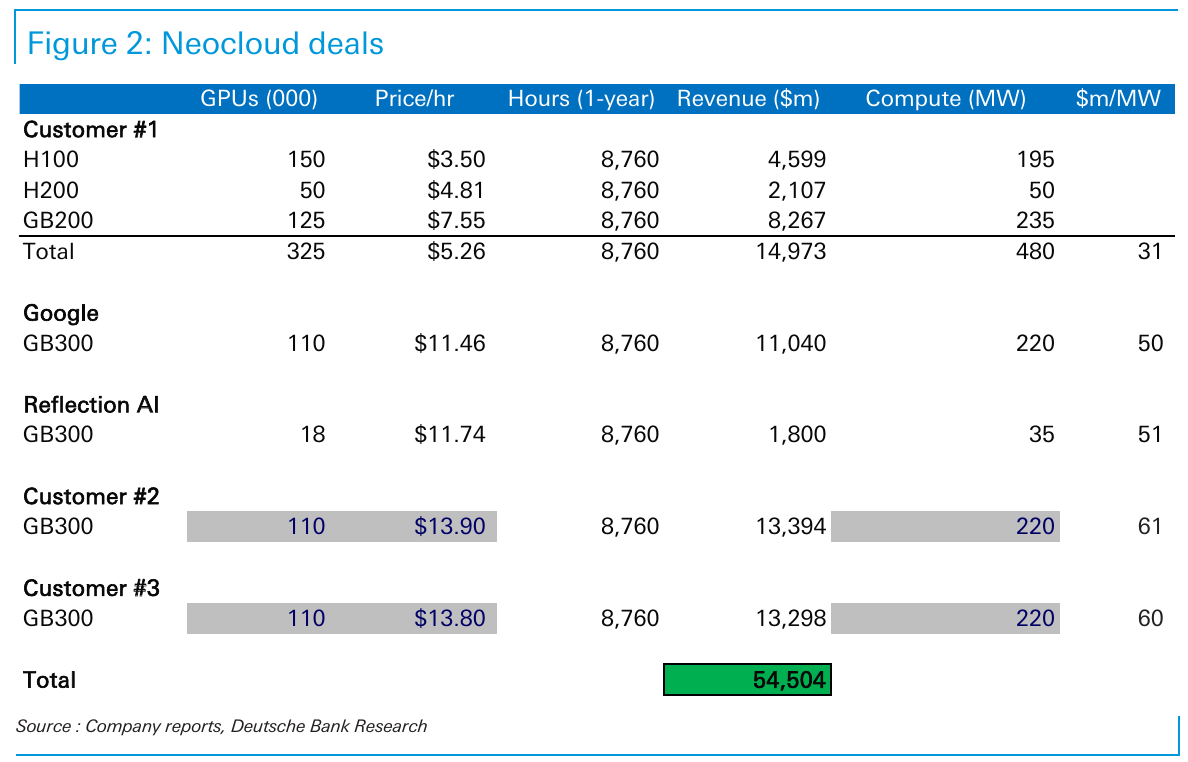
Put differently, the term structure of AI compute is steeply inverted: buyers pay roughly double for the privilege of not committing. That is what a market looks like when demand is real but nobody (including the buyers) is willing to bet on it lasting. Physical commodity traders will recognize the shape: it's backwardation, and it usually means the shortage is priced as temporary.
It also explains why the neocloud model is so attractive to its owners. Goldman's hyperscaler work puts all-in capex at roughly $42 billion per GW (more on that below). At $40-50 billion a year of revenue, a neocloud recoups the entire build in about one year of rent; at the $20 billion long-term floor, it takes two. Which is why the next detail matters so much:
One caveat to highlight is the duration risk of these hosting deals - with most of these deals being 90-day cancellable on both sides, there is some risk that our assumption for revenues to be recognized at current rates through contract expiry (2029 in most cases) is overly-bullish.
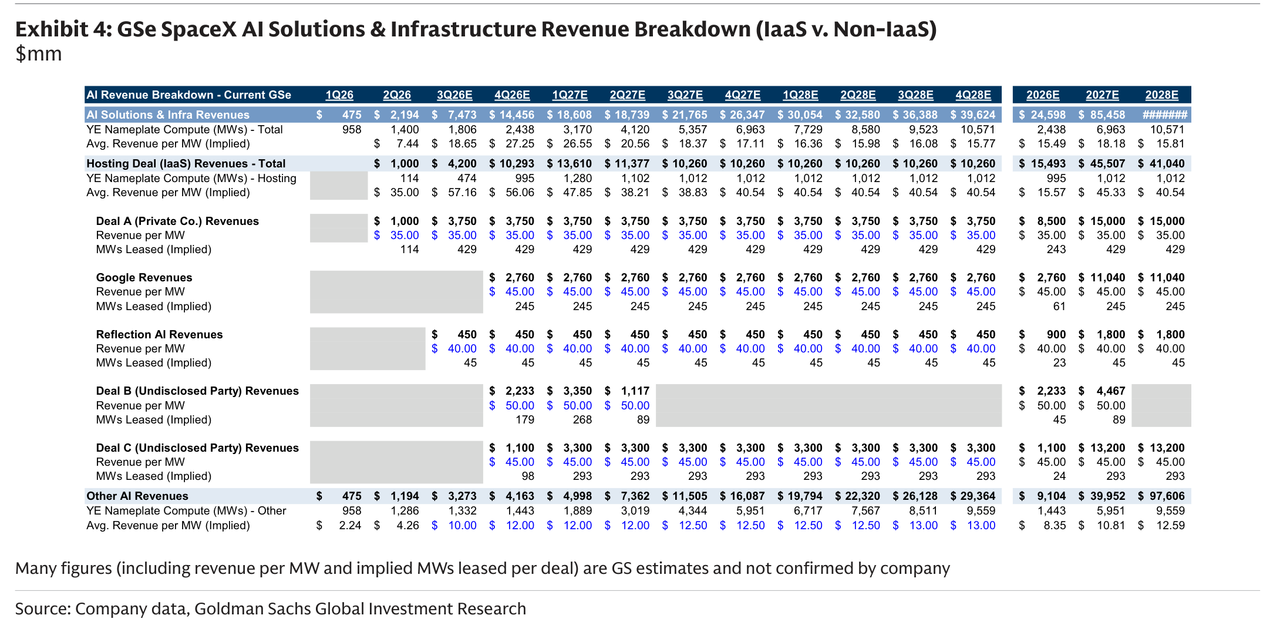
Translation: the $50 billion-a-gigawatt revenue stream that SpaceX is trying to borrow $40 billion against is, contractually, a quarterly lease. We made the same point when SpaceX went looking for a record $40 billion in chip-collateralized SPV debt last week; Goldman has now put a number on it. In its model, hosting/IaaS revenue goes from $1 billion in 2Q26 to more than $10 billion a quarter by 4Q26, and $45.5 billion in 2027 on just ~1GW of capacity, at an implied $35-57 billion per GW:
Here Is The Problem: Spot Is Four Times The Hurdle
Now compare that rate card to what the rest of the AI economy needs to earn.
Last month Goldman's tech analysts tried to size the AI economy needed to justify hyperscaler capex, and concluded that the six big US hyperscalers (Alphabet, Amazon, Microsoft, Meta, Oracle and SpaceX) need roughly $1.42 trillion of cumulative AI revenue in 2028-30, or about $11.6 billion per GW per year, to earn a 15% ROIC on their 2026-27 AI compute spend. Here is the sensitivity grid (from "Sizing the AI Economy Needed to Justify ROIC on Hyperscaler AI Capex", available to pro subs):
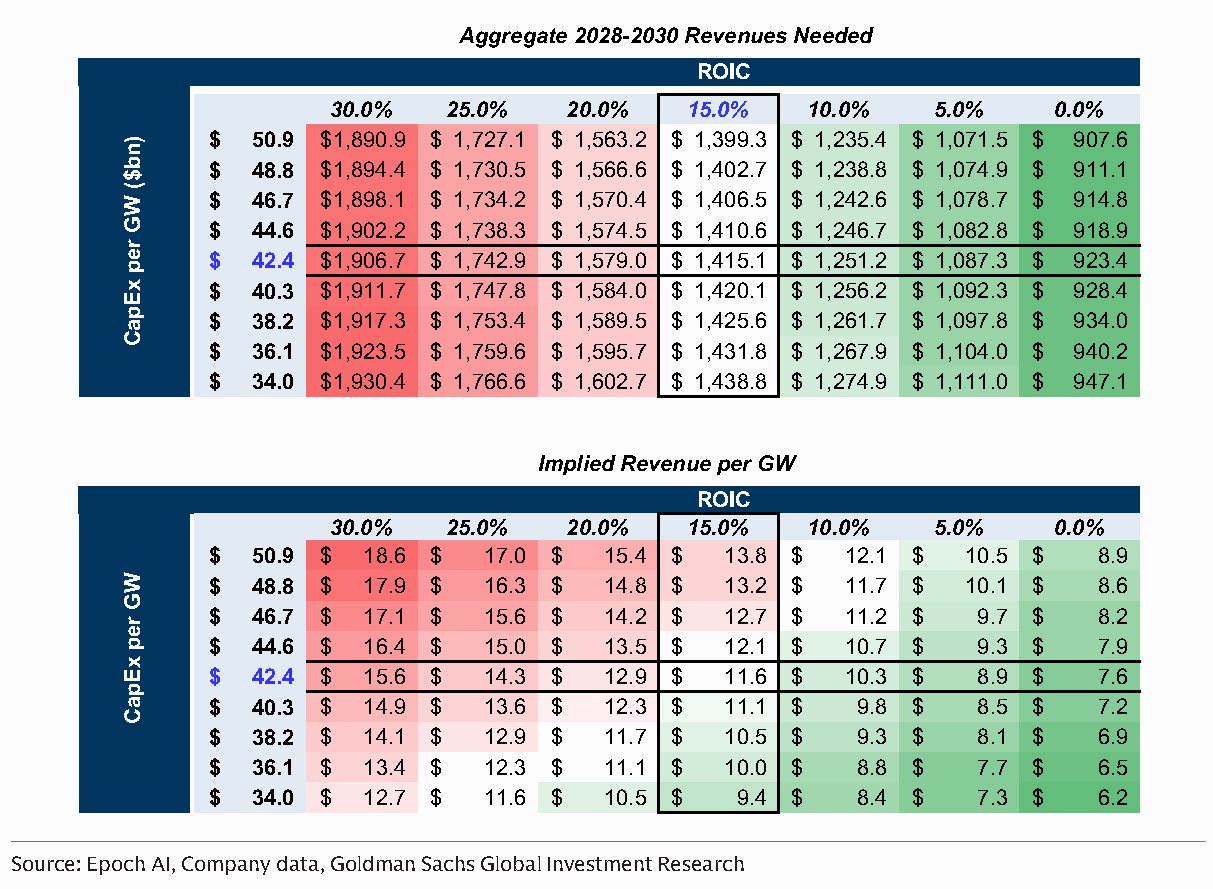
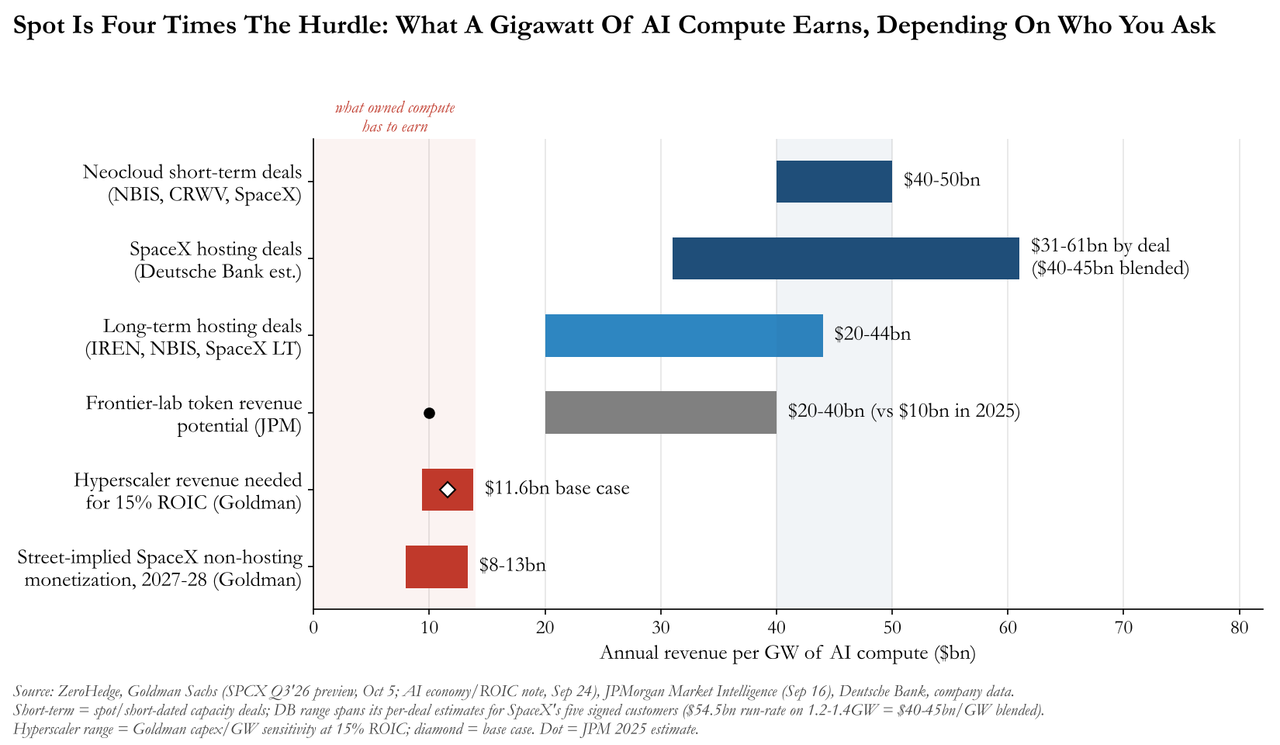
Even at a 30% ROIC and the most expensive capex assumption, the number never gets above $18.6 billion per GW. Short-term neocloud rents are 2-4x that. Our chart below puts every estimate we could find on one axis:
Two things jump out.
First, hyperscalers are paying neoclouds 4x what their own compute has to earn. Goldman models Google's SpaceX deal at $45 billion per GW (Deutsche says $50 billion). That same Google, per Goldman's ROIC framework, needs just ~$12 billion a GW from its own data centers. Nobody rationally pays a 4x premium for a commodity unless they can't get it any other way, so this is not a sign of healthy demand so much as a sign of power and shell scarcity: Google is renting because it can't build fast enough. Remember that the next time a hyperscaler raises its capex guide (undoubtedly much higher). The moment self-built capacity catches up, the premium on rented capacity goes away, and so does a big chunk of neocloud revenue, which incidentally is a point we made two weeks ago.
The more data centers are lit, the faster this bubble pops
— zerohedge (@zerohedge) September 25, 2026
Second, even the bulls' token economics can't pay spot rents. JPMorgan's Gokul Hariharan, in a framework for the next leg of AI infrastructure after what the bank's International Market Intelligence desk called a "biblical de-rating" (available to pro subs), was about as constructive as it gets:
Frontier-model vendors generate 60–80% inference gross margins and could earn $20–40bn of annual revenue per GW from AI tokens (vs $10bn in 2025).
Do the napkin math. If compute is 20-40% of a lab's token revenue (i.e., a 60-80% gross margin), then a lab paying $45 billion a year to rent a gigawatt would need to sell roughly $110-225 billion of tokens off it, or three to eleven times JPM's own optimistic range. In other words, nobody is renting spot capacity at $45 billion a gigawatt to serve paying customers at a profit. They're renting it to train the next model, funded by the next round of equity or debt.... well, mostly debt.
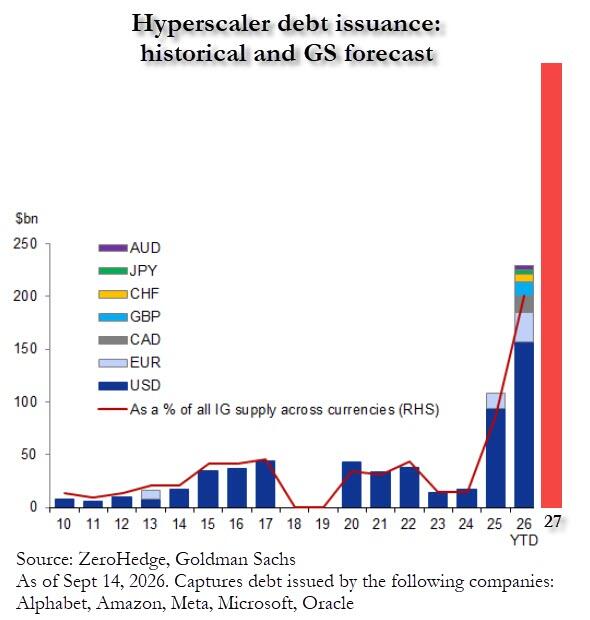
Which is exactly the point Rothschild Redburn's Alexander Haissl made when he slapped Sell ratings on CoreWeave and Nebius last month: compute pricing is rising, but who pays matters, and the top-paying customers are mostly VC-funded startups and big tech companies using compute for training rather than inference. In his words, "training demand can persist as long as external capital remains available." Which, yes, is another point we made two weeks ago.
How many of those customers are funded by VCs who are also investors in Anthropic
— zerohedge (@zerohedge) September 23, 2026
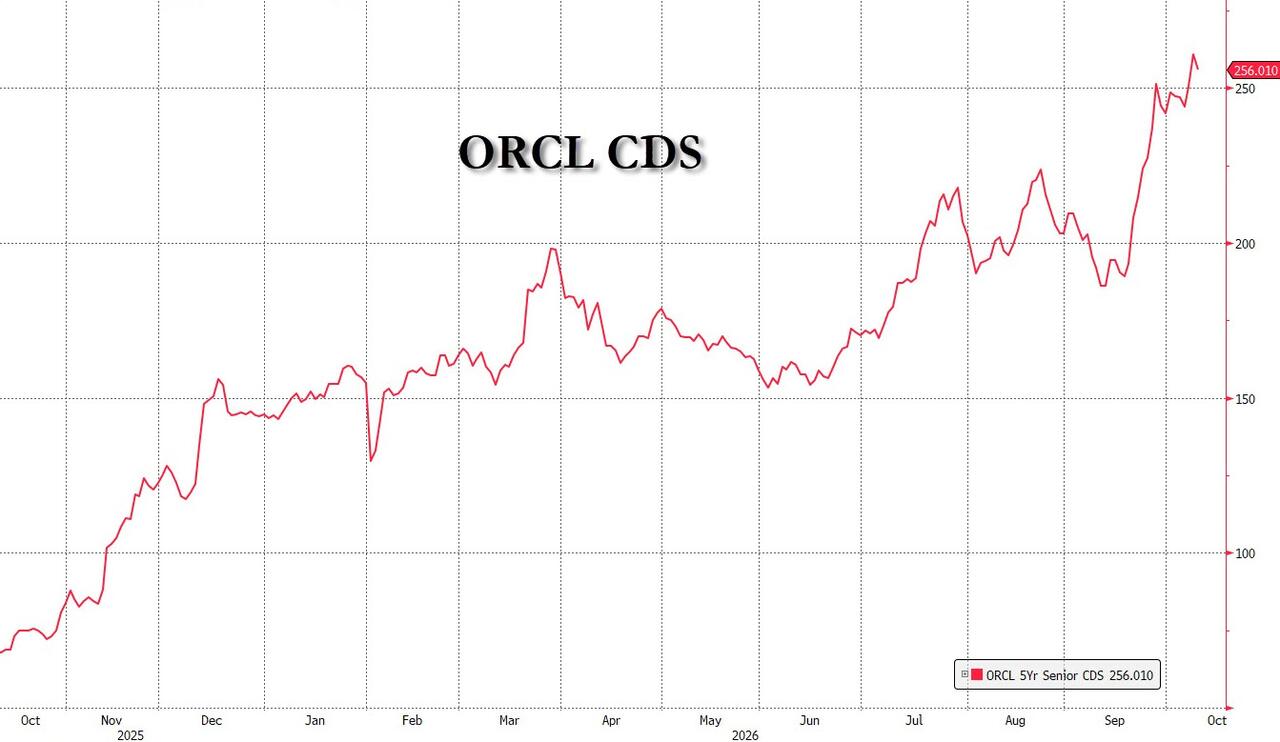
Goldman's TMT desk is now flagging Oracle and Broadcom credit spreads as the key indicator of concern over debt-funded AI capex, with Oracle 5Y CDS closing at a record 261bp on Thursday.
Only Compute You Rent Out Earns Neocloud Rates
The cleanest illustration of the gap is inside Goldman's own SpaceX model. The ~1GW rented to third parties earns $40.5 billion per GW. Everything SpaceX keeps for itself ("Other AI revenues": Grok, X, enterprise, the Cursor acquisition) is modeled at $12-13 billion per GW, almost exactly the hyperscaler hurdle. And the Street is even lower: back out the hosting deals from Visible Alpha consensus and SpaceX's own compute is implicitly monetized at ~$8 billion per GW in 2027 and ~$13 billion in 2028:
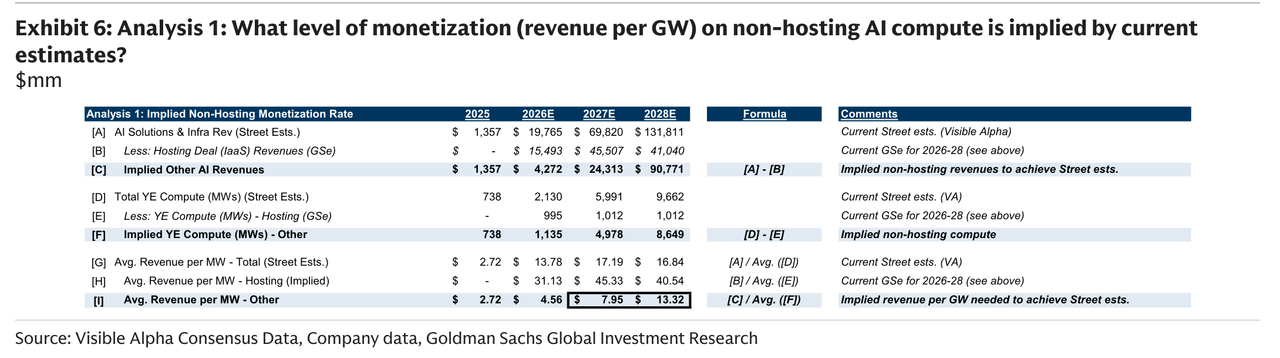
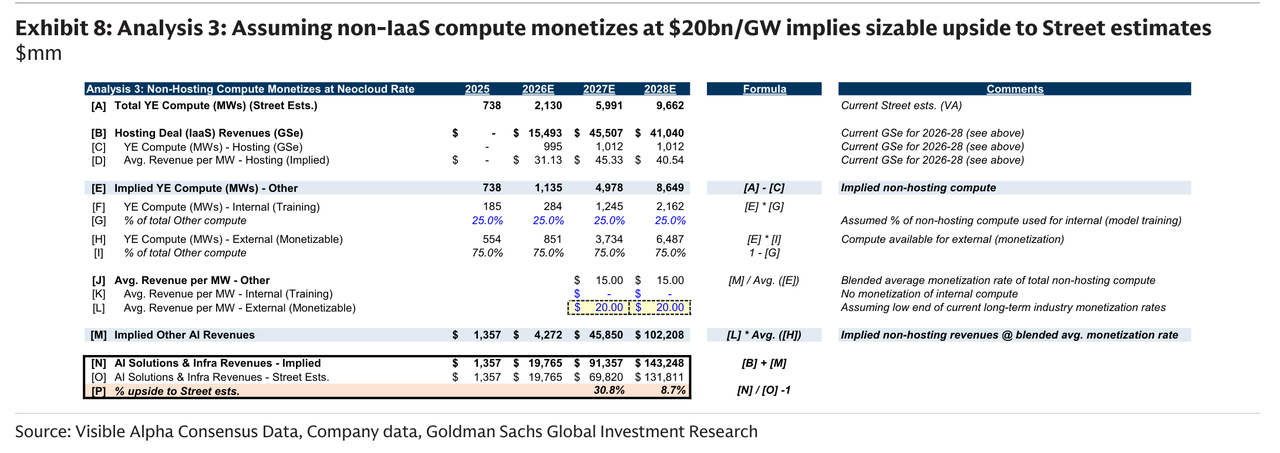
Goldman's bull case is that this is "significantly lower than current industry rates" and that if SpaceX can monetize 75% of its non-hosting compute at the $20 billion long-term floor (leaving 25% for training at zero revenue), AI revenue would come in ~31% above Street for 2027 and ~9% above for 2028:
What if the 90-day leases do get cancelled? Then, Goldman says, SpaceX would need to earn ~$18 billion per GW on reallocated compute in 2028 to hit consensus, "a reasonable, if not conservative, level of monetization compared to current industry rates":
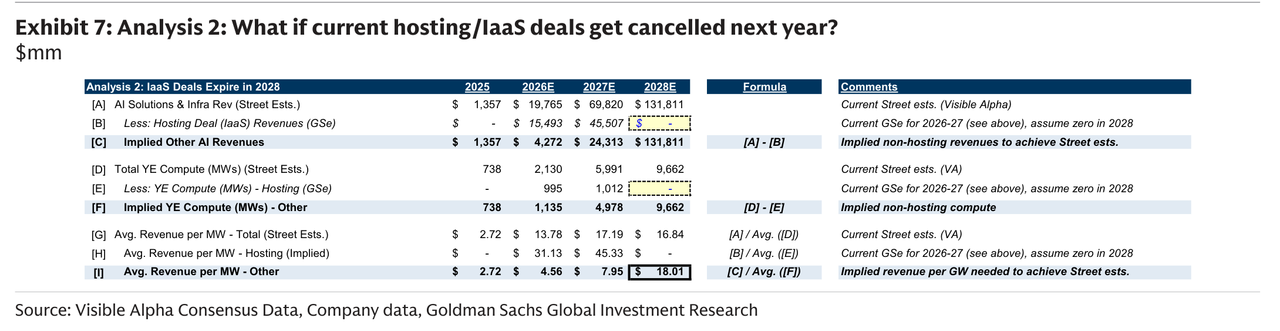
Maybe. But note what "current industry rates" means here: the price of renting compute to someone else at a moment of acute shortage. The bull case quietly assumes that compute used in-house (or rented to whoever replaces today's tenants) will earn what scarce compute earns today. The Street, which models $8-13 billion, is pricing the opposite: that once the shortage ends, a gigawatt earns roughly what a hyperscaler needs it to earn, and not a penny more.
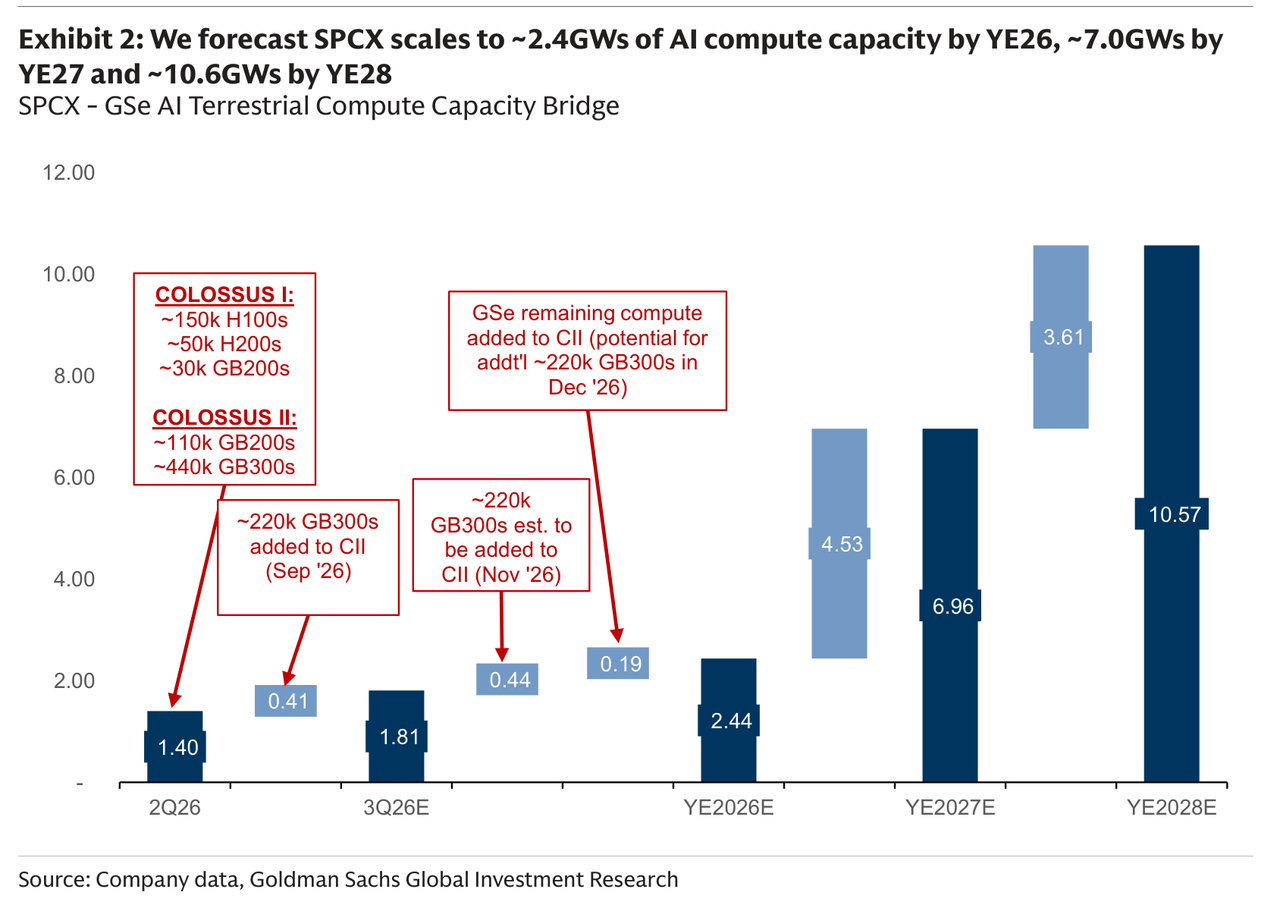
Oh, and there will be a lot more gigawatts. Goldman sees SpaceX alone going from 1.4GW in 2Q26 to ~7GW by end-2027 and ~10.6GW by end-2028:
Neocloud Revenue Is Somebody Else's Cost
Which brings us to the real tension between neocloud revenue, hyperscaler revenue and AI "industry" revenue: they are largely the same dollar, counted several times.
Follow a single dollar of end-user spend.
- An enterprise pays Anthropic, which books it gross (cloud partner cut included).
- The cloud partner (AWS, Google) books its share as cloud revenue.
- If that partner is short of capacity, it rents a gigawatt from SpaceX or CoreWeave, which books it as hosting revenue.
- Then SpaceX and CoreWeave pay Nvidia, which books it as data center revenue.
Add up "AI revenue" across the stack and you get a number several times larger than what end users actually paid, and every layer above the end user is someone else's cost.
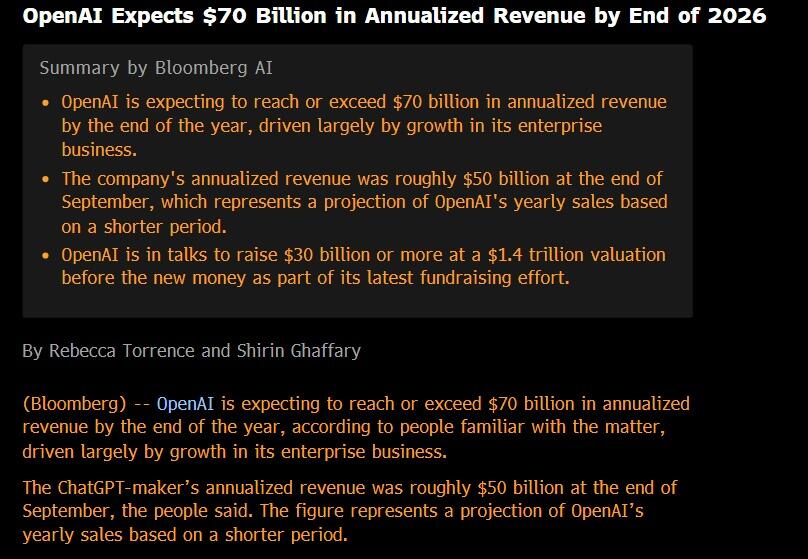
That's not a hypothetical. Just this week, AI equities puked after the FT reported that OpenAI's annualized revenue was ~$50 billion at end-September, $20 billion below the ~$70 billion MRR number circulating. As Goldman's TMT specialist Sean Johnstone explained (available to pro subs), the gap came from gross vs net reporting:
Anthropic reports closer to gross revenue (full customer spend through cloud partners, partner cut booked as a cost). OpenAI has reported closer to net (mainly its own share). When some investors tried to put the two on a like-for-like basis by grossing up OpenAI's figures, they produced the higher ~$40bn (August) and then ~$70bn numbers... The episode highlights how sensitive the complex has become to the precise trajectory of two private companies that use different reporting conventions.
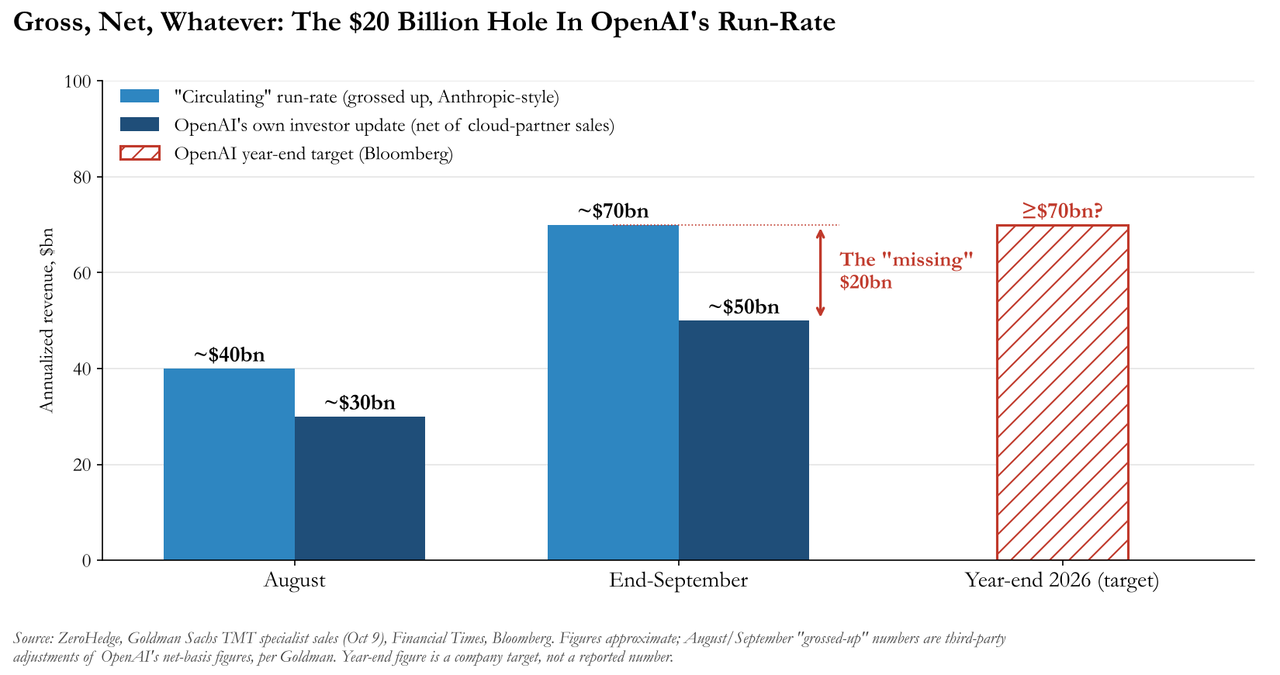
And then Bloomberg added that even the $50 billion was gamed exercise in reaching the highest possible annualized number, i.e., "a projection of OpenAI's yearly sales based on a shorter period":
The same desk also reminded clients of Brad Gerstner's mid-September framework: the top three labs (Anthropic, OpenAI, SpaceX/xAI) were at a combined ~$100 billion run-rate in July and needed to reach $180-200 billion by year-end "to keep the AI trade intact." And as Johnstone notes, even that framework mixed Anthropic on gross, OpenAI on net and SpaceX on a "closer to gross" basis "for its compute hosting contracts." In other words, part of the "lab revenue" that is supposed to pay for compute is itself compute revenue. Diversification at its finest.
The buyer base is also absurdly narrow. As we tweeted two weeks ago:
The top 10% of AI customers account for 99.5% of model-serving spend and 99% of neocloud spend, leaving the bottom 90% of firms with 0.5% and 1%: Apollo https://t.co/npmKbOV75r
— zerohedge (@zerohedge) September 28, 2026
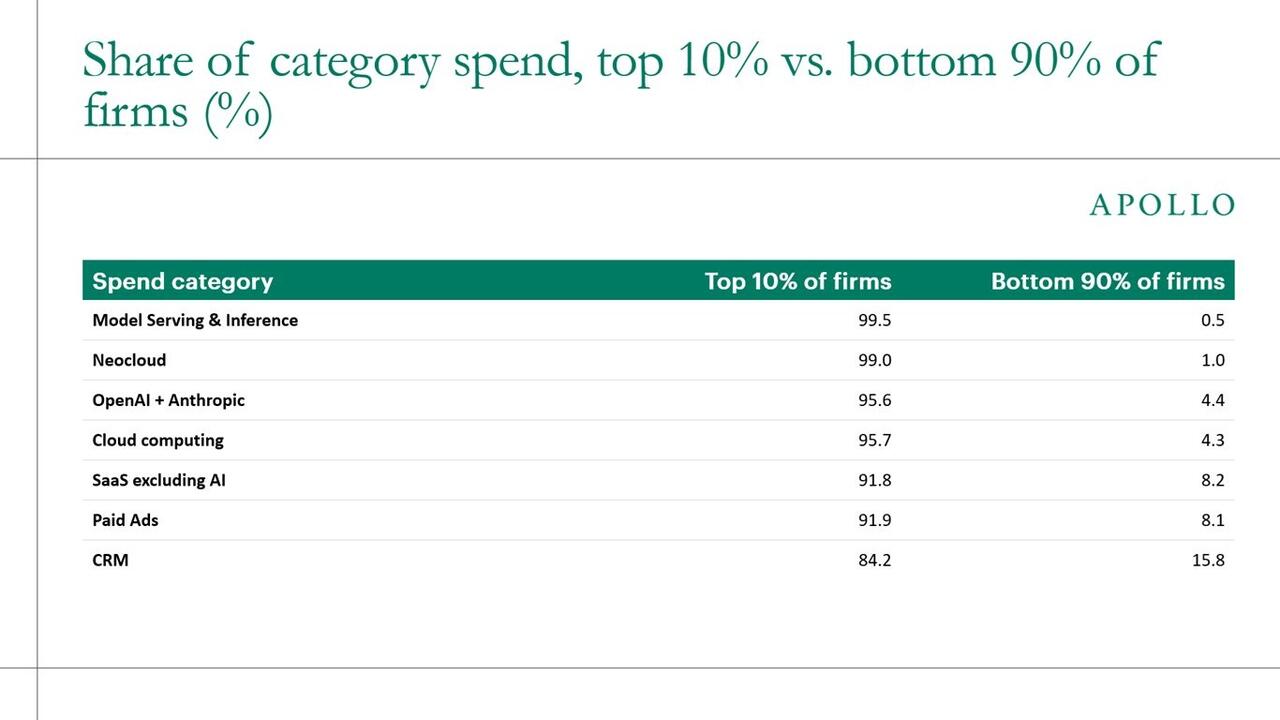
Put that next to Goldman's 90-day cancellation clauses and the picture is clear: neocloud revenue rests on a handful of customers, most of them cash-burning labs and capacity-starved hyperscalers, renting on paper they can walk away from in a quarter.
Spot Prices Don't Scale
Finally, the math that ties it together. Back out Goldman's $1.42 trillion revenue requirement at $11.6 billion per GW per year and you get roughly 41GW of AI compute that the six US hyperscalers are building with their 2026-27 capex (our approximation). Now price those 41GW at each point on the rate card:
- At Goldman's 15% ROIC hurdle: ~$470 billion a year of AI revenue
- At the long-term hosting floor of $20 billion: ~$810 billion
- At today's short-term neocloud rate of ~$45 billion: ~$1.8 trillion
Compare that with the ~$100 billion the top three labs were running at in July, the $180-200 billion Gerstner says they need by year-end, and the ~$300 billion of annual AI revenue Goldman's Portfolio Strategy team says the market "now needs evidence of" to support the current scale of investment:
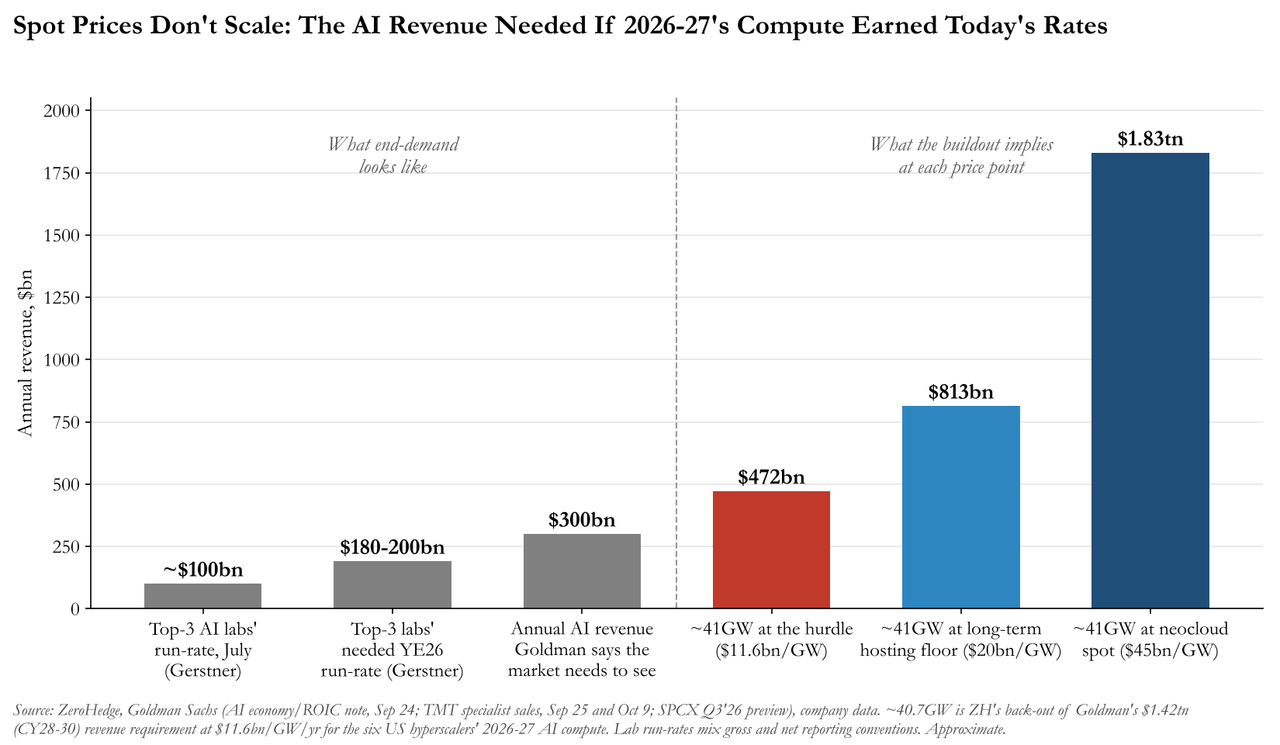
Put differently, today's neocloud rates are a marginal price for scarce capacity, not an average price the whole buildout can earn. Even the hurdle rate requires end-demand to grow roughly 2.5x from Gerstner's year-end target, and that is before anyone pays a neocloud a dime of scarcity premium (or takes into account that an entire country named China exists with an entirely separate, and much, much cheaper AI ecosystem). Which is also why Goldman's TMT desk, summing up the bank's capex research, concluded with admirable understatement that "future returns should increasingly come from selective winners... rather than owning anything linked to AI capex."
Bottom Line
Goldman's Sheridan remains a buyer of SpaceX with a $230 price target, and argues that the "supply constraints and lack of available capacity putting upward pressure on spot rates" give him confidence SpaceX can monetize compute "at high ROICs even if these deals are canceled."
He may be right about SpaceX, which has the power, the shells and the Nvidia relationship. But for the AI complex as a whole, the rate card says something less flattering. Short-term rents of $40-50 billion per GW are a scarcity premium paid mostly for training, mostly by capital-funded buyers, on 90-day paper. The long-term market already prices compute at half that, the hyperscalers need a quarter of it, and the Street is pricing in-house compute at the hurdle. With capacity set to multiply (SpaceX alone more than 4x from year-end levels by 2028), the scarcity premium is the thing least likely to survive, and as it compresses, the neocloud revenue that props up hosting deals, chip-backed SPVs and lab "run-rates" compresses with it.
In compute (as in shipping, and everything else), nothing cures record rates like record rates. The term curve is already telling you where AI compute is headed; the only question is whether end-user revenue gets there first... or (more likely) the credit market, where chip-collateralized obligations are priced as if spot were forever, figures it out on its own.
Much more in the full Goldman SpaceX Q3'26 preview and "Sizing the AI Economy Needed to Justify ROIC on Hyperscaler AI Capex" notes, as well as Deutsche Bank's "Got compute?", all available to pro subs.