No Need To Doom About Our $40 Trillion In Debt

$40 Trillion, And Bessent's One-Day Win
The scary number is accurate—and easy to misuse. Treasury's daily data put Total Public Debt Outstanding at $40.047 trillion on August 18th: $32.266 trillion held by the public and $7.782 trillion held inside the government. Outside investors aren't sitting on all $40 trillion.
The real danger is less cinematic: a large primary deficit, repeated every year, with interest piled on top. The Congressional Budget Office's outlook projects a $1.9 trillion deficit in fiscal 2026, including a primary deficit of 2.6% of GDP and more than $1 trillion of net interest. Debt held by the public rises from 101% of GDP this year to 120%—about $56 trillion—in 2036. Serious? Yes. Hopeless? No.
Treasury Secretary Scott Bessent is leaning on the long end. On August 19th, Treasury said it would at least double the maximum size of its 10-to-30-year liquidity-support buybacks, from $2 billion to at least $4 billion per operation, between September 9th and November 4th. Treasury called it liquidity support. Markets heard an attempt to push long rates down.
It worked—for a day. The official yield curve shows the 10-year falling from 4.71% on Tuesday to 4.65% Wednesday, while the 30-year fell from 5.28% to 5.19%. By Friday they were back at 4.74% and 5.27%. Buybacks can improve plumbing and move duration risk around. They can't erase the borrowing requirement.
What A Neutral Steward Would Do
Imagine a national steward with no party, donors, or sacred programs. He wouldn't force a balanced budget during a recession or war. He would put the primary deficit on a six-year glide path toward zero—and make missed targets trigger automatic corrections split between revenue and outlay growth.
One credible revenue leg combines three published CBO options: a narrow 5% value-added tax exempting major necessities, Social Security payroll taxes above $250,000, and a cap on the tax benefit of itemized deductions. CBO estimated roughly $2.18 trillion, $1.43 trillion, and $736 billion, respectively, over their ten-year windows. CBO should rescore them under current law, but the scale is real.
On spending, the steward cuts planned Defense Department funding by roughly a tenth while redesigning forces and demanding more from allies. Add lower Medicare Advantage benchmarks and site-neutral Medicare rates. CBO estimated savings of $959 billion, $489 billion, and $157 billion. Together, the six published estimates total just under $6 trillion before interactions and interest. Not enough. So missed glide-path targets automatically broaden consumption-tax coverage or slow benefit growth for affluent future retirees. Recessions pause the mechanism; Congress doesn't get to bury it.
What Survives From Our Earlier Plans
We've attacked this problem before. How To Really Reduce The U.S. Debt (original article) proposed exchanging Treasuries for shares in a national infrastructure fund. America's Debt Problem Gives It Two Choices (the follow-up) emphasized productive investment and reciprocal defense cuts. How Trump May Have Solved America's Fiscal Dilemma (the third piece) paired tariff revenue with taxpayer stakes in subsidized companies.
Fresh arithmetic keeps the useful parts and kills the magic. A revenue-backed power plant, port, or toll road can justify itself. But swapping Treasuries for fund shares doesn't retire a dollar of debt unless creditors surrender value or taxpayers transfer an asset. Productive investment may raise future GDP. It isn't debt reduction before the cash arrives.
Intel shows why taxpayers should get equity. The 2025 agreement put 433.323 million shares in the government's contracted position at a headline average price of $20.47, against an $8.9 billion investment. At Intel's $90.07 Friday close, that position was worth roughly $39.0 billion—about $30.1 billion above cost, a 340% gain.
No Doom. No Magic.
America has a way out: bind the primary deficit to a credible glide path, spread the pain across spending and revenue, keep taxpayer upside when public money takes commercial risk, and count growth only after it appears. Until then, long yields remain a structural threat—and every long-duration investment gets repriced around them.
The government can get ahead of the curve by investing in high-growth sectors such as AI and biotech. So can we. Whatever Washington does, investors will be better off if their money compounds faster than inflation—and faster than the fiscal drag. With that in mind, we have three biotech trades teed up for today. We've had some recent success with these, such as our 10x Genomics (TXG) exit a couple of weeks ago.
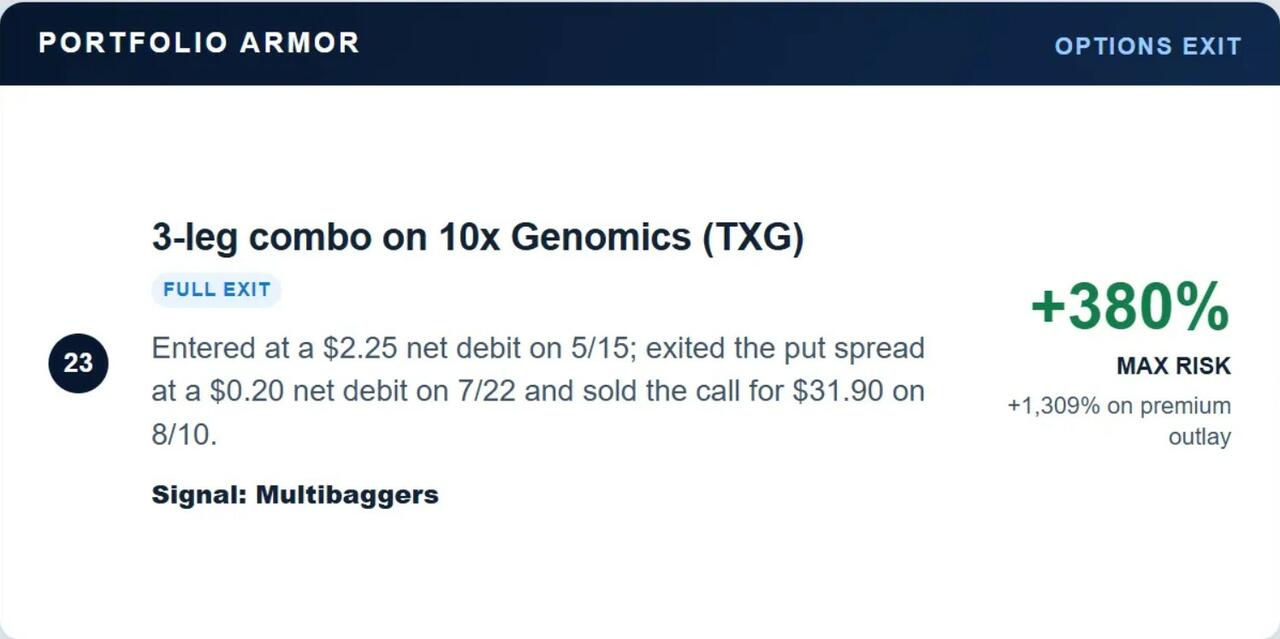
So we're trading biotech again today.
To unlock today's trade alert, you can sign up as a free subscriber to the Portfolio Armor Substack below.