


Data Center Alley Goes Dark: Amazon Abandons Data Centers In Loudoun County
Finishing a data center in America has become a logistical nightmare. Now just starting one is turning into a problem too, even in the one county that was supposed to say yes to everything.
Back in April, when we reported that "Half Of US Data Centers Scheduled To Start In 2026, Will Be Canceled Or Delayed," the blame was spread across the usual suspects: power, transformers, permitting and a vague, growing sense that the locals were getting restless. Two months later, Blackstone sold its stake in three Northern Virginia data centers amid grassroot outrage, cashing out of a bet it made less than three years earlier, in the heart of what is known, with zero irony, as "Data Center Alley."
And now the restless locals have claimed their biggest scalp yet.
According to the Washington Post, Amazon has scrapped a plan to build data centers on the site of George Washington University's former campus in Ashburn, Northern Virginia, after reaching an agreement with local officials amid widespread opposition from residents. Under the deal announced Tuesday by Loudoun County Board of Supervisors Chair Phyllis J. Randall, Amazon will repurpose the majority of the 122-acre campus for mixed-use and residential development, and commit to never building data centers on the land. It will also donate 25 acres to the county for a community arts center and recreational facility, and hand $5 million to the county's housing fund.
"By choosing dialogue over reflexive disagreement, Loudoun County and Amazon created an opportunity for the County," Randall said in a statement. "This agreement provides new places for our Loudoun residents to gather, create, and play. And, most importantly to me, we will provide more attainable homes for working families."
Some context on just how big a reversal this is: Amazon paid GWU $427 million for the campus earlier this year, roughly four times its assessed value, according to Supervisor Juli Briskman, because the zoning made data centers "a reasonable expectation." It filed a site plan in late July for "Bridgefield Tech Center": four two-story data center buildings totaling more than 800,000 square feet. Briskman promptly vowed to fight it "every step of the way," and by September Randall was meeting with Amazon because a "likely disagreement" was emerging over what the land could legally be used for, per Bisnow. Amazon's take was that it read the site's legal potential differently than the county, but chose a "shared vision" over costly litigation. Translation: Amazon also agreed not to sue.
So instead of 800,000 square feet of servers, Loudoun gets an arts center, an indoor sports facility, housing, and roughly $70 million in land and cash (the 25 acres carry a stated fair market value of about $65 million). The rezoning alone is expected to take about a year, even on a fast-track schedule. Amazon, for its part, is left holding a very expensive future apartment complex.
Now for the punchline: according to Fortune, Loudoun's ~233 data center buildings generated about $1.2 billion in property tax revenue in fiscal 2026, roughly 39% of the county's entire budget. Amazon alone says it has invested more than $63 billion in the county since 2011. In other words, the county that arguably needs data centers more than any other in America just accepted a check to make sure one never gets built. If "Data Center Alley" is saying no to data centers, well, who exactly is left to say yes?
The timing was impeccable too. One day later, President Trump took to Truth Social to urge data center developers to "pay the community, and/or individuals within the community, a 'dividend'" to win local support, adding "MAKE DEALS, and get them built!" Amazon did pay a dividend, and it did make a deal. It just forgot the "get them built" part.
Data Center Alley, Unplugged
Amazon's U-turn is the latest in a remarkable string of reversals in what was, until recently, the most data-center-friendly real estate on the planet. Regular readers will recall that the trouble started in Prince William County, next door, where the 2,100-acre "Digital Gateway" (up to 37 buildings, ~5GW of capacity and roughly $100 billion of planned spending) was hit by a court ruling that voided its rezoning. In April, Brookfield-backed Compass pulled out after spending "tens of millions" and years chasing approvals. Then came Blackstone's sale on June 29... and two days later, we flagged the other shoe dropping:
*BLACKSTONE’S QTS ABANDONS MASSIVE DATA CENTER IN VIRGINIA
— zerohedge (@zerohedge) July 2, 2026
Then, last month, Loudoun's board voted 7-1-1 to draft an up-to-12-month pause on new data center applications, which Randall insisted was "not a moratorium" (a 12-month pause being "the maximum allowed by Virginia law"). The final vote was due this week; instead, on the same day as the Amazon deal, it was pushed to November 17. Here is how 2026 has gone in Data Center Alley so far:
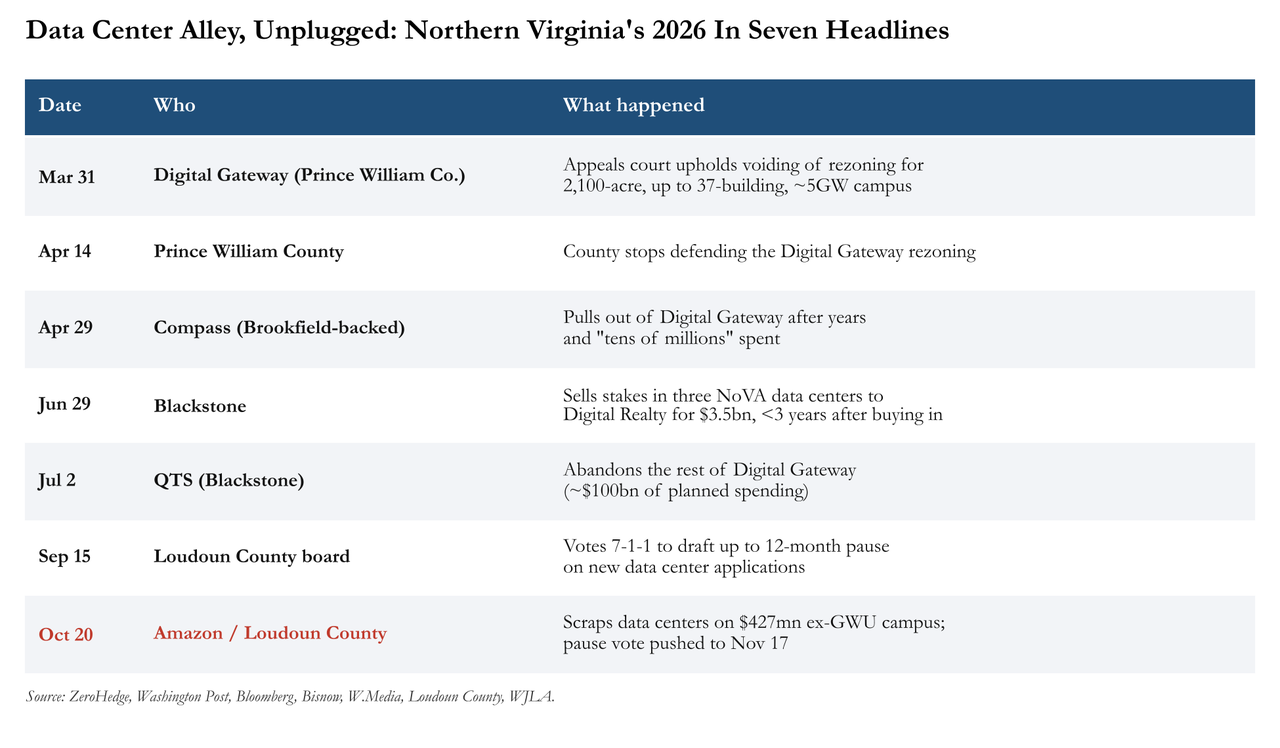
Note that none of this involves a sputtering hyperscaler running out of money: Amazon spent $427 million to buy the land and is now spending another $70 million to walk away from what it bought it for. The capital is there. The permission is not.
The 6% Problem
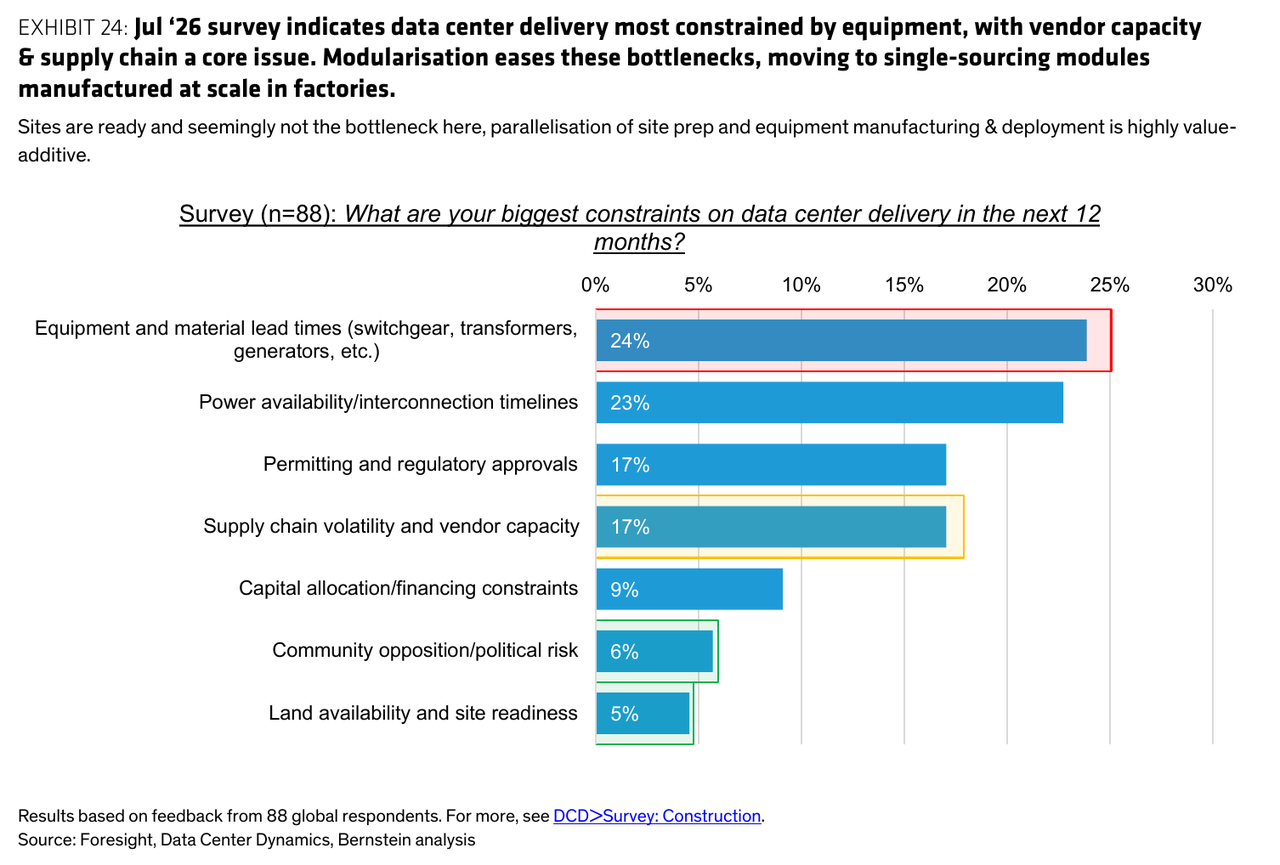
The most striking thing here is how fast "community opposition" went from footnote to deal-breaker. As recently as July, when Data Center Dynamics surveyed 88 industry respondents about their biggest delivery constraints over the next 12 months (a survey Bernstein highlighted in its modular-builds deep dive [MARKETDESK LINK]), "community opposition/political risk" ranked second to last, at just 6%, behind equipment lead times (24%), power and interconnection (23%), permitting (17%) and supply chains (17%).
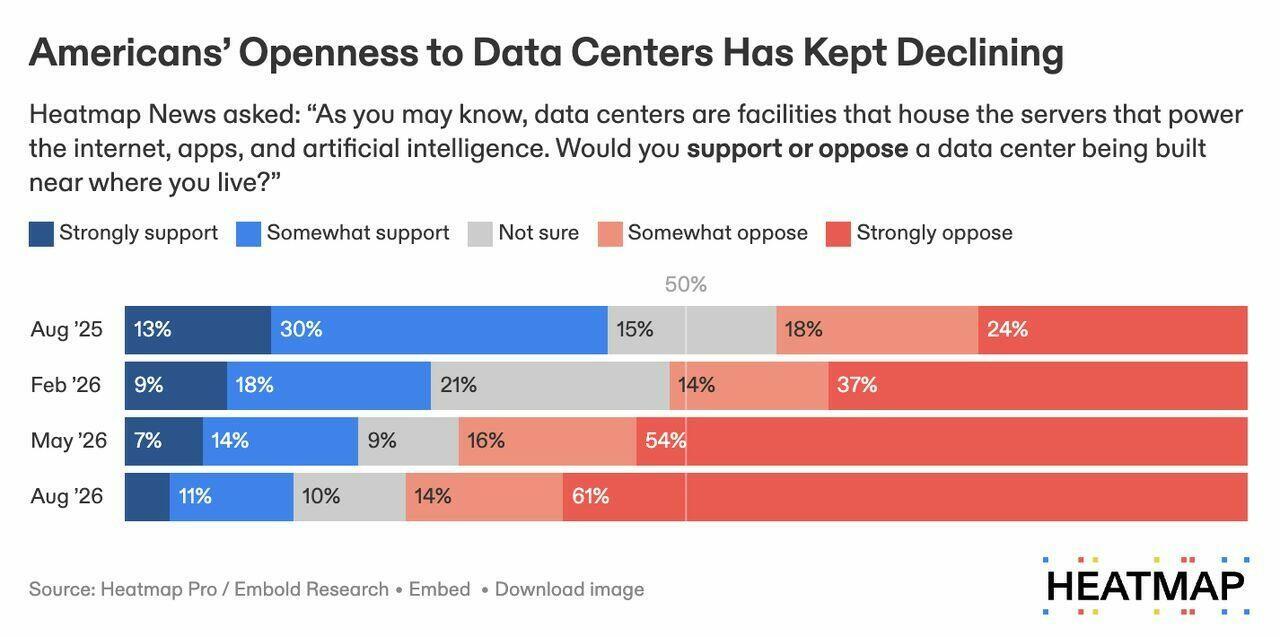
Three months later, that 6% just killed an 800,000-square-foot Amazon campus in the friendliest zip code in America. Maybe the respondents should get out more: the Heatmap/Embold poll that tracks Americans' views on a data center "being built near where you live" shows the share strongly opposed going from 24% in August 2025 to 61% in August 2026, while total support collapsed from 43% to below 20%.
And the backlash has gone institutional. In September, Wells Fargo flagged a fourfold jump in active local moratoriums, to 374 by the end of summer from 92 in June, with the average one lasting nearly a year. Its utilities analyst Shahriar Pourreza summed it up: "DCs are unpopular across the political spectrum." Just how bipartisan? In Ohio, one of the top data center states, both leading candidates for governor are running on restricting the industry:
Ohio is one of the top data center states: AWS, META, GOOGL, MSFT and SB Energy are all building here. Both leading governor candidates, Democrat Amy Acton and Republican Vivek Ramaswamy, said they want new restrictions on the industry. Acton said she supports what she’s calling a “conditional moratorium” on new data center construction. Developers must cover 100% of their own utility costs, build exclusively with union labor, operate with full transparency and meet Ohio’s existing air and water quality standards Ramaswamy also laid out his data center policy, which he calls his "Ohioans-First Data Center Pledge." His campaign describes the plan as resting on three “non-negotiable” requirements: nearby residents must receive free electricity from data center developers, new facilities must pay their full property taxes with no abatements, with that revenue used to fund property tax rebates for homeowners, and developers must meet strict air and water quality standards while prioritizing brownfield sites over farmland. “If a project fails to meet any one of these three requirements, it will not be built. Period,” Ramaswamy’s campaign states.
— zerohedge (@zerohedge) September 23, 2026
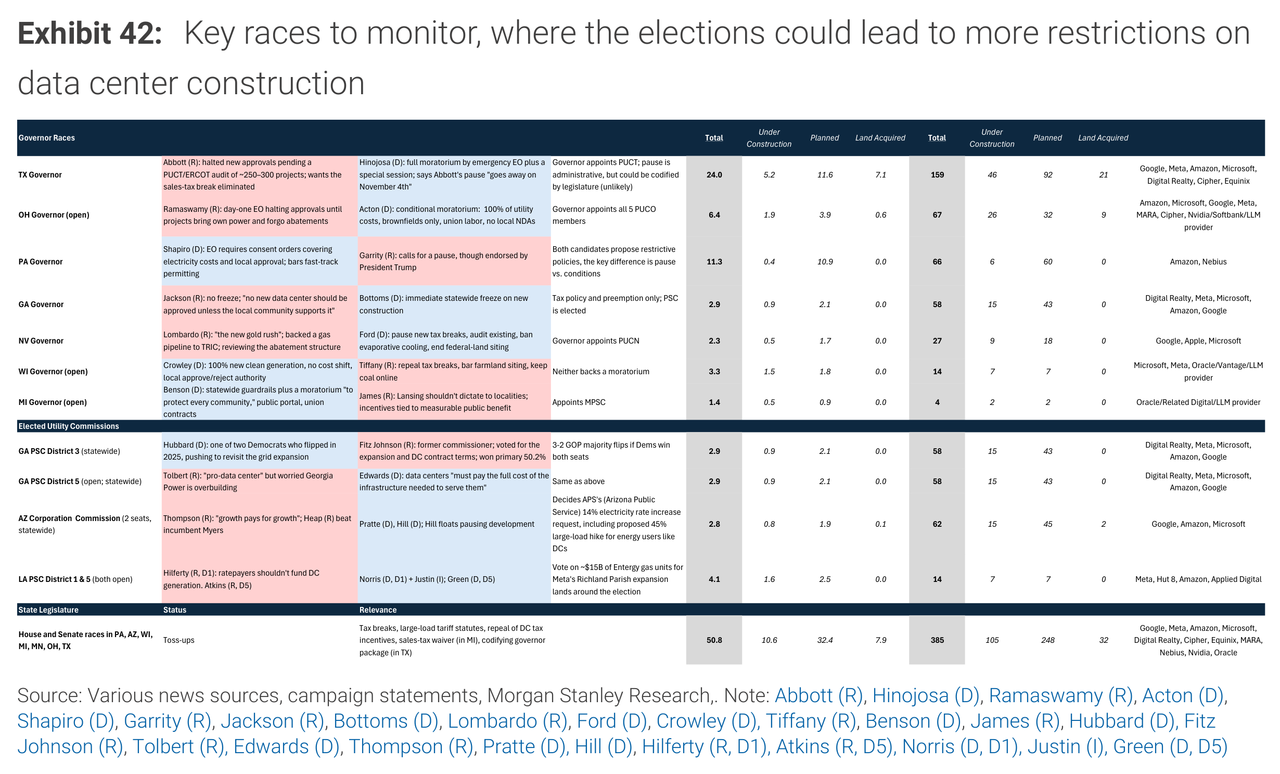
Morgan Stanley's map of the November races that could tighten the screws further (from its "Following AI's $1.6 trillion Money Trail" report shows 50.8GW of capacity, including 10.6GW already under construction, sitting in states where the elections "could lead to more restrictions on data center construction." Texas alone accounts for 24GW, and its governor has already ordered a halt to new data centers pending an audit of 250-300 projects. Midterms are 11 days away.
To be fair, not everyone thinks the pitchforks matter. Last week SemiAnalysis did a project-by-project audit and concluded that of the ~21GW of capacity sitting in moratorium areas, only about 2.3GW (three projects) is likely to be delayed, which The Economist's Archie Hall described as "much more bark than bite."
Perhaps. But here is the thing: the Amazon campus was never under a moratorium. Loudoun's pause hasn't even been enacted. What killed it was a zoning fight, a threat of litigation and a negotiated "dividend," none of which shows up in a moratorium tracker. Which is probably why Hall himself sees the bigger risk in deterrence: the projects that quietly never get proposed, or get "re-envisioned" into townhouses before anyone counts them.
Goldman's Outlook Is "Largely Intact"... Assuming Half Of It Never Shows Up
What does Goldman make of all this? In its latest Power Tracker (available to pro subs) Goldman's commodity team argues that "despite rising political push back against US data centers," its capacity estimates "show the 2027 growth outlook is largely unchanged, with moderate revisions." The bank raised its year-end 2026 US data center capacity forecast by 5GW to 64GW, while cutting its year-end 2027 forecast by 5GW to 90GW, and still sees US data center power demand growing 38% in both 2026 (+12GW) and 2027 (+17GW).
So far so bullish. But read the fine print under the chart:
Our GS data center capacity forecast assumes only 60/50% of currently scheduled additions are realized, which is derived from the historical relationship between scheduled and activated capacity.
In other words, Goldman's "largely intact" outlook already assumes that 40% to 50% of what's on the schedule never gets switched on. Which, if we recall, is precisely the "half" we wrote about in April (when Sightline Climate warned that 30-50% of the ~16GW slated for 2026 would be delayed, with only ~5GW actually under construction), and which SemiAnalysis spent an entire June post telling everyone to "stop saying." Goldman, it turns out, never stopped saying it; it just put it in a footnote. And note which way the revision went: the near term got pulled forward, while 2027, the year the hyperscalers are spending like there is no tomorrow for, got cut.
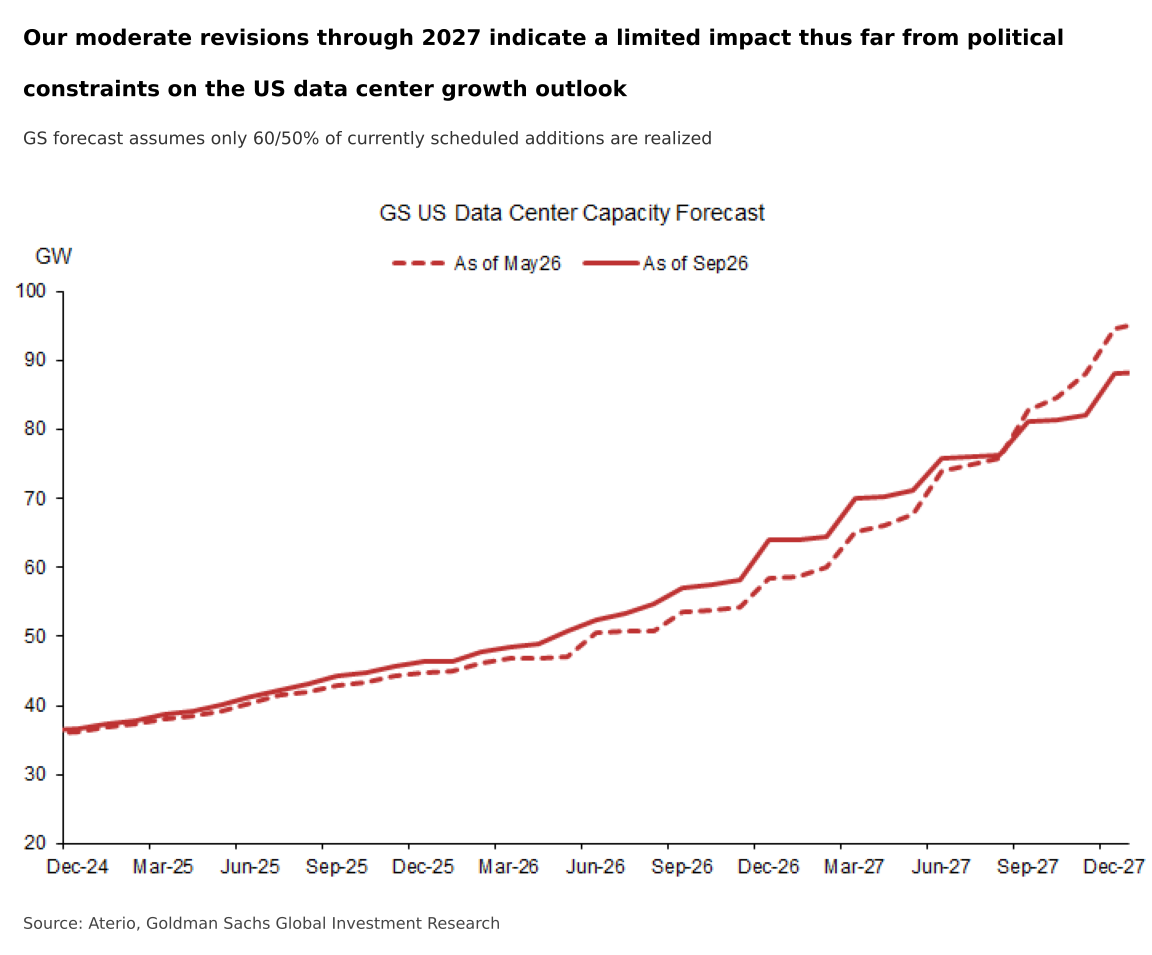
Goldman also notes that "effective peak spare capacity tightened YoY across nearly every key region" this summer. That matters, because even the projects that do survive the zoning board walk straight into the next wall.
Break Ground, Then Wait For The Grid
Because getting permission is merely step one. Step two is getting power, and that is where the timelines go from awkward to absurd. Per Berkeley Lab data compiled by Bernstein, the median time from interconnection request to commercial operation in the US has stretched to over five years, more than triple the 1.5 years it took in 2005.
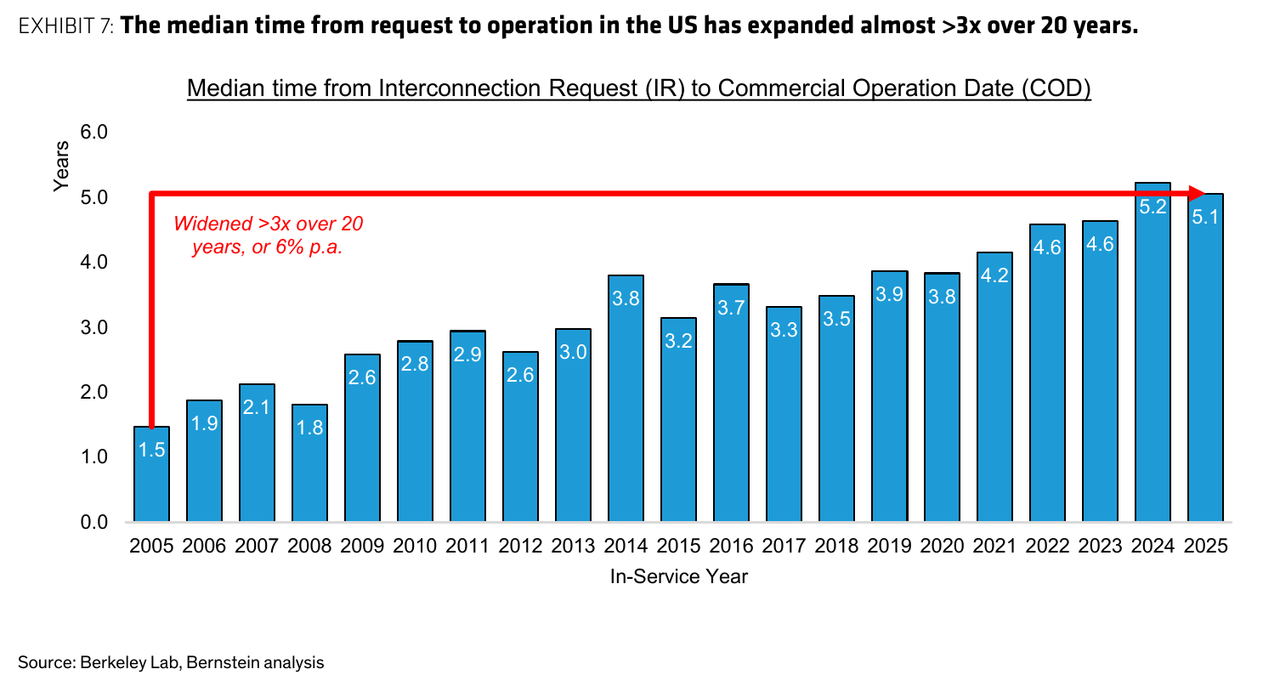
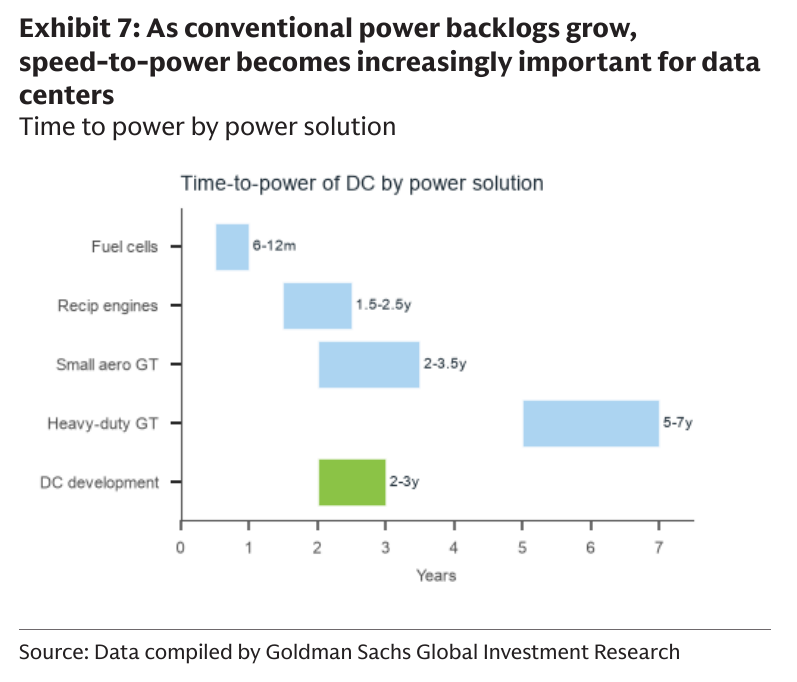
Hence the scramble for "speed to power." Goldman's Carbonomics team (in its report on "Behind-the-meter power solutions for data centers," which we covered in detail last month) lays out the mismatch neatly: a data center takes 2-3 years to develop, while a heavy-duty gas turbine takes 5-7 years to show up. GE Vernova, recall, is now taking reservations for 2031 delivery.
Then there are the transformers, switchgear and generators that topped the Bernstein survey: Apollo's Torsten Slok (who took his number from our June report) pegs transformer lead times at up to 26 months in his latest note, while Bloomberg reported earlier this year that delivery times for the large units data centers need had stretched to as much as five years. Throw in a chronic shortage of electricians (there is a reason why we told readers to learn to be one back in January) and you get a pipeline where every link must arrive on time for any of it to matter.... which will never happen. As one TechRadar headline put it, "if one piece of your supply chain is delayed then your whole project can't deliver." Correct.
Add it all up and Morgan Stanley's verdict is grim. Even after counting every "time to power" fix available (spare grid capacity, nuclear, announced turbines and engines, Bloom fuel cells), the bank projects that US data center developers face a 32GW power shortfall through 2028, a result of "intensifying challenges with respect to People, Power and Politics." That is down from the 44GW shortfall MS warned about last November, which says more about how hard everyone is scrambling for turbines and fuel cells than about any improvement in the grid.
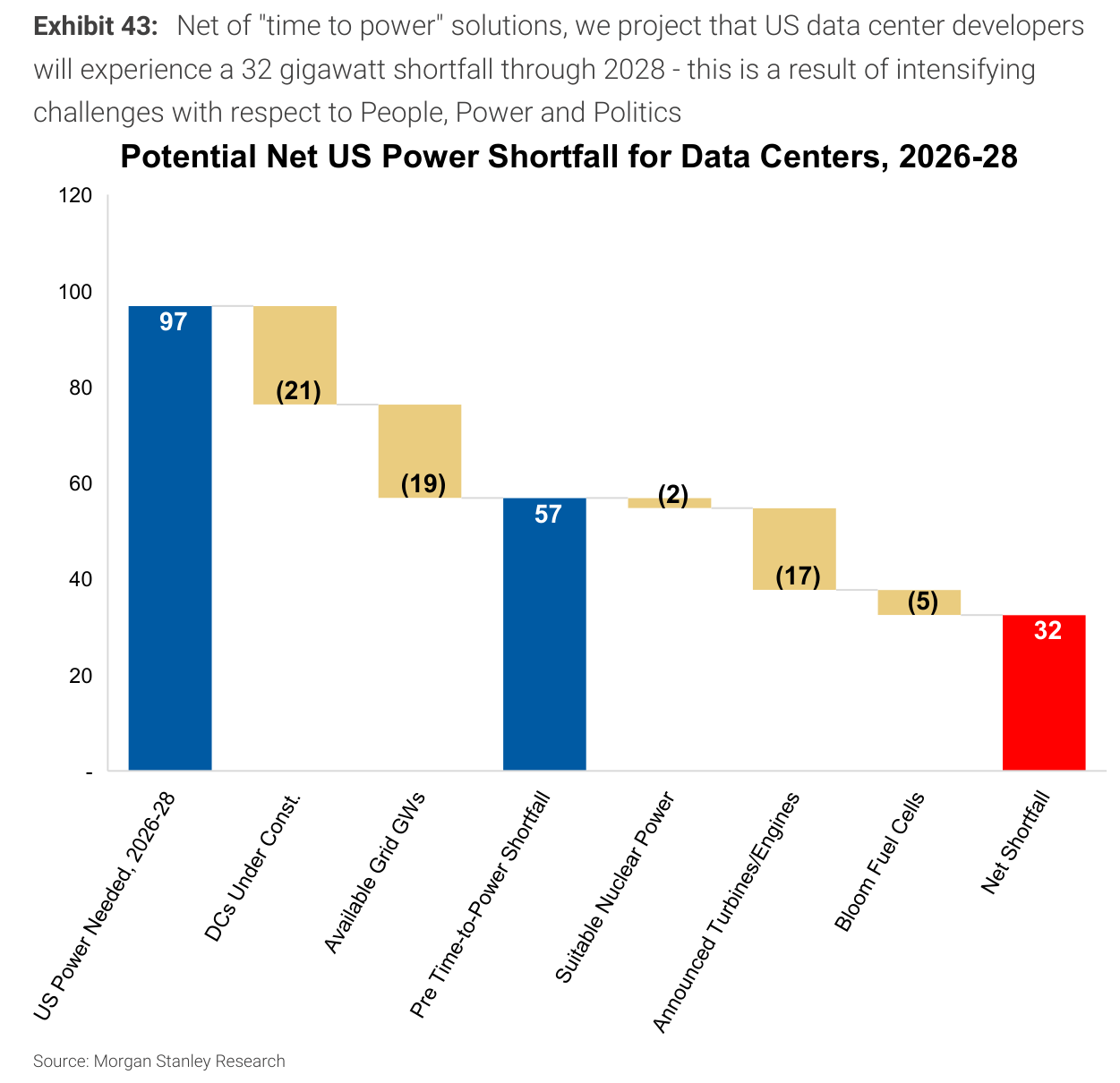
And, as a reminder, the "Politics" part of that triad just got a lot worse in Virginia, a lot worse in Ohio, and possibly a lot worse in Texas on November 3. Which is why we keep saying the only real solution is to make "behind the meter" mandatory: if the community won't give you its grid, bring your own power plant... and then hope the zoning board lets you build that too.
Who Wins When Nothing Gets Built
So who benefits from a buildout that keeps getting pushed out? Torsten Slok had a timely answer this week in "Winners and Losers if the Data Center Buildout Is Delayed." The winners are owners of operating data centers ("capacity that is already online can raise rents and fill every megawatt"), holders of powered land and grid access, long-lead equipment makers and on-site power producers. The losers: hyperscalers whose "revenue is capped by supply rather than demand, and committed capex keeps accruing while capacity sits idle," developers and construction-stage investors whose "cash flows start later while interest and carrying costs continue," and equity investors in the AI trade, whose "valuations that assume on-time delivery are exposed to earnings revisions and multiple compression."
Slok draws a crucial distinction between delay and cancellation:
A delay hurts returns by pushing cash flows out, but the asset remains and may become more valuable. The real risk is that scarcity unwinds, for example, if supply catches up in a rush or demand softens, which would erode the premium on existing capacity.
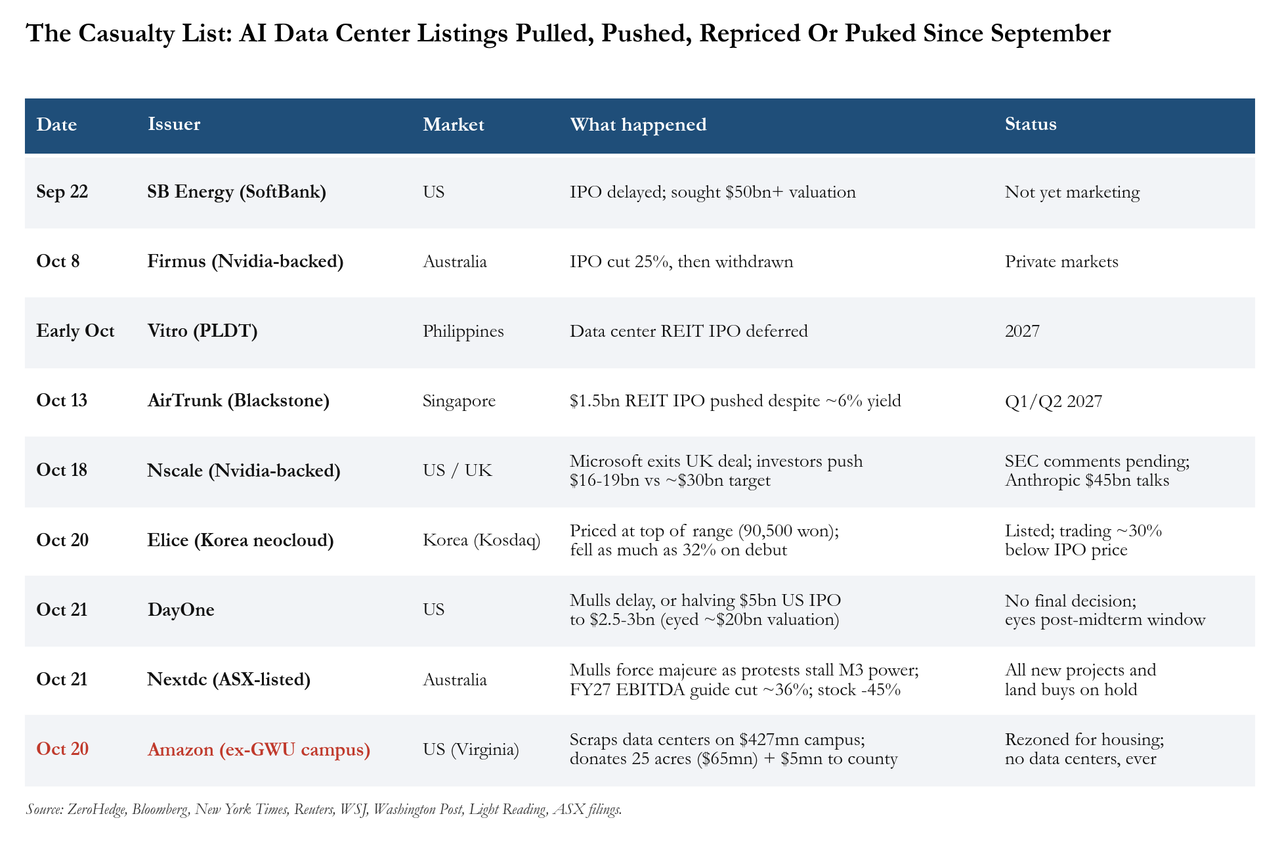
Which, come to think of it, is a pretty good description of what Blackstone did in June: sell fully leased, already operating Virginia capacity to Digital Realty at a scarcity premium, while it lasts. Amazon's Loudoun campus, meanwhile, falls squarely in the "cancellation" bucket, and joins a fast-growing list. Here is the latest update of our AI data center Casualty List, which also includes last week's Nextdc collapse after protesters stalled power to its Melbourne campus:
If Loudoun Says No, Who Says Yes?
The bulls will say this is one 800,000-square-foot campus in a county that already has 233 data center buildings, and that SemiAnalysis still sees 38GW of US capacity coming online in 2027 (good luck with that). Maybe. But the bull case has always rested on the assumption that the binding constraints were physical (chips, power, transformers) and that money could eventually buy its way through all of them. Loudoun just showed that money can't buy permission. Amazon brought $427 million, a $70 million "dividend" and the threat of a lawsuit, and the best it could get was the right to build townhouses.
Despite all this, Goldman says the outlook is "largely intact." We'd note that it is intact precisely because Goldman already assumes that half of it won't happen, and that the one revision it did make cut 2027. Between Loudoun's pause vote on November 17, the midterms two weeks before that, and turbine slots booked into the next decade, we suspect that haircut is the floor... and that the next revision (undoubtedly lower) won't be confined to a footnote.
Then again, Amazon can always try again somewhere else in Loudoun... in 12 months, "the maximum allowed by Virginia law."
Much more in the full Goldman Power Tracker, the Morgan Stanley "Following AI's $1.6 trillion Money Trail" report and Goldman's Carbonomics "Behind-the-meter power solutions for data centers" note, all available to pro subs.