


Amazon, Canadians, And The Navy All Want Reactors In Indiana
Amazon, Canadians, and the U.S. Navy all showed up in Indiana this past week with reactor plans.
On Monday, AEP, X-energy and Amazon unveiled a 960 MW nuclear proposal in Sullivan County, and Canada's AtkinsRéalis signed on to study up to eight CANDU reactors. On Tuesday, Radiant said the Navy had picked it to put a microreactor at Naval Weapons Station Crane.
That's as many as 21 reactors floated in two days, in a state that has never had a commercial nuclear power plant. Its most serious attempt, Public Service Indiana's Marble Hill, was abandoned half-built in 1984 after roughly $2.5 billion had been spent.
This time, the state is doing a lot of the courting itself. Since Gov. Mike Braun took office in 2025, Indiana has passed laws that let utilities recover most of the cost of developing small modular reactors before one is ever built and give a 20% tax credit to companies that manufacture them in the state.
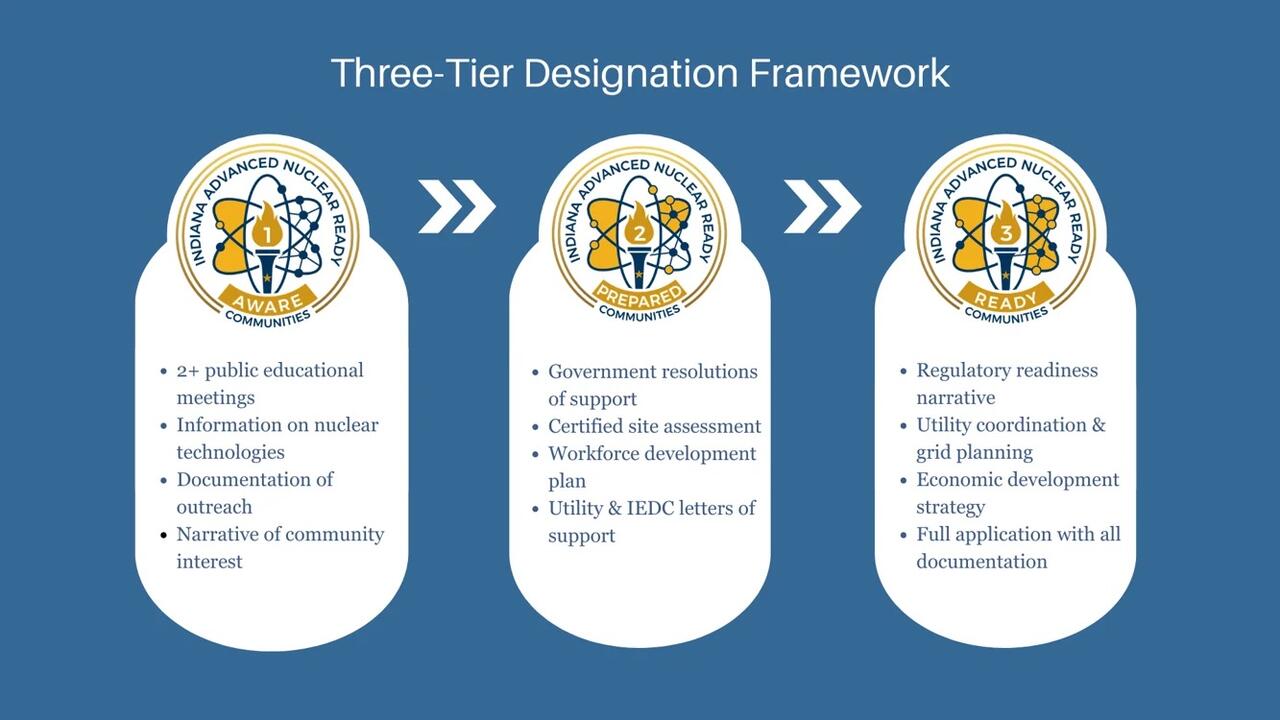
In April, Braun signed a letter of intent with hometown drugmaker Eli Lilly to explore putting reactors at Lilly sites, and this summer the state launched a program to certify communities as “Nuclear Ready.”
Reactor startup First American Nuclear moved its headquarters from Washington state to the Indianapolis area last year, promising more than $4 billion in investment.
Amazon picks up the tab
AEP and X-energy signed a joint development agreement to evaluate 12 of X-energy's 80 MW Xe-100 reactors at the former site of the Breed Generating Station, a long-retired coal plant.
What sets this one apart is Amazon. Too many new nuclear projects are being announced with no buyer and/or no money attached. This one finally has both, with Amazon supporting as both financier and customer.
Amazon is funding the project's development, and it intends to buy the power under a long-term contract "covering the costs of the facility and its operations for the duration of the contract," according to AEP.
"Our agreements with Amazon and X-energy will provide all necessary capital protections and financial safeguards that we have said are essential for any potential nuclear project to move forward," said AEP CEO Bill Fehrman.
So, the plan is for Amazon, not Indiana ratepayers, to carry the bill. Amazon's Josh Weissman said the company will "pay our full costs without passing them to others," the same promise Amazon made when it signed the White House's Ratepayer Protection Pledge in March.
Indiana Michigan Power expects its Indiana peak load to jump from 2,800 MW to more than 7,000 MW by 2030, with Amazon's $11 billion data center campus near New Carlisle among the new loads.
Amazon also led X-energy's Series C-1 round in 2024. Indiana is the pair's second project, after Energy Northwest's Cascade plant in Washington.
X-energy shares, which priced at $23 in April's IPO, closed Friday at just over $10.
A heavy water rival for Ramaswamy
Also on Monday, at Purdue's nuclear summit in Indianapolis, AtkinsRéalis signed an MOU with the state and Hoosier Energy, a rural power co-op, to evaluate "a campus of up to eight CANDU nuclear reactors" with as much as 6 GW of capacity.
CANDU is Canada's heavy water reactor. Heavy water lets it run on natural uranium, skipping enrichment entirely, and it refuels without shutting down.
Sound familiar? Two weeks ago, we covered Atlas Atomics, the startup Vivek Ramaswamy cofounded, after it raised about $400 million at a roughly $1.9 billion valuation to build an improved heavy water reactor.
That makes AtkinsRéalis, the exclusive licensee of Canada's CANDU technology, Atlas's most direct competitor.
AtkinsRéalis has also started the NRC licensing process, as we noted then, while Atlas, still in stealth, has yet to show a design.
The Navy goes inland
The Navy selected Radiant Nuclear to design, build, and deliver a microreactor power plant at Crane, the world's third-largest naval installation by area, more than 500 miles from the nearest ocean.
The Pentagon said in September that Crane would host the Navy's first shore-based advanced microreactor, installed by September 2028. Radiant's Kaleidos is a factory-built, 1 MW, helium-cooled unit that runs up to five years between refuelings and needs no cooling water.
The project runs through the Army's Janus program, which picked Radiant and four others in August. Radiant's share, up to $750 million for 15 reactors starting at Fort Benning, Georgia, was the program's largest award.
In April, the Air Force chose Radiant for Buckley Space Force Base in Colorado.
Add the Navy, and Radiant becomes the first reactor company to land all three services at once. It now bills itself as "the only company partnered with the Army, Navy, and Air Force."
The @USNavy has selected Radiant to deploy our Kaleidos microreactor at Naval Weapons Station Crane, Indiana. With this selection, Radiant is now the only nuclear microreactor company with partnerships across the Army, Navy and Air Force. The Navy has more than 70 years of safe reactor operations. It wrote the playbook on reactor safety. Earning its confidence is powerful independent validation of Kaleidos. This milestone moves us closer to our goal: reliable, resilient nuclear power wherever the mission demands. Through our work with all three branches, we’re building a clear path from military deployment to nuclear energy at scale for government and commercial customers. Read more details here: https://t.co/LQ3MXZgTMH
— Radiant (@RadiantNuclear) October 20, 2026
Kaleidos itself is now at Idaho National Laboratory's DOME test bed, and as we noted earlier this month, Radiant could announce criticality by year end.
If the Pentagon hits its 2028 deadline, Indiana's first nuclear power, more than four decades after Marble Hill, will come from that 1 MW Navy reactor, likely years before either of the big plants could be finished.